What Is NATO Becoming?
From Collective Defence to Collective Capability
The Ankara Summit may appear to revolve around diplomacy, defence spending and political leadership. Yet beneath the public debate, a deeper transformation is taking place. NATO is no longer changing only how it deters conflict. It is gradually redefining what collective security itself requires.
For more than seventy years, NATO has been understood primarily as a military alliance. Collective defence, embodied by Article 5, formed the foundation of its strategic identity. That principle remains unchanged. What is changing is the meaning of military strength itself.
Collective defence is no longer enough. The defining challenge of the coming decade is collective capability.
Security is no longer determined solely by the number of soldiers, aircraft or armoured vehicles available during a crisis. Increasingly, it depends upon whether nations possess the industrial capacity to sustain those capabilities over time.
Military power begins long before forces reach the battlefield. It begins inside factories. Research laboratories. Shipyards. Semiconductor facilities. Energy infrastructure. Logistics networks. Capability is becoming the new currency of security.
The defining question is no longer who can deploy military power. It is who can continuously produce it.
From Consumption to Production
🟦 Signal Question
If military capability increasingly depends on industrial capacity, where does defence policy end and industrial policy begin?
This transformation extends far beyond defence budgets. For decades, many Western economies were organised around efficiency, globalisation and consumption. Industrial production dispersed across international supply chains, while manufacturing steadily lost political visibility. That era appears to be ending.
Across Europe, governments are rediscovering production as a strategic capability. Factories are returning to the centre of political debate. Semiconductors have become strategic infrastructure. Energy systems are increasingly viewed through the lens of resilience. Advanced manufacturing has become a national security concern.
This broader shift can already be observed across multiple strategic sectors. Aerospace, semiconductor manufacturing, energy infrastructure and critical technologies are no longer discussed as isolated industries. They increasingly form interconnected components of Europe’s emerging capability architecture.
Industrial capacity has become an essential component of strategic resilience.
Security is no longer something governments simply purchase. Increasingly, it is something societies must be capable of building.
From American Protection to European Responsibility
🟦 Signal Question
Can Europe achieve genuine strategic autonomy without rebuilding the productive foundations of its economy?
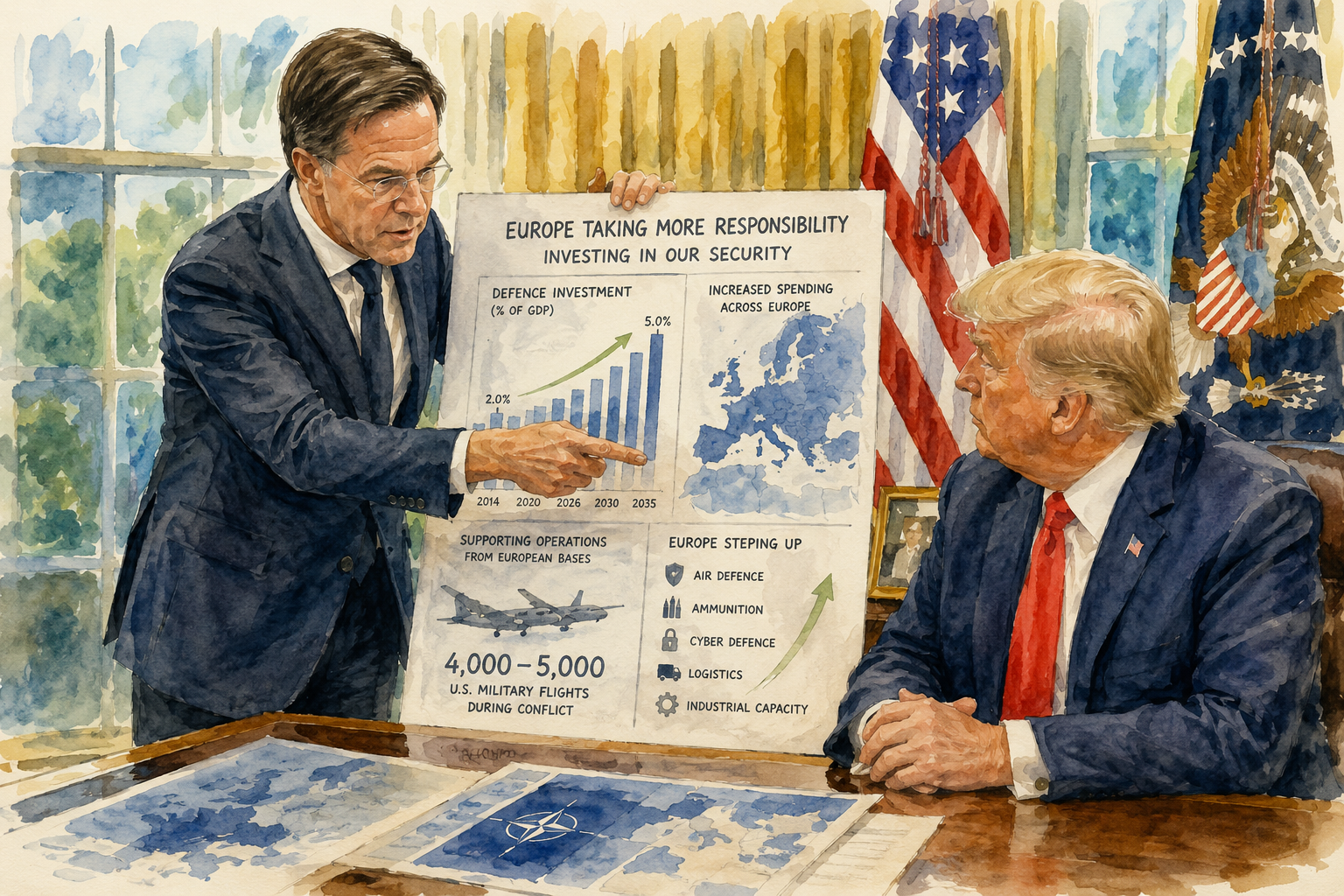
Mark Rutte’s meeting with President Donald Trump in Washington illustrates this broader transition. Public attention focused largely on diplomatic language, defence spending targets and political symbolism.
Yet beneath those discussions lies a more profound strategic message. The United States increasingly expects European allies to assume greater responsibility for the conventional defence of the European continent, allowing Washington to devote more strategic attention to the Indo-Pacific.
This should not necessarily be interpreted as American disengagement. Rather, it represents a redistribution of strategic responsibility. Europe is being asked not merely to spend more. It is being asked to become a stronger producer of security. That transition presents an uncomfortable paradox.
Europe is expected to strengthen its strategic autonomy while significant elements of the technologies, raw materials and supply chains upon which modern defence depends remain globally interconnected. Building capability therefore requires more than larger budgets. It requires rebuilding industrial ecosystems capable of operating under geopolitical pressure.
From Alliance to Architecture
🟦 Signal Question
Can strategic responsibility exist without strategic production capacity?
Perhaps this is NATO’s most significant transformation. The alliance increasingly resembles more than a collective defence organisation. It is gradually evolving into an architecture of capability.
Military readiness now depends upon advanced manufacturing. Artificial intelligence. Cybersecurity. Space systems. Energy resilience. Industrial supply chains. Critical infrastructure. The boundaries between economic policy, industrial policy and security policy continue to blur. Collective defence increasingly rests upon collective production. Collective resilience depends upon collective capability.
The upcoming Ankara Summit will undoubtedly address today’s geopolitical challenges. Yet history may ultimately remember this period for something far more significant. Not because NATO changed its treaty. But because it quietly changed its architecture.
Perhaps the defining geopolitical question of the coming decade is no longer who can buy security, but who can build it.
Credit
Illustration: OpenAI (DALL·E), commissioned by Altair Media.
Caption
An artistic impression of Mark Rutte presenting Europe’s growing defence responsibilities to President Donald Trump ahead of the NATO Summit. The illustration symbolises the broader transition from collective defence towards collective capability and industrial resilience within the Alliance.
