The New European Economy
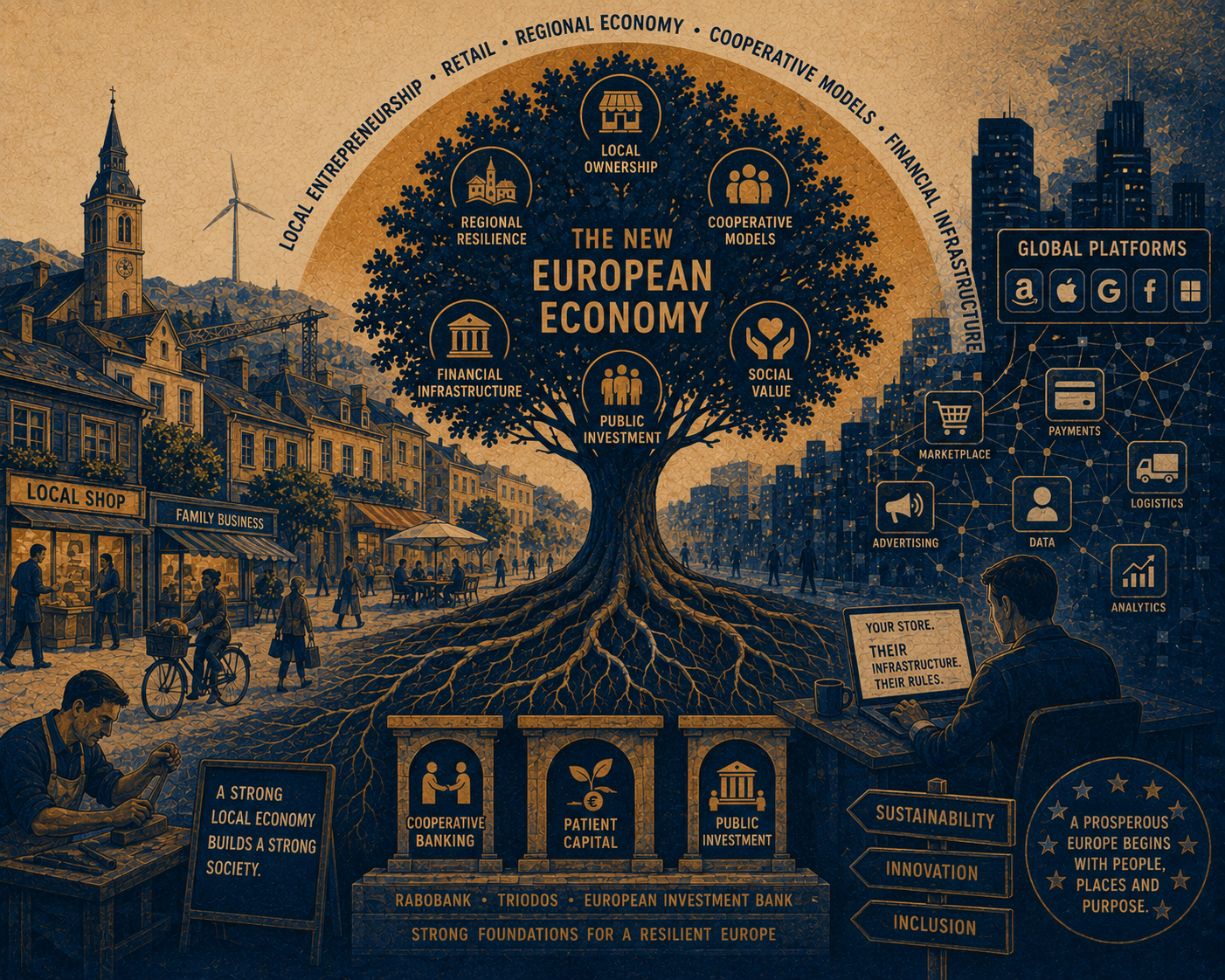
Can Europe build an economy that remains socially rooted?
Europe often speaks about the economy through abstraction. Growth rates. Inflation figures. Interest policy. Market performance. Productivity indicators. These metrics matter enormously. But they can also create a dangerous illusion: the idea that economies exist primarily inside dashboards, financial models and macroeconomic statistics.
In reality, economies remain deeply physical and social systems. They exist in: shops, industrial clusters, regional supply chains, local banks, family businesses, ports, communities, public infrastructure.
Behind every abstract economy lies a lived economy built upon geography, ownership and trust. And perhaps one of Europe’s defining challenges in the twenty-first century is that while its economic systems became increasingly digital and globalized, many of the social foundations beneath them quietly began to weaken.
The Economy Beneath the Spreadsheet
Modern economic debate often revolves around scale. Bigger platforms. Faster logistics. Global efficiency. Frictionless commerce. But economies do not function inside spreadsheets alone.
They depend on local continuity, regional stability and social trust. A healthy economy is not merely a machine for generating transactions. It is also the structure through which communities remain economically and socially livable over time. This becomes especially visible during periods of disruption.
When local businesses disappear, regions lose more than commercial activity. They lose apprenticeship structures, local investment networks, intergenerational ownership and forms of economic participation that once anchored prosperity within communities themselves.
A shopping street is not merely a retail corridor. It is a social and economic ecosystem.
Behind every abstract economy lies a physical and social economy built upon ownership, geography and trust.
That distinction matters enormously. Because societies can remain statistically prosperous while simultaneously becoming economically hollowed out at the local level.
Europe’s Fragmented Economic Architecture
Compared to both the United States and China, Europe often appears economically fragmented.
Different banking systems.
Different regulatory traditions.
Different tax structures.
Different languages and regional markets.
For decades, this fragmentation was frequently interpreted as weakness — an obstacle to scale, speed and technological dominance. And in some respects, it is.
Europe struggles to create digital giants at the pace seen in Silicon Valley. Capital markets remain less centralized. Economic coordination often moves more slowly and requires political compromise across multiple layers of governance. But Europe’s fragmentation also produces something else: distribution.
The American economy increasingly concentrates around winner-takes-all platform structures. China increasingly organizes capital through large-scale industrial coordination and state-backed systems.
Europe historically evolved differently. Its economy remained more regionally layered, more cooperative and more socially embedded. Small and medium-sized enterprises continued playing a structural role far larger than in many other advanced economies.
That structure may appear less efficient from the perspective of pure scale. But socially, it often creates stronger shock absorption.
Europe’s economy may be less optimized for hyper-scale, but often remains more deeply anchored within the social fabric of everyday life.
That distinction could become increasingly important in an era of geopolitical instability, platform dependency and economic concentration.
The Platformization of Commerce
The modern economy is increasingly organized through platforms. Retail, payments, hospitality, advertising, logistics, visibility, customer relationships are now heavily mediated through a relatively small number of global technological infrastructures.
Amazon, Booking, Apple, Meta, Uber and Google increasingly function not merely as companies, but as operational layers beneath everyday economic life itself. This fundamentally changes the relationship between local entrepreneurs and the economy surrounding them.
Many small businesses still appear independent on the surface. The local bakery still exists. The family-owned hotel still operates. The independent retailer still opens its doors each morning. But underneath, the infrastructure through which customers, data, payments and visibility flow increasingly belongs to someone else.
Many European entrepreneurs still possess the physical keys to their businesses, while gradually losing control over the digital infrastructure through which customers, data and visibility reach them.
That creates a new form of dependency. Economic life remains geographically local while the infrastructure organizing that life becomes increasingly centralized elsewhere. And over time, this shifts not only profit flows, but power itself.
The Disappearing Middle Economy
Historically, Europe depended heavily on what might be called the “middle economy”: family businesses, regional manufacturers, cooperatives, local banks, small and medium-sized enterprises.
Particularly within the Rhineland economic tradition, these structures formed the backbone of regional stability and social continuity.
They reinvested locally.
They maintained long-term relationships.
They embedded economic value within communities themselves.
The platform economy increasingly weakens that middle layer. Large-scale digital infrastructures centralize visibility, logistics and customer ownership. Economic value gradually migrates upward toward globally scalable systems optimized for extraction and efficiency rather than regional continuity.
The effects become visible across Europe: emptying shopping streets, shrinking margins, regional dependency, disappearing local ownership, weakened community institutions. And slowly, regions begin losing not only businesses, but economic autonomy itself.
When economic power concentrates inside global platforms, regions lose more than commerce. They lose part of their ability to shape their own economic future.
This may become one of the defining structural tensions within Europe’s economy in the coming decades.
Banking Was Never Neutral
Financial systems have always shaped the physical reality societies ultimately build. Banks determine: which businesses receive investment, which innovations survive, which regions attract capital, which economic models expand. Capital is never neutral.
Historically, many European banking systems remained partially rooted in geography and community. Cooperative banking traditions, regional financial institutions and long-term lending structures often maintained stronger relationships with local economies than purely extractive shareholder systems.
That legacy still matters. Institutions such as Rabobank, Triodos and various regional cooperative structures represent fundamentally different philosophies of economic organization.
Not perfect alternatives, certainly. But reminders that financial systems can optimize for different priorities: long-term continuity, regional resilience, social value, stakeholder relationships.
Financial infrastructure functions as the blueprint of society itself. The way capital is organized ultimately determines which physical and social realities emerge over time.
This becomes increasingly important in an era dominated by speculative capital, algorithmic investment logic and short-term shareholder pressure. Because economies eventually become reflections of the incentives embedded within their financial architecture.
Europe’s Cooperative Tradition
Europe possesses a long cooperative tradition that is often underestimated in modern economic debate. Cooperatives,
mutual organizations, regional banks, family-owned firms, public investment structures are frequently dismissed as remnants of an older economic era. But perhaps their relevance is growing again precisely because societies are becoming more centralized and volatile.
Cooperative systems generally optimize less aggressively for exponential scale. Instead, they often optimize for continuity, resilience and long-term social stability. That distinction matters enormously during periods of systemic stress.
Cooperative models may scale more slowly, but they often create deeper forms of social continuity and regional resilience.
In highly centralized economies, shocks can destabilize entire regions rapidly. Economies built upon distributed ownership structures often possess stronger internal buffers. This is why Europe’s cooperative tradition may represent not economic nostalgia, but strategic infrastructure for the future.
Not as a rejection of innovation. But as an alternative architecture for organizing ownership, value and participation inside increasingly digital economies.
The Geography of Economic Life
Digital economies operate globally. Human beings still live locally. Children still grow up in neighborhoods. Communities still depend on schools, healthcare systems, public transport and regional employment. Economic decline is still experienced geographically.
That creates one of the defining tensions of modern capitalism. Economic systems increasingly optimize globally while social life remains territorially rooted.
Economies may function digitally, but societies remain profoundly geographic.
This is why economic policy cannot be reduced to platform growth or technological acceleration alone.
An economy that continuously extracts value from local communities without reinvesting socially into those same places eventually destabilizes the environments upon which long-term prosperity depends.
A healthy economy therefore requires more than innovation. It requires rootedness.
Public Investment and Strategic Autonomy
Europe increasingly speaks about strategic autonomy. Semiconductors. AI infrastructure. Energy systems. Defense capabilities. Quantum technologies. But strategic autonomy requires something deeper than industrial ambition alone. It requires financial systems capable of investing patiently across decades.
The United States often relies on aggressive venture capital structures optimized for rapid scaling and market exits. China increasingly combines industrial planning with state-coordinated capital allocation.
Europe frequently struggles to mobilize comparable long-term strategic investment capacity. And yet many of Europe’s most important technological successes — including ASML, advanced photonics ecosystems and precision manufacturing clusters — emerged precisely because patient long-term investment structures remained possible.
Strategic autonomy ultimately depends not only on technology, but on financial infrastructures willing to invest beyond short-term market logic.
This may become one of Europe’s defining economic challenges in the coming decades: whether it can still organize capital around long-term societal goals rather than purely short-term extraction.
Can Europe Build a Rooted Economy?
The central economic question facing Europe may therefore not simply be how to compete faster. The deeper question is what kind of economy Europe ultimately wants to build.
One optimized entirely for scale, acceleration and frictionless global integration? Or one capable of remaining technologically advanced while still preserving local ownership, regional resilience and democratic accountability?
A rooted economy does not reject innovation. Nor does it reject markets. It simply recognizes that economies are not abstract systems detached from human life. They shape cities, communities, identities and the lived architecture of society itself.
A healthy economy is not measured solely through market valuation or logistical efficiency.
Ultimately, it is measured by whether citizens still feel ownership over the systems upon which their daily lives depend. And perhaps Europe’s real opportunity in the twenty-first century lies precisely there.
Not in perfectly imitating American platform capitalism or Chinese state coordination. But in building an economy that remains globally competitive precisely because it stays socially, financially and geographically rooted.
This article is part of the series The European Architecture — Rethinking Infrastructure, Society and Democracy in the Digital Age.
The series explores how Europe can rethink infrastructure, technology, finance, culture and democratic legitimacy in an era increasingly shaped by AI, platforms and digital systems. Through long-form analyses and essays, Altair Media Europe examines whether Europe can develop a new human-centred societal architecture for the twenty-first century.
Illustration credit
Illustration created with AI assistance for Altair Media Europe
Caption
A conceptual illustration of Europe’s emerging economic crossroads — contrasting globally centralized platform infrastructures with locally rooted entrepreneurship, cooperative finance and regionally embedded economic ecosystems.
