Beyond Models
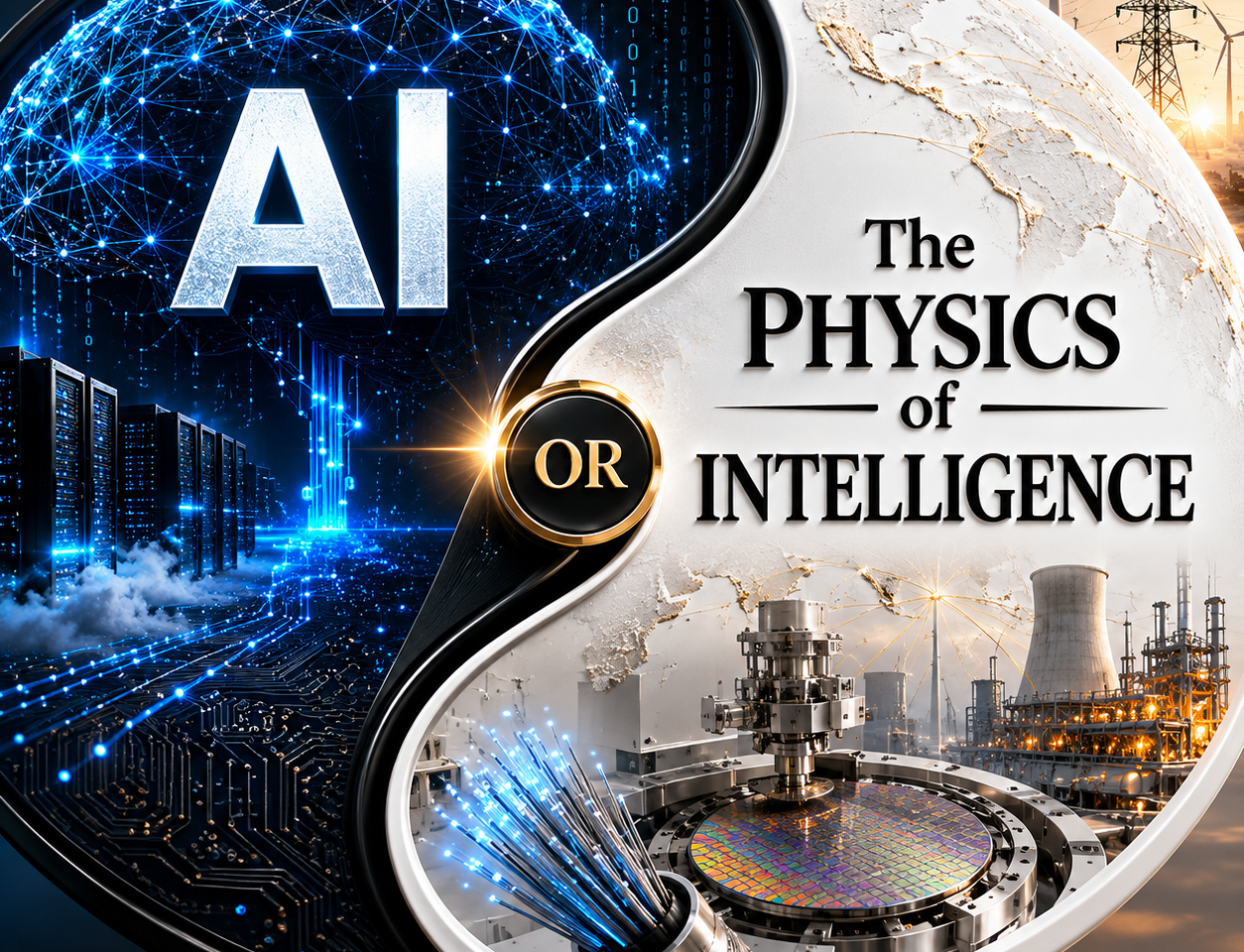
Why Artificial Intelligence Is Becoming an Industrial System
For years, artificial intelligence was largely presented as a software story. The focus was on algorithms, machine learning breakthroughs and increasingly powerful models capable of generating text, images and software code. Companies such as OpenAI, Anthropic, Google DeepMind and Meta became the public faces of the AI revolution. Yet beneath the headlines, another reality has been quietly emerging.
Artificial intelligence does not exist in isolation from the physical world. Every AI-generated response depends on electricity, semiconductors, networking equipment, cooling systems and increasingly complex industrial infrastructure. Intelligence may be digital, but its foundations remain profoundly physical.
As AI continues to scale, the industry appears to be evolving from a software sector into something much larger: an industrial ecosystem built upon energy, manufacturing capacity, infrastructure and supply chains.
“Artificial intelligence is shifting from a software sprint to an infrastructure marathon.”
Much of the public conversation surrounding AI remains focused on applications and models. These are the visible layers. The invisible layers are increasingly becoming the most important.
Read MoreEurope’s Nervous System

Why Siemens may be building the architecture behind the age of automation
When people think about robotics, they often imagine humanoid machines walking through warehouses, autonomous robots replacing workers or futuristic demonstrations from Silicon Valley. The global robotics conversation is increasingly dominated by companies such as Tesla, NVIDIA, Figure AI, Boston Dynamics and a growing ecosystem of AI-driven robotics startups.
Yet beneath the headlines, a different transformation is quietly taking place. And Europe may be pursuing a fundamentally different path. At the center of that transformation stands Siemens.
Not as a robotics company in the traditional sense. But increasingly as one of the companies building the digital infrastructure that allows automated factories, industrial AI systems and future robotic environments to function at scale.
While the United States focuses heavily on artificial intelligence and Japan remains a global leader in industrial robotics hardware, Siemens appears to be positioning itself around a different question: How do entire industrial systems become intelligent?
Read MoreEurope Is Starting to Think Like a System

Why a joint call from Airbus, ASML, Ericsson, Mistral AI, Nokia, SAP and Siemens reveals a deeper shift in Europe’s technological strategy
For years, Europe’s technology debate was largely defined by regulation. The Digital Markets Act, the Digital Services Act and the AI Act positioned the European Union as a global rulemaker in an increasingly digital world. While the United States focused on scale and China emphasized coordination, Europe often appeared most comfortable acting as regulator.
A recent joint statement from the European Tech Creators suggests that this may be changing.
Signed by leaders from Airbus, ASML, Ericsson, Mistral AI, Nokia, SAP and Siemens, the statement argues that Europe must move beyond simply regulating technology and focus more actively on creating the conditions for innovation, investment and industrial scale.
The wording itself is notable. Less attention is given to autonomy or protectionism. More emphasis is placed on critical technologies, strategic value chains, resilient infrastructure and the ability to scale.
That may sound like a subtle shift. In reality, it reflects a much larger transformation in how Europe increasingly understands technological power.
“Sovereignty is not about doing everything ourselves. It is about mastering key control points in the value chain and creating the conditions for innovation to scale.”
Justin Hotard, President & CEO, Nokia
For much of the past decade, discussions surrounding technological sovereignty focused on reducing dependence on external actors.
Read More