Europe Is Starting to Think Like a System
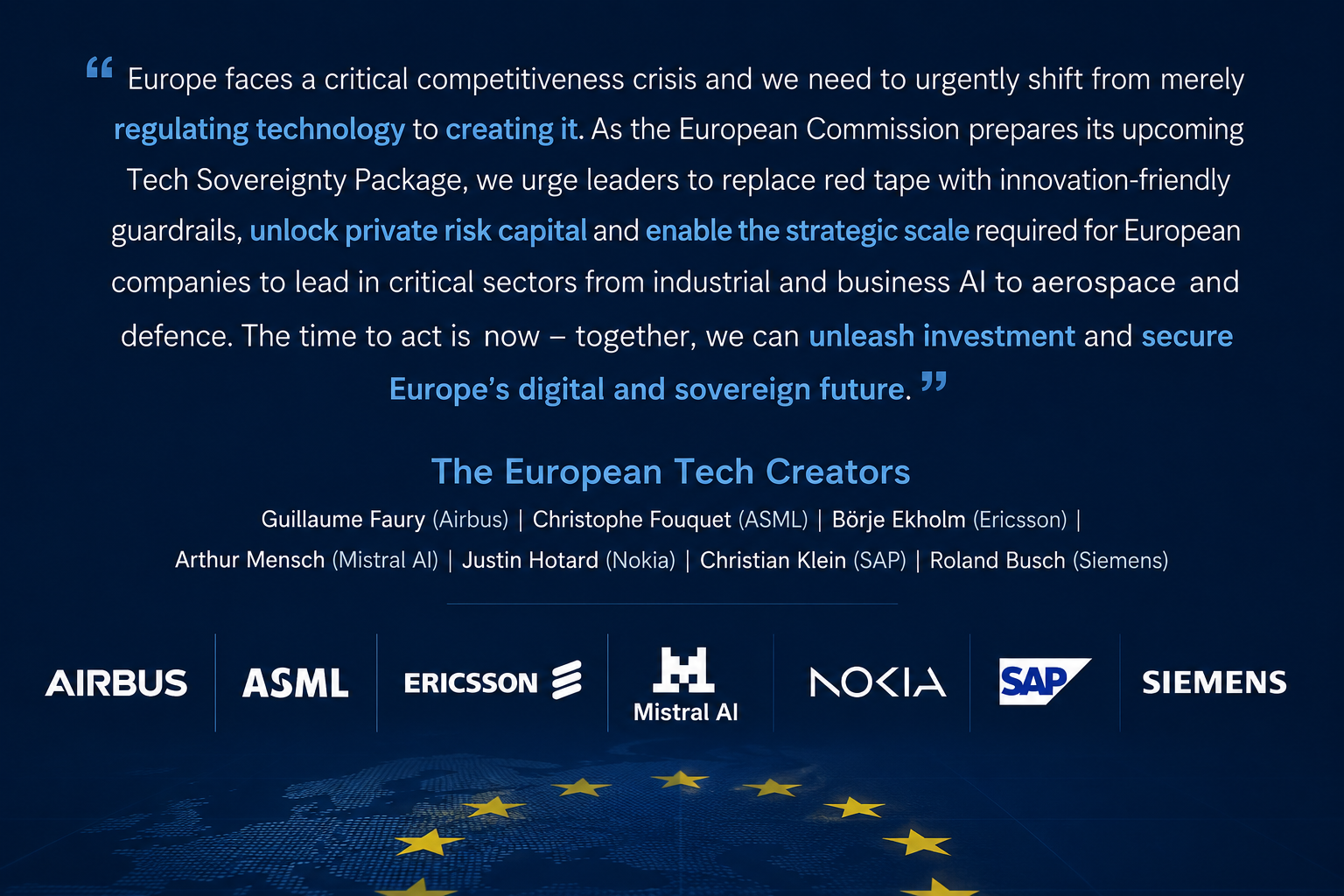
Why a joint call from Airbus, ASML, Ericsson, Mistral AI, Nokia, SAP and Siemens reveals a deeper shift in Europe’s technological strategy
For years, Europe’s technology debate was largely defined by regulation. The Digital Markets Act, the Digital Services Act and the AI Act positioned the European Union as a global rulemaker in an increasingly digital world. While the United States focused on scale and China emphasized coordination, Europe often appeared most comfortable acting as regulator.
A recent joint statement from the European Tech Creators suggests that this may be changing.
Signed by leaders from Airbus, ASML, Ericsson, Mistral AI, Nokia, SAP and Siemens, the statement argues that Europe must move beyond simply regulating technology and focus more actively on creating the conditions for innovation, investment and industrial scale.
The wording itself is notable. Less attention is given to autonomy or protectionism. More emphasis is placed on critical technologies, strategic value chains, resilient infrastructure and the ability to scale.
That may sound like a subtle shift. In reality, it reflects a much larger transformation in how Europe increasingly understands technological power.
“Sovereignty is not about doing everything ourselves. It is about mastering key control points in the value chain and creating the conditions for innovation to scale.”
Justin Hotard, President & CEO, Nokia
For much of the past decade, discussions surrounding technological sovereignty focused on reducing dependence on external actors.
Beyond the Sovereignty Debate
Semiconductors became a symbol of that ambition. Europe launched the Chips Act. Governments sought to attract advanced manufacturing facilities. Policymakers increasingly spoke about strategic autonomy in critical technologies.
Yet the rise of artificial intelligence is exposing the limits of that thinking.
The shift is not occurring in isolation. American industrial policy, China’s long-term technology planning and intensifying competition around AI infrastructure are forcing Europe to reassess how technological influence is actually created. What once appeared to be a debate about sovereignty is increasingly becoming a debate about strategic relevance.
Modern technology ecosystems are extraordinarily interconnected. Semiconductor production depends on global supply chains. AI depends on cloud infrastructure, energy systems, advanced networking, software platforms and specialized hardware. No region can realistically control every layer.
As a result, a different question is emerging. The challenge is no longer how Europe can do everything itself. The challenge is determining which parts of the system Europe must remain indispensable to.
“Europe’s future competitiveness depends on strengthening its capabilities in critical technologies and reducing strategic dependencies.”
European Tech Creators Statement
The concept of “control points” sits at the heart of this emerging strategy.
The Logic of Control Points
In practice, control points are the critical technologies, standards or infrastructure layers upon which larger ecosystems depend. Europe may never dominate every segment of the digital economy. It may not operate the largest hyperscale cloud platforms, build every AI model or manufacture every semiconductor. But it does not necessarily need to.
When ASML supplies the lithography systems required to manufacture advanced chips, Europe occupies a position that cannot easily be bypassed. Similar dynamics exist in industrial automation, telecommunications infrastructure, enterprise software, photonics and advanced engineering.
This is the difference between autonomy and indispensability. One seeks complete control. The other seeks structural relevance. Increasingly, Europe appears to be moving toward the latter.
A Coalition of Infrastructure Builders
Perhaps the most interesting aspect of the statement is not what is being said, but who is saying it. The companies behind the initiative represent remarkably different sectors.
Airbus builds aerospace infrastructure. ASML enables advanced semiconductor manufacturing. Ericsson and Nokia underpin communications networks. SAP provides enterprise software. Siemens operates at the heart of industrial automation. Mistral AI represents Europe’s emerging ambitions in artificial intelligence.
Viewed individually, they belong to different industries. Viewed collectively, they form something else entirely: a significant portion of Europe’s strategic technology architecture.
This is why the statement feels different from a traditional industry lobbying effort. It reflects a growing awareness that Europe’s future competitiveness may depend less on individual champions and more on how effectively entire ecosystems operate together.
“The opportunity to secure Europe’s digital and sovereign future is real, but the window is narrowing.”
European Tech Creators Statement
For decades, Europe has excelled at creating frameworks, standards and regulatory safeguards.
From Regulation to Coordination
Those capabilities remain important. Trust, governance and accountability will continue to shape the development of artificial intelligence and digital infrastructure. But regulation alone does not create industrial capacity.
The European Tech Creators appear to be making a broader argument: Europe must become better at coordinating innovation across infrastructure layers, attracting long-term capital and supporting the scaling of strategically important technologies.
This does not mean copying the American or Chinese model.
Europe’s strengths remain different. The continent possesses world-leading capabilities in industrial systems, advanced manufacturing, telecommunications, photonics, energy infrastructure and engineering. What has often been missing is the ability to connect those strengths into coherent strategic ecosystems.
Increasingly, policymakers and industry leaders seem to be reaching similar conclusions. The future may belong not to isolated technologies, but to integrated systems.
Thinking Like a System
What makes this development particularly significant is that it extends beyond technology policy. It reflects a gradual shift in mindset.
Europe is beginning to think less in terms of sectors and more in terms of systems.
Artificial intelligence depends on semiconductors. Semiconductors depend on advanced manufacturing. Data centres depend on energy infrastructure. Energy systems increasingly rely on industrial automation, software orchestration and resilient communications networks.
These connections have always existed. What is changing is the growing recognition that they must be understood and governed together.
The challenge facing Europe is therefore no longer simply technological. It is architectural.
The question is not whether Europe can compete with the United States or China on every layer of the digital economy. It is whether Europe can connect its own strengths into systems that the rest of the world continues to depend upon.
Increasingly, that appears to be the strategy emerging behind Europe’s new generation of technology coalitions. And perhaps that is the most important message hidden within the European Tech Creators initiative.
Europe is no longer asking how it can do everything itself. It is beginning to ask how it can become impossible to ignore.
Credit
Graphic generated with AI for Altair Media Europe
Caption
Graphic featuring a statement from the European Tech Creators coalition, signed by leaders from Airbus, ASML, Ericsson, Mistral AI, Nokia, SAP and Siemens. The image highlights Europe’s need to strengthen critical technologies, innovation capacity and industrial competitiveness, with company logos displayed beneath the statement against a blue European-themed background.
