A European Financial Architecture

Rethinking money, banking and public trust in twenty-first century Europe
Money is often viewed as a financial instrument. Banks are often viewed as businesses. Payment systems are often viewed as technology. Yet beneath these familiar structures lies a deeper question: what kind of financial architecture does a democratic society need in an increasingly digital age?
For decades, Europe’s financial system evolved around stability, trust and institutional legitimacy. Banks connected savers with borrowers. Central banks protected monetary stability. Payment systems enabled economic activity. Together, these institutions formed an invisible infrastructure supporting daily life across the continent.
Today, that architecture is changing. Digital payments, fintech platforms, artificial intelligence, new forms of financial intermediation and growing geopolitical competition are reshaping how money moves through society. At the same time, questions about trust, accessibility, financial sovereignty and public legitimacy are becoming increasingly important. The challenge is no longer simply how to make finance more efficient. The challenge is understanding what role financial institutions should play in a rapidly evolving European society.
This series explores finance not as a collection of products, markets or regulations, but as infrastructure. It examines how money, banking, technology and public trust interact, and asks what a European financial architecture might look like in the decades ahead. Not as a policy blueprint, but as a broader reflection on the relationship between financial systems, democratic societies and the people they ultimately serve.
Read MoreRetail Is Becoming Urban Infrastructure
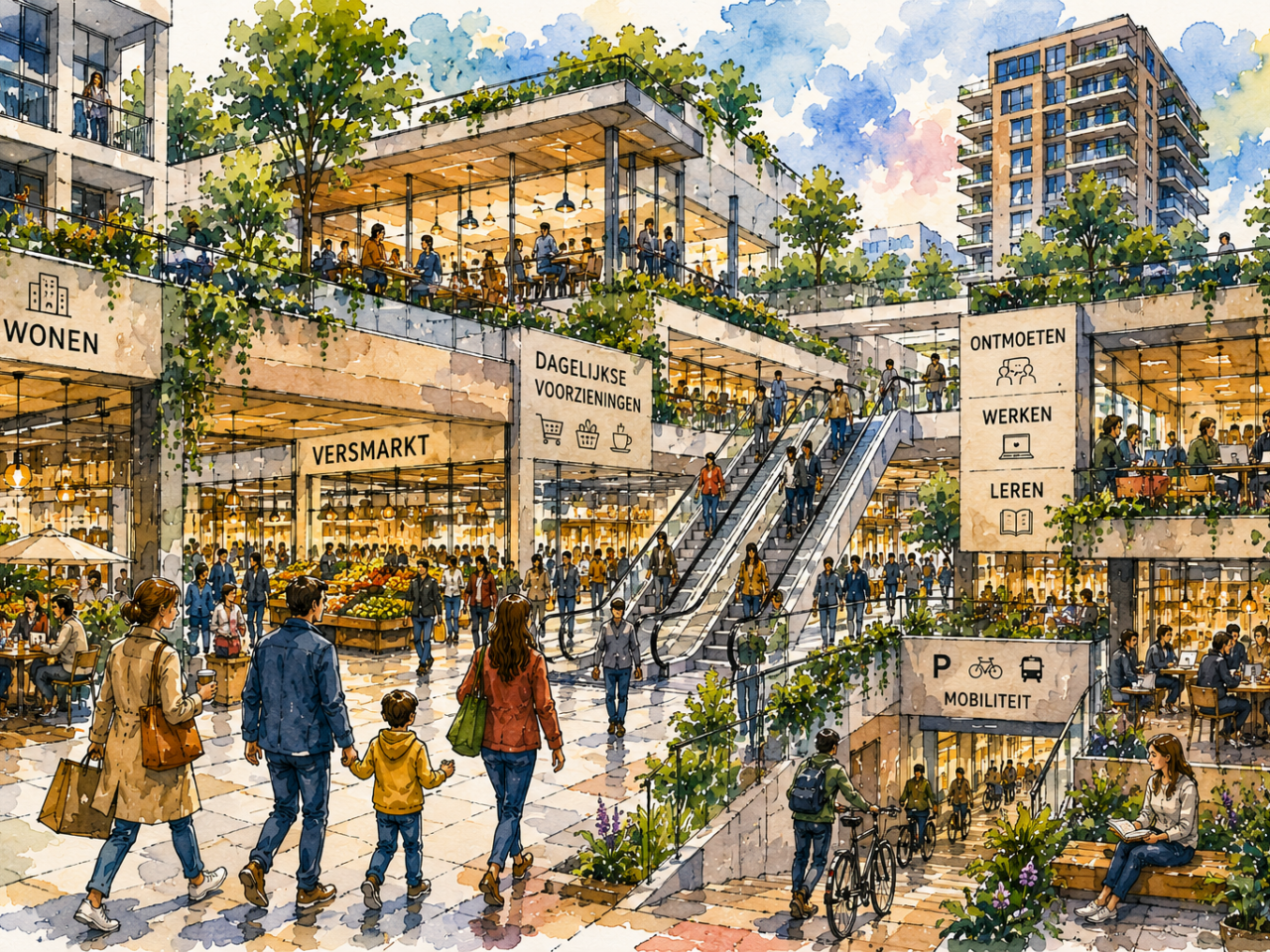
Why shopping centres are turning into miniature cities
Across Europe, shopping centres are increasingly evolving beyond retail alone. Housing, hospitality, public space and daily services are converging into integrated urban environments, transforming many commercial districts into miniature cities within the city itself.
For decades, shopping centres were designed around a relatively simple principle. People arrived, purchased goods and left. Retail was the primary function. Everything else existed to support the transaction. Today, that model is quietly changing.
As e-commerce absorbs a growing share of retail activity, physical shopping environments are increasingly searching for a different purpose. Rather than functioning solely as commercial destinations, many are evolving into mixed-use urban ecosystems where living, working, shopping and social interaction coexist within the same physical space.
The shopping centre is gradually becoming something larger than retail.
“When transactions move online, physical places must create value in other ways.”
This transformation is visible across Europe. Residential towers rise above commercial districts. Restaurants replace vacant retail units. Public squares, community facilities and flexible workspaces increasingly become part of the development strategy.
The objective is no longer simply to attract shoppers. The objective is to create environments where people remain present.
Read MoreFrom Machine Builder to Strategic Infrastructure

How ASML became a strategic control point in the global technology economy
Beyond the Semiconductor Industry
For decades, ASML was primarily known as a supplier of lithography systems to the semiconductor industry. Today, the company occupies a far more complex position at the intersection of semiconductors, artificial intelligence, economic security and technological sovereignty.
The question is no longer simply what ASML produces. The question is what ASML has become.
Most successful technology companies create products that customers value. ASML does something fundamentally different. Its machines enable other companies to create products.
Without ASML’s lithography systems, the world’s most advanced semiconductors would be impossible to manufacture at scale. Controlling the global market for Extreme Ultraviolet (EUV) lithography systems, the company occupies a uniquely influential position within the semiconductor ecosystem.
From artificial intelligence and cloud infrastructure to advanced manufacturing and defence systems, much of the modern technology economy ultimately depends on capabilities developed in Veldhoven.
This creates an unusual reality. ASML is not simply another participant in the semiconductor industry. It occupies one of the most important control points within it.
Some companies compete within markets. Others help define how markets function.
For much of its history, ASML was viewed primarily through the lens of engineering excellence and commercial success. Today, governments, investors and technology leaders increasingly view the company through a strategic lens.
The difference is significant. One perspective focuses on products. The other focuses on dependency.
Read More