Retail Is Becoming Urban Infrastructure
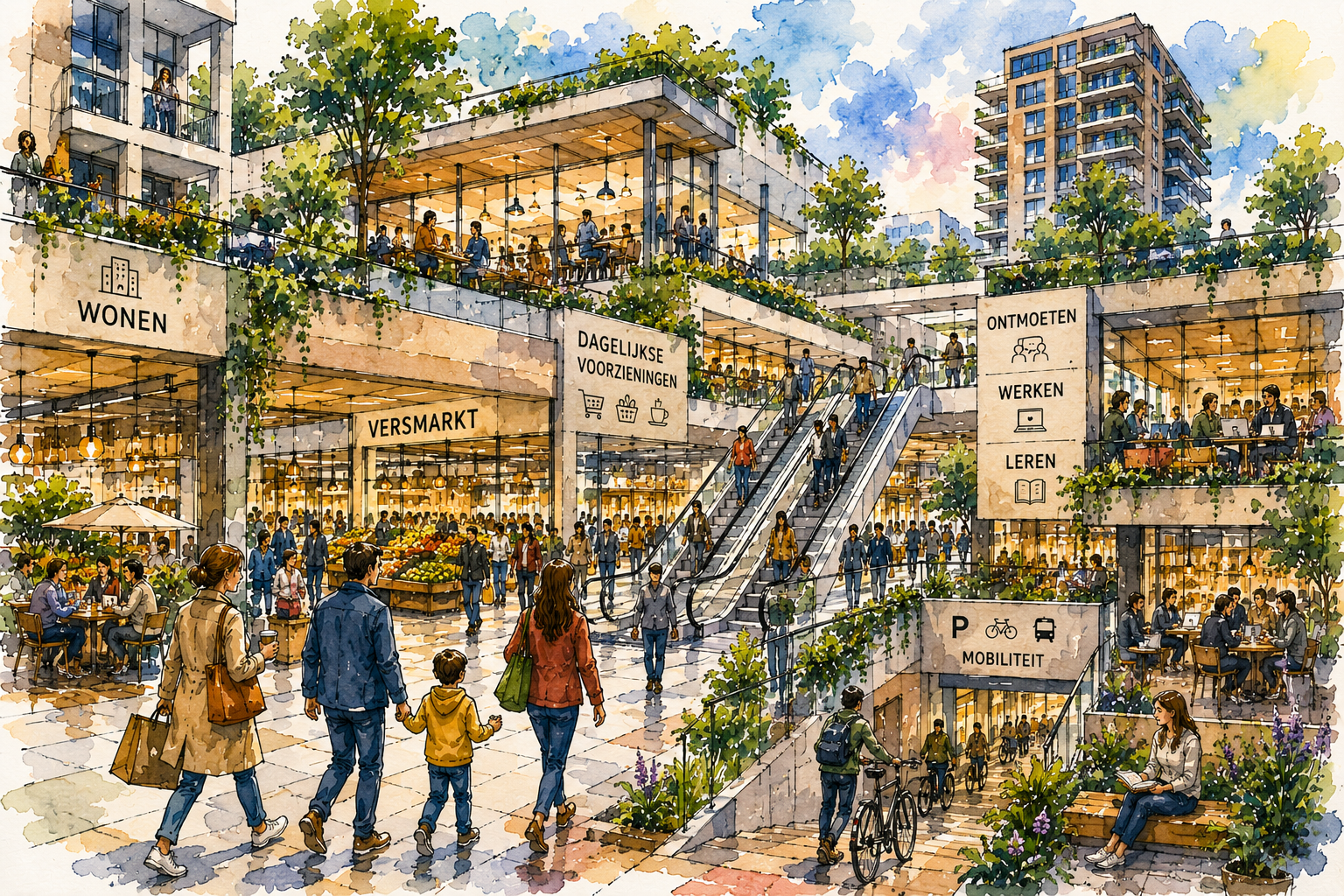
Why shopping centres are turning into miniature cities
Across Europe, shopping centres are increasingly evolving beyond retail alone. Housing, hospitality, public space and daily services are converging into integrated urban environments, transforming many commercial districts into miniature cities within the city itself.
For decades, shopping centres were designed around a relatively simple principle. People arrived, purchased goods and left. Retail was the primary function. Everything else existed to support the transaction. Today, that model is quietly changing.
As e-commerce absorbs a growing share of retail activity, physical shopping environments are increasingly searching for a different purpose. Rather than functioning solely as commercial destinations, many are evolving into mixed-use urban ecosystems where living, working, shopping and social interaction coexist within the same physical space.
The shopping centre is gradually becoming something larger than retail.
“When transactions move online, physical places must create value in other ways.”
This transformation is visible across Europe. Residential towers rise above commercial districts. Restaurants replace vacant retail units. Public squares, community facilities and flexible workspaces increasingly become part of the development strategy.
The objective is no longer simply to attract shoppers. The objective is to create environments where people remain present.
Beyond the shopping centre
Perhaps the most significant change is the growing integration of housing.
Historically, many shopping centres functioned as isolated destinations, separated from surrounding urban life. They were places people visited temporarily before returning elsewhere. Modern developments increasingly reverse that logic.
Housing, retail, hospitality and services are now designed together as interconnected components of a single environment. Residents live above stores. Cafés serve both visitors and local communities. Daily services reduce the need for travel. Public spaces encourage interaction throughout the day rather than only during shopping hours.
The result is a more continuous form of urban activity. Instead of experiencing peaks and troughs tied to opening hours, these environments increasingly generate activity throughout the entire day and evening. In many ways, shopping centres are becoming compact urban districts.
The Aarhof and the mixed-use city
Local redevelopments such as De Aarhof in Alphen aan den Rijn illustrate this transformation in real time.
Proposed residential towers, renewed retail functions and public amenities are not simply modernising a commercial centre. They are gradually reintegrating it into the wider urban fabric.
The objective is not merely to create a better shopping environment. The objective is to strengthen the surrounding city itself.
This same logic appears across numerous European developments. Successful urban environments rarely depend upon a single function. Instead, they bring together multiple layers of daily life: housing, shopping, hospitality, mobility and public space.
That combination creates resilience. When one activity slows, others continue generating movement, relevance and economic activity within the area.
“The most successful urban spaces are rarely built around a single purpose.”
In many respects, developments such as De Aarhof reveal a convergence between retail strategy and urban planning. The objective is no longer merely to attract consumers, but to create environments capable of supporting daily life across multiple generations.
The future of retail may therefore depend less on retail itself and more on its ability to participate in broader urban ecosystems.
Why long-term capital is paying attention
This transformation also helps explain the growing interest of long-term investors in physical environments.
Groups such as HAL Trust have historically focused on assets capable of compounding value over extended periods rather than relying upon short-term valuation cycles.
From this perspective, the future value of a shopping centre becomes increasingly disconnected from retail turnover alone. Resilience emerges from the broader ecosystem surrounding the asset. Housing generates stability, hospitality drives daily activity, public amenities foster civic relevance and accessibility ensures regional connectivity. This represents a shift toward infrastructure thinking.
Infrastructure succeeds because society repeatedly depends upon it. Ports, railways, energy networks and digital infrastructure derive their value not simply from ownership, but from their position within everyday life.
The same principle is increasingly being applied to physical urban environments.
People may choose whether to visit a particular store. They cannot easily avoid the places where daily life increasingly converges. When housing, mobility, services and public amenities become integrated within a single environment, that environment gradually acquires infrastructural characteristics.
The shopping centre becomes less a collection of stores and more a platform for everyday urban life.
The return of the everyday city
This evolution may also reveal something deeper about contemporary society. For decades, urban development often separated functions into distinct zones. Residential districts existed apart from workplaces. Shopping centres operated separately from cultural institutions. Public services occupied their own spaces.
Many modern developments increasingly move in the opposite direction. They attempt to bring daily life back together.
Retail becomes part of a wider urban experience where housing, mobility, education, leisure and public space reinforce one another. The objective is not efficiency alone. It is the creation of places that remain active, useful and socially relevant throughout the day.
This may explain why mixed-use developments increasingly attract attention from both investors and municipalities. They offer something many modern cities have gradually lost: proximity between the activities that shape everyday life.
People rarely experience life through isolated categories. Cities should not be designed that way either.
Why shopping centres may become more important, not less
The rise of e-commerce did not eliminate the need for physical places. If anything, it forced those places to become more meaningful.
Shopping centres can no longer rely solely on retail transactions. Increasingly, they must contribute to the wider life of the city itself. That transition is gradually transforming many commercial environments into something surprisingly familiar.
Not simply places to shop. But places to live, meet, work and belong.
In many ways, the future shopping centre may look less like a mall and more like a neighbourhood.
Series reference
This article is part of The Future of Retail — an Altair Media Europe series exploring how shopping centres, libraries and public spaces are evolving into social and urban infrastructure in an increasingly digital society.
Illustration credit
Illustration generated with AI by OpenAI for Altair Media Europe
Caption
Modern shopping centres increasingly combine housing, hospitality, public amenities and retail, transforming commercial districts into integrated urban environments designed around everyday life rather than transactions alone.
