Where Are the Lasers?

How one German breakthrough and one Dutch question reveal Europe’s next quantum challenge
German quantum company SAXON Q claims to have achieved one of quantum computing’s long-standing ambitions: a room-temperature quantum processor that fits inside a standard 19-inch server rack. If the technology proves scalable, quantum computing may be moving beyond specialised laboratories and into ordinary computing infrastructure.
Yet the announcement immediately raises a more fundamental question.
“Where are the lasers?”
The question, posed by Professor Martijn Heck of Eindhoven University of Technology, shifts the discussion away from qubit counts and engineering claims towards something far more important.
If quantum computing is truly leaving the laboratory, what has happened to the complex photonic infrastructure traditionally required to control it?
Perhaps that question tells us more about the future of quantum computing than the processor itself.
Read MoreIs Nokia Becoming Europe’s AI Infrastructure Company?

Why one telecom company’s transformation may reveal where artificial intelligence is heading next
For years, Nokia was primarily associated with mobile networks. Investors followed smartphone history, 5G contracts and quarterly results. Today, a different story is emerging.
The Finnish technology company has reported one of its strongest quarters in recent years. Operating profit exceeded expectations, AI and Cloud revenues more than doubled, and Nokia secured €2.8 billion in new AI and cloud orders. Financial markets understandably focused on the numbers.
The more interesting question, however, may not be how much Nokia earned. It may be what those results reveal about the next phase of artificial intelligence.
Read MoreCan Europe Build an Algorithm Industry?
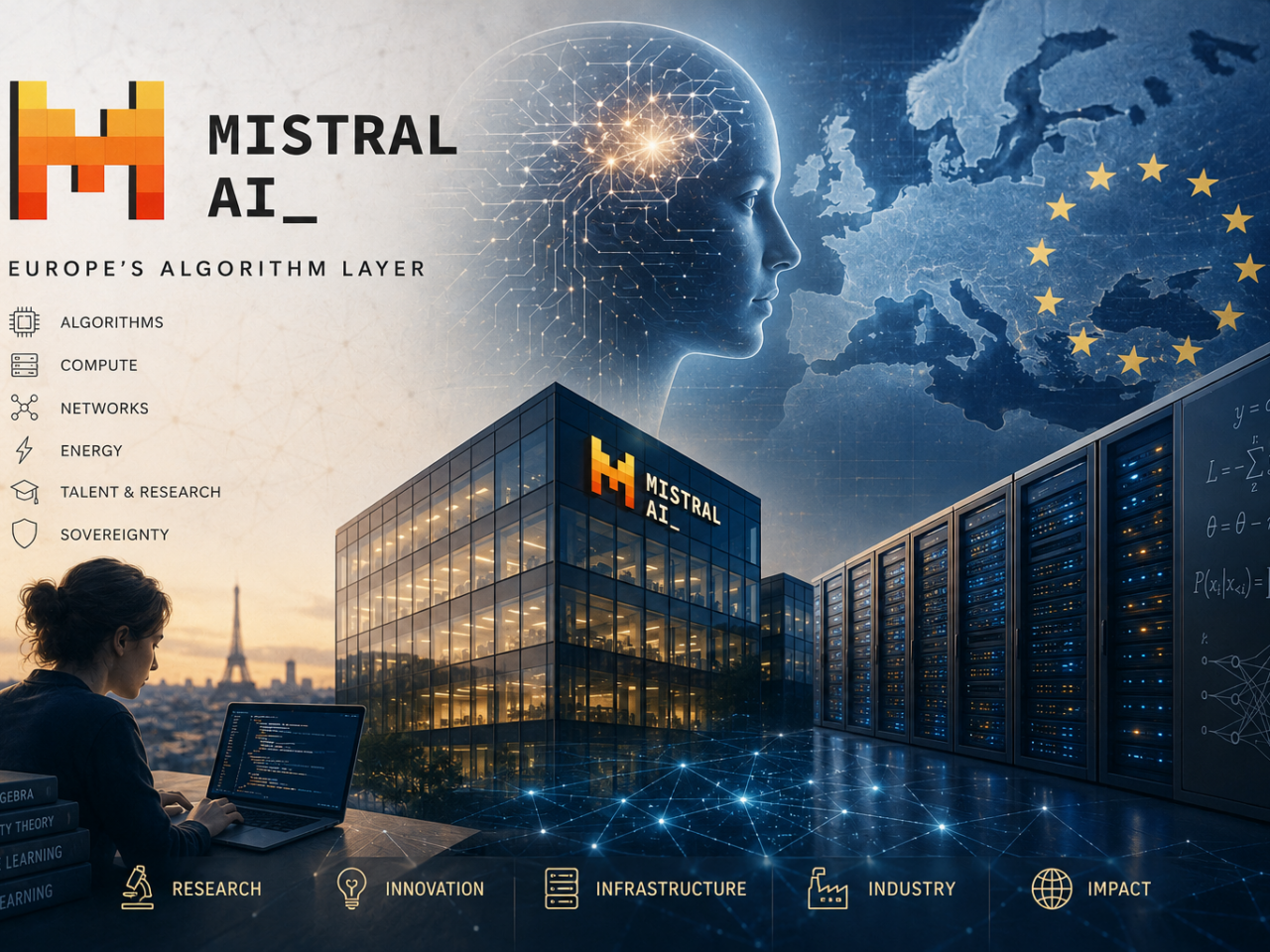
Why Mistral AI represents far more than a chatbot.
Who Builds Europe’s AI?
Artificial intelligence is often presented through chatbots, spectacular demonstrations and rapidly changing benchmarks. Governments debate regulation, technology companies announce increasingly capable models and investors compare market valuations. Yet beneath these visible developments lies a far more fundamental question.
Who builds the algorithms that increasingly shape how societies communicate, learn, work and make decisions?
The answer may ultimately prove more important than which chatbot writes the fastest email or produces the most convincing answer. Europe’s position in artificial intelligence will not be determined solely by how quickly organisations adopt AI, but by whether the continent can develop an industry capable of designing, training and continuously improving its own foundation models.
French company Mistral AI has rapidly become one of Europe’s most visible attempts to answer that question. Not because it offers another chatbot, but because it is helping to build the algorithmic foundations upon which future AI systems will depend.
Read More