Why Mistral AI Had No Real Choice
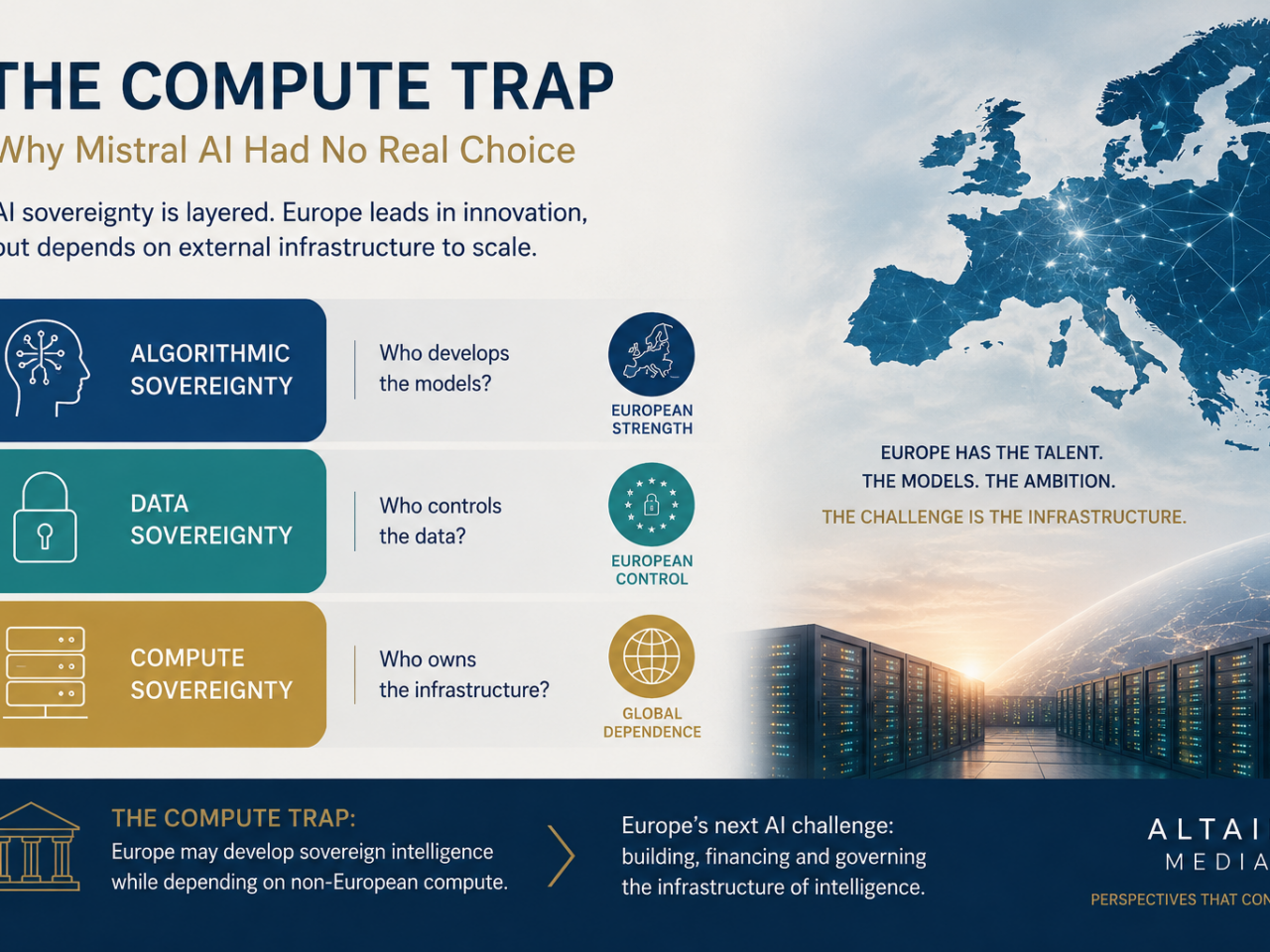
Europe’s next sovereignty debate may no longer be about data—but about compute
The Compute Trap
Artificial intelligence is increasingly discussed through the language of sovereignty. The Microsoft–Mistral partnership immediately raised questions about whether Europe was losing control over one of its most promising AI companies. That may be the wrong question.
The partnership suggests something more fundamental. It reveals that sovereignty is no longer a single concept. Artificial intelligence now depends upon several different layers of sovereignty, each shaped by different economic and technological realities.
Over the past decade, European policymakers focused primarily on data and algorithms. Today, a third layer is emerging beneath both.
Compute
Europe may therefore be approaching what could be described as the Compute Trap: possessing world-class AI capability while depending upon external infrastructure to develop and deploy it at scale.
Read MoreCan Europe Afford to Lose Airbus?

The Strategic Value of Industrial Capability
Airbus is often evaluated through aircraft deliveries, financial performance and market share. Yet these indicators reveal only part of its significance. The more important question is not how profitable Airbus has become, but what Europe would lose if the capabilities it represents were no longer exist.
Throughout this series, Airbus has appeared in many different forms. As a manufacturer of commercial aircraft. As a builder of strategic defence capabilities. As a provider of resilient communication systems.
Together, these perspectives reveal a broader reality. Airbus is not simply an aerospace company. It is one of Europe’s largest repositories of industrial capability. That distinction matters because capabilities are fundamentally different from products.
Products can be purchased. Capabilities must be cultivated. They emerge through decades of engineering expertise, institutional cooperation, industrial learning and patient investment. Once lost, they are rarely rebuilt quickly.
Read MoreThe Capability Principle: Strategic capabilities accumulate over generations but can disappear within a single political generation.
The Agentic Bank: Why Banking Is Not Silicon Valley

What ABN AMRO’s AI ambitions reveal about Europe’s next institutional challenge
Artificial intelligence is no longer simply a technological development. It is becoming a boardroom strategy. Across Europe’s financial sector, AI is increasingly presented as the foundation for higher productivity, leaner organisations and a fundamentally different model of banking.
Few banking leaders have articulated that ambition as clearly as ABN AMRO CEO Marguerite Bérard. Artificial intelligence is no longer described as a supporting technology, but as a strategic driver of the bank’s future transformation. Then came an unexpected reality check.
During an internal meeting that later became public, Meta CEO Mark Zuckerberg acknowledged that the company’s transition towards agentic AI had proven considerably more difficult than expected. Even one of the world’s leading AI companies is discovering that the journey from powerful language models to reliable autonomous agents is proving slower, more complex and more organisationally disruptive than anticipated.
Here lies the strategic dilemma for European banking. If Silicon Valley is still struggling to deploy autonomous AI inside organisations built for rapid experimentation, how should systemically important banks approach the same technology while carrying legal obligations, public responsibilities and societal trust?
Meta develops digital products. Banks manage institutional confidence. The technology may be similar. The responsibilities are not.
Read More