The Photonic Dilemma

Why the Future of AI May Depend on Manufacturing, Not Physics
The invisible limit of artificial intelligence
While the world marvels at increasingly human-like responses from artificial intelligence, engineers in the cleanrooms of Silicon Valley are grappling with a stubborn law of physics: copper is running out of road. The electrical cables and interconnects that stitch together today’s data centers are approaching their thermal and bandwidth limits. As AI models scale into the trillions of parameters, the challenge is no longer simply how fast a processor can compute—but how fast information can move between thousands of them.
In the sprawling infrastructure behind modern AI systems, the bottleneck has shifted. Graphics processors may perform trillions of calculations per second, but those calculations are useless if data cannot flow quickly enough between chips, racks and clusters. The result is a growing engineering crisis quietly unfolding behind the scenes of the AI boom.
It is here that an alternative technology—long studied but rarely deployed at scale—has returned to the center of attention: silicon photonics. Instead of sending electrical signals through copper wires, photonic systems use light to transmit information through microscopic optical pathways etched into chips.
“The bottleneck for AI is no longer the compute itself, but the ability to move data between the compute elements. Silicon photonics is the only path to scale the bandwidth density required for the next generation of LLMs.”
Mark Wade
CEO & Co-founder, Ayar Labs
Source: AI Hardware & Edge AI Summit
For Wade and others working at the frontier of AI hardware, the implication is clear: the future of artificial intelligence may hinge less on algorithmic breakthroughs than on the physical infrastructure that moves data through machines.
Read MoreThe Nuclear Comeback of Europe

Why Brussels is reopening the nuclear option in the race for climate neutrality and strategic autonomy
For years, nuclear power was the black sheep of European climate policy — a legacy technology many policymakers hoped to phase out sooner rather than later. But as geopolitical winds shift and the continent’s electricity system strains under the pressure of the energy transition, a remarkable policy pivot is unfolding in Brussels. Under the leadership of Ursula von der Leyen, the European Commission is no longer merely tolerating nuclear energy; it is cautiously re-embracing it.
The change reflects a broader reassessment of Europe’s energy security. The war in Ukraine, the collapse of Russian gas imports and growing concerns about grid stability have forced policymakers to rethink the balance between renewable expansion and reliable base-load electricity. At the center of this new debate is a technology that, until recently, existed largely in theoretical designs and pilot projects: Small Modular Reactors.
“Nuclear energy is available around the clock, providing electricity all year. The nuclear tech race is on. Europe has been a pioneer in nuclear technology. And it can lead again.”
Ursula von der Leyen
President, European Commission
Source: Speech at the Nuclear Energy Summit, Brussels (March 2024)
Her statement signals a subtle but consequential shift in Europe’s energy narrative. Instead of framing nuclear power as an inconvenient relic of the twentieth century, the Commission increasingly portrays it as a strategic tool — one capable of stabilizing the electricity system while the continent rapidly expands wind and solar capacity.
Read MoreThe Architecture of a Sustainable Digital Europe
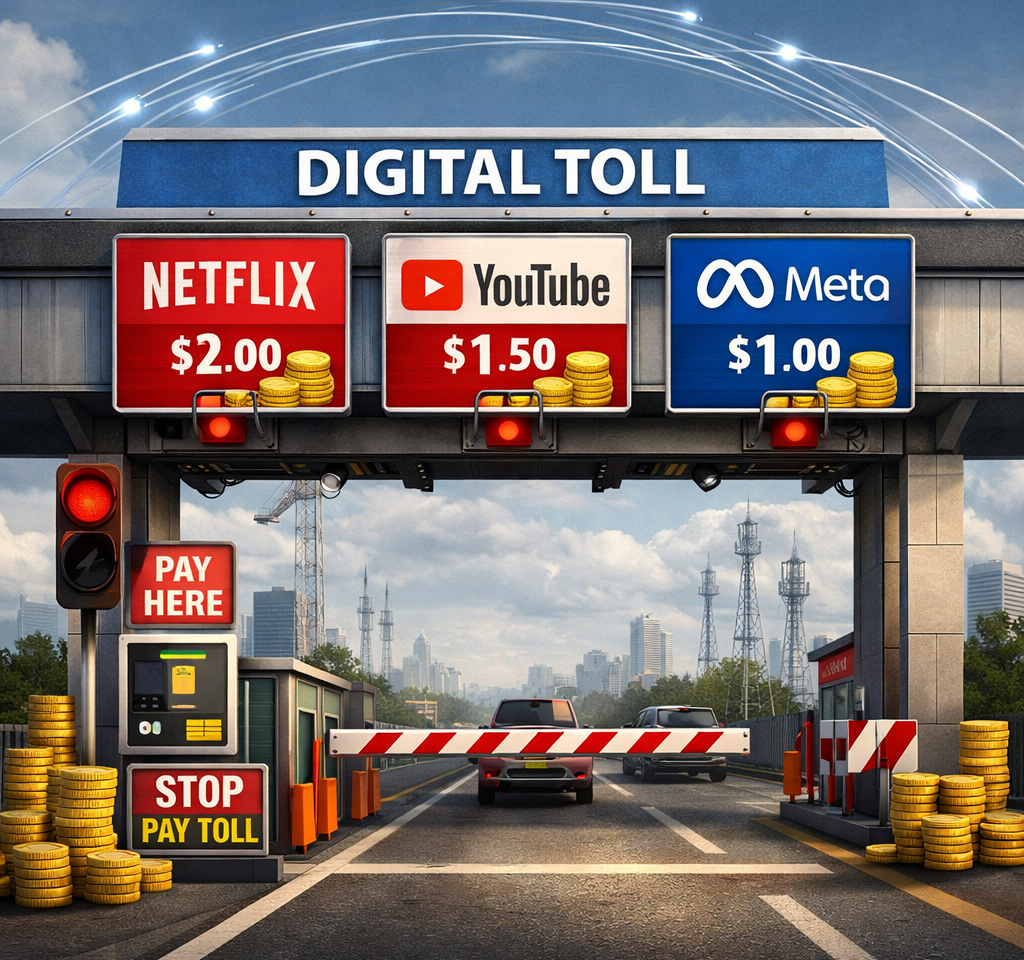
Why Europe’s “Fair Share” debate is really about the future of its digital economy
A network economy under pressure
Europe’s digital economy runs on an invisible foundation: connectivity. Every video stream, AI query, cloud service and social media interaction ultimately travels through telecom infrastructure built and maintained by network operators.
For decades, this system functioned on a relatively simple economic model. Consumers paid telecom providers for access to the internet, while content and application providers delivered services over that infrastructure.
But the digital ecosystem has changed dramatically. A small number of global platforms now generate the majority of internet traffic, while the investment burden for expanding and maintaining networks remains largely with telecom operators.
This imbalance has become the focal point of a heated debate in Europe often referred to as the “Fair Share” discussion, though policymakers increasingly describe it as a broader issue of ecosystem cooperation.
“Connectivity is the backbone of our economies, defence and democratic resilience. In a rapidly deteriorating geopolitical environment, the EU can no longer afford overregulation, fragmentation and underinvestment.”
Connect Europe
Industry association representing European telecom operators
Source: Policy statement on the Digital Networks Act, January 2026
The central question is no longer merely about telecom regulation. It has evolved into a discussion about Europe’s long-term digital competitiveness, investment capacity and technological sovereignty.
Read MoreSociety & Culture

When Electronics Carry Responsibility: Building Sustainable Healthcare Tech from Day One
Tuesday, February 3, 2026
Healthcare is becoming increasingly electronic. From wearable sensors and smart patches to remote diagnostics and continuous monitoring, digital technologies now sit directly on the human body — sometimes even inside it. These innovations promise earlier detection, better outcomes and more personalised care. Yet beneath this progress lies a growing contradiction.

Toddlers 1 – AI 0
Tuesday, January 20, 2026
While the world marvels at data centers and NVIDIA chips consuming electricity equivalent to small cities, a two-year-old sits on the floor of an ordinary daycare. Using no more than a dim household bulb’s worth of energy—20 watts—this child performs feats Silicon Valley can only dream of: learning a language, understanding sarcasm, recognizing a banana, whether drawn, plastic or half-eaten.
