Munich–Berlin — Where Connectivity Becomes Industrial Intelligence
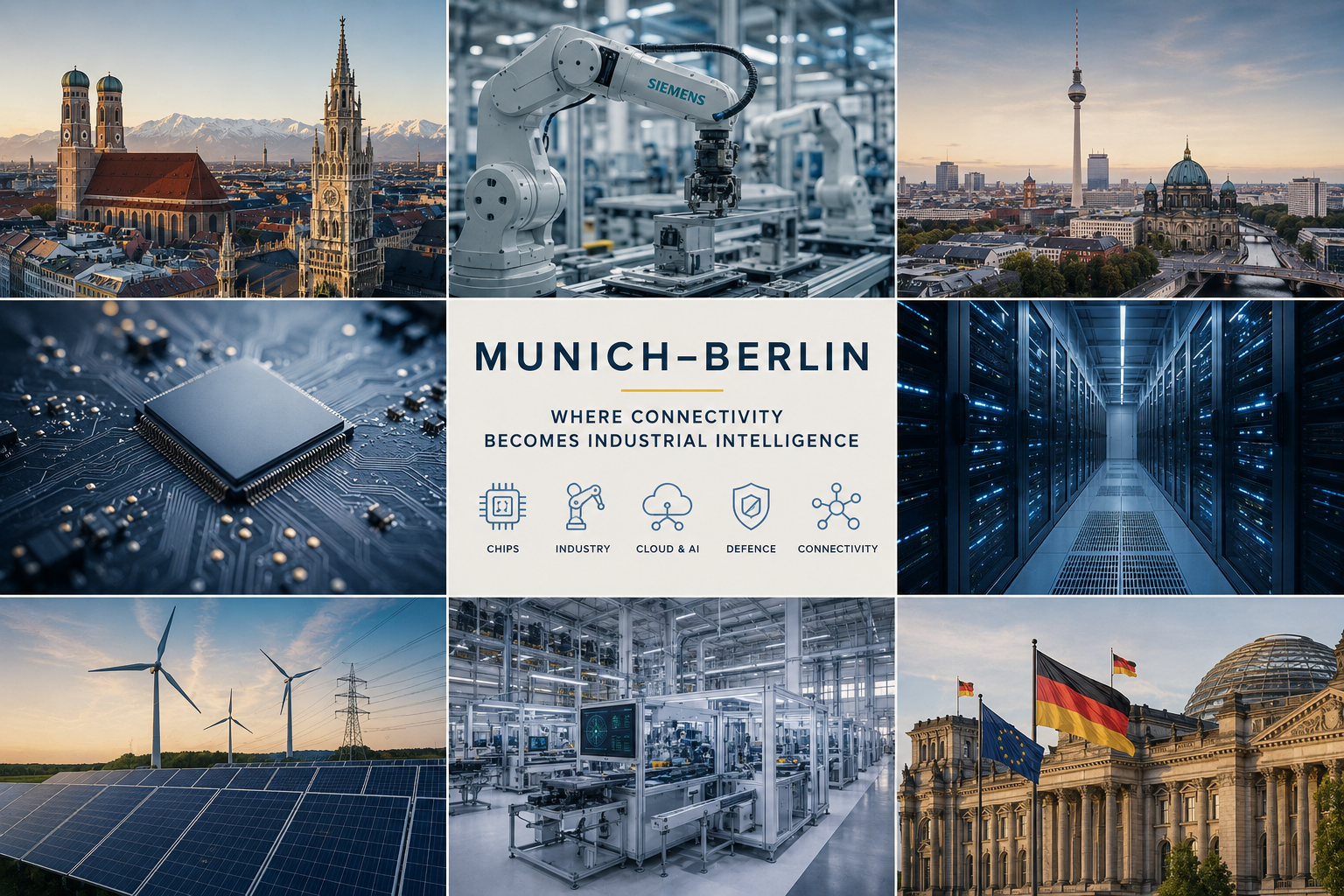
Why Europe’s future industries will be built on intelligent infrastructure
Munich and Berlin are often seen as two very different faces of Germany. Munich is recognised for engineering, advanced manufacturing and industrial technology. Berlin is known for software, research, digital innovation and government.
Together, however, they illustrate one of the most important transformations taking place within Europe’s economy.
The future of industrial competitiveness will depend not simply on better factories or faster communications networks, but on the convergence of engineering, artificial intelligence, cloud computing and secure digital infrastructure into one intelligent industrial ecosystem.
The future of industrial competitiveness will be built on intelligent infrastructure.
Few European regions demonstrate this transformation more clearly than the innovation corridor linking Munich and Berlin.
Beyond Telecommunications
The previous generation of telecommunications connected people. The next generation is increasingly connecting economies.
Factories, energy systems, transport networks, ports and defence industries are becoming intelligent environments in which communication is no longer separate from production itself. Connectivity is evolving from supporting infrastructure into operational infrastructure.
As artificial intelligence becomes embedded within industrial systems, communication networks are no longer simply moving information. They are enabling machines, software and industrial processes to operate as one integrated system.
Telecommunications is therefore becoming more than a sector of the economy. It is becoming part of Europe’s industrial architecture.
Munich — Engineering Industrial Intelligence
Munich has long been recognised as one of Europe’s foremost engineering centres. Companies such as Siemens helped define industrial automation decades before the concept of Industry 4.0 entered public debate. Today, that engineering tradition is entering a new phase.
Industrial control systems that once operated largely in isolation are increasingly connected with cloud platforms, artificial intelligence and real-time data environments. The historic boundary between Operational Technology and Information Technology is gradually disappearing. Manufacturing itself is becoming software-defined.
The factory is no longer simply a place of production. It is becoming a distributed computing environment.
Digital twins simulate production before factories are built. Edge computing analyses industrial processes close to the factory floor, while artificial intelligence continuously optimises production, predictive maintenance and resource efficiency.
The modern factory is no longer simply a place where products are assembled. It is becoming a distributed computing environment in which physical machines and digital intelligence operate as one integrated system.
Berlin — Orchestrating Digital Capability
Berlin contributes a different, yet equally essential, capability. While Munich engineers industrial systems, Berlin increasingly concentrates the software, cybersecurity, cloud infrastructure and institutional capacity required to operate them at scale.
Research organisations, software companies, federal institutions and a growing ecosystem of digital innovation increasingly influence how Europe’s industrial infrastructure is secured, governed and connected.
If Munich builds operational capability, Berlin increasingly provides the digital frameworks through which that capability is coordinated. Together they illustrate that Europe’s industrial future will depend as much upon software architecture and institutional governance as mechanical engineering.
Chips Meet Industry
Europe’s semiconductor ambitions are often discussed separately from industrial policy. In reality, they are becoming increasingly inseparable.
Advanced processors enable artificial intelligence. Artificial intelligence enables autonomous industrial systems. Those systems depend upon secure communications, cloud platforms, advanced sensors, integrated photonics and resilient energy infrastructure.
Rather than evolving independently, these technologies are gradually converging into a single industrial architecture. Future competitiveness will therefore depend less on individual technologies than on Europe’s ability to integrate them into coherent industrial systems.
Energy Becomes Part of the Factory
Industrial intelligence is also transforming Europe’s energy infrastructure. Modern factories are no longer passive consumers of electricity. Increasingly, they respond to fluctuations in energy supply, coordinate production with grid conditions and integrate batteries, renewable generation and intelligent energy management into everyday operations.
Industrial intelligence is no longer confined to the factory floor. It is becoming part of Europe’s energy, communications and security infrastructure.
The factory of the future will communicate not only with suppliers and customers, but increasingly with the electricity network itself. Energy is becoming part of the digital production system. This convergence carries implications far beyond manufacturing.
Industrial Intelligence as Strategic Capability
Industrial infrastructure increasingly serves both civilian and strategic purposes. Software-defined production environments can adapt more rapidly to changing economic conditions, while resilient manufacturing capacity has become an increasingly important component of national security.
The distinction between civilian industry and strategic capability is gradually becoming less clear. Europe’s industrial resilience increasingly depends upon digital resilience.
The ability to combine engineering, secure communications, cloud infrastructure and artificial intelligence is becoming a strategic capability in its own right.
One Corridor, Two Capabilities
Munich and Berlin perform different but complementary roles. Munich builds the physical-digital industrial engine. Berlin provides the software, cloud, cybersecurity and institutional frameworks that allow these systems to operate at scale.
Together they bridge the historic divide between industrial engineering and digital architecture. The factory of the future will no longer be defined by machines alone. It will be defined by the intelligence connecting them.
A Blueprint for Europe’s Industrial Future
The Munich–Berlin corridor illustrates a broader transformation taking place across Europe.
Future competitiveness will not be determined solely by manufacturing capacity, software expertise or scientific excellence in isolation. It will increasingly depend upon Europe’s ability to connect these capabilities into integrated industrial ecosystems.
Industrial intelligence therefore represents far more than the next phase of manufacturing. It represents a new model of economic organisation in which engineering, software, communications, energy and artificial intelligence function as parts of the same infrastructure.
Conclusion
Brainport Eindhoven demonstrated where Europe engineers enabling technologies. Paris-Saclay revealed where future communications are first imagined.
The Nordic Axis showed how specialised ecosystems collaborate across borders to develop the networks upon which intelligent societies depend.
Munich and Berlin complete the picture by demonstrating where these capabilities converge into intelligent industrial systems.
Together, these regions reveal that Europe’s future competitiveness will depend not on individual technologies, but on its ability to integrate hardware, scientific knowledge, connectivity, software, energy and industrial intelligence into one coherent technological architecture.
Industrial intelligence begins where engineering, software and connectivity become one system.
Regional Rising is therefore more than a series about Europe’s innovation ecosystems. It is an exploration of how Europe’s future economy is being designed—one interconnected region at a time.
Regional Rising explores the European ecosystems where future industries are imagined, engineered and brought to scale.
Credit
Illustration: Altair Media (AI-assisted visualisation)
Caption
The Munich–Berlin corridor illustrates the convergence of Europe’s industrial and digital capabilities. Munich contributes engineering, automation and advanced manufacturing, while Berlin strengthens software, cloud infrastructure, cybersecurity and institutional capacity. Together, they demonstrate how intelligent infrastructure is becoming the foundation of Europe’s next industrial transformation.
