Moldova and Europe’s New Frontier
Why one small country reveals how the European Union is redefining security, sovereignty and enlargement
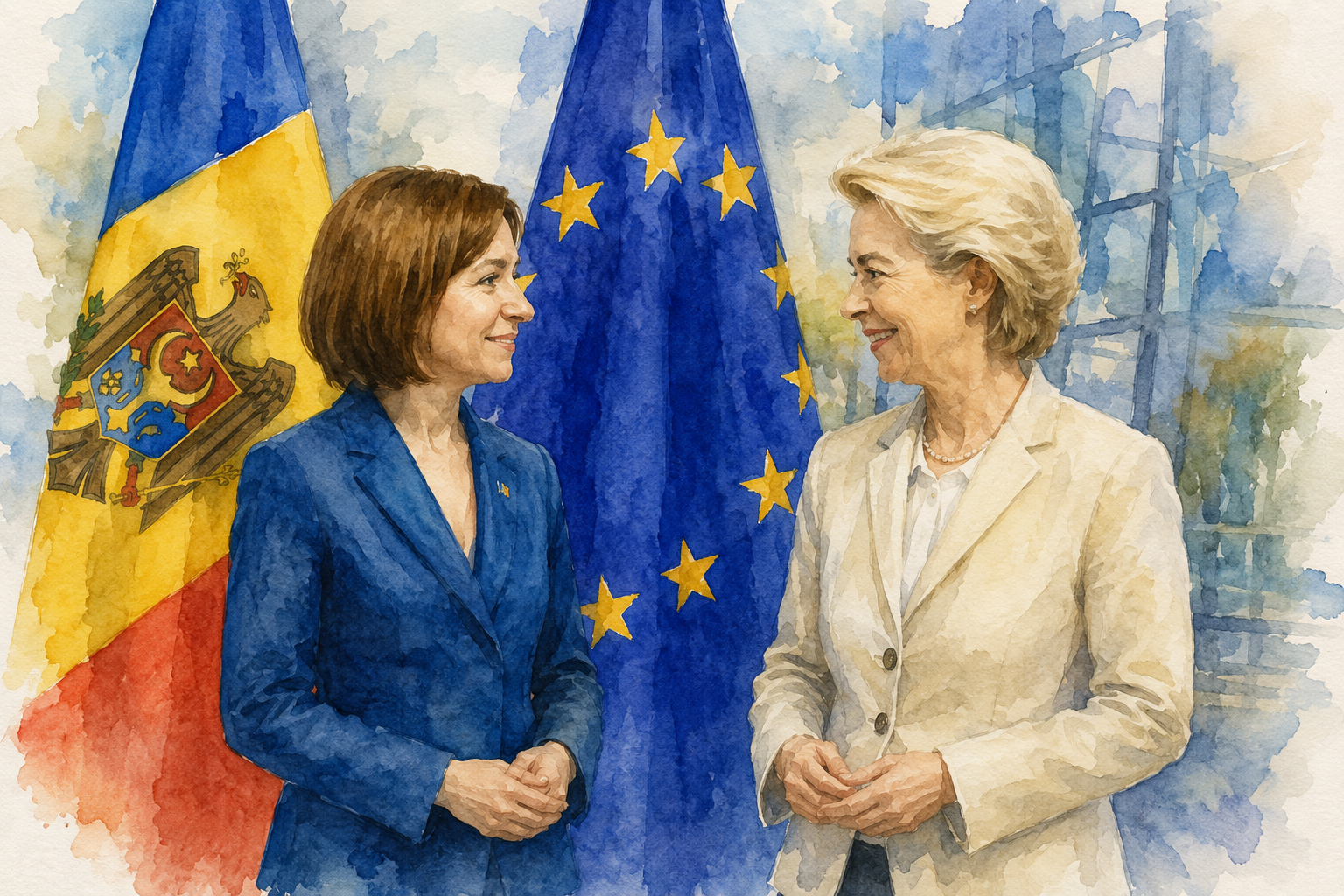
For many Europeans, Moldova remains a relatively unfamiliar country. With fewer than three million inhabitants and an economy far smaller than most European states, it is rarely discussed in debates about the future of Europe. Yet this week Moldovan President Maia Sandu stood alongside European Commission President Ursula von der Leyen and European Council President António Costa in Brussels for the second official EU–Moldova summit.
The meeting came at a significant moment. Only days earlier, the European Union formally opened the first negotiating cluster in Moldova’s accession process, marking another step in what has become one of the fastest-moving enlargement tracks in recent European history.
Yet the significance of Moldova extends beyond the question of when it may become a member of the European Union. The more interesting question is what Moldova reveals about the changing nature of Europe itself.
Beyond Enlargement
For much of the post-Cold War era, European enlargement was largely understood through an economic lens. Countries joined a common market. Trade barriers disappeared. Capital moved more freely. Businesses gained access to larger consumer markets. Membership was often presented as the final stage of economic and political convergence.
That logic has not disappeared. But Moldova suggests that something else is happening.
The question is no longer whether Moldova is large enough for Europe. The question is whether Europe can afford another unstable frontier.
Today, enlargement is increasingly connected to security, resilience and strategic stability. The European Union is no longer simply expanding a market. It is increasingly shaping a wider political and institutional space around itself.
In that sense, Moldova is not merely applying to join Europe. Moldova is becoming part of a broader European effort to reduce instability along its eastern frontier.
A Country Between Systems
Few countries illustrate Europe’s geopolitical challenges as clearly as Moldova. Situated between the European Union and Ukraine, the country has spent much of its modern history balancing competing political and economic influences.
Russian influence has long remained visible through energy dependence, information campaigns and the unresolved status of the breakaway region of Transnistria. At the same time, support for European integration has steadily increased, particularly since Russia’s invasion of Ukraine transformed security perceptions across Eastern Europe.
For Moldovan policymakers, accession is not simply an economic project. It is increasingly viewed as a strategy for long-term political stability, institutional development and national security. This explains why the current negotiations focus heavily on judicial reform, anti-corruption measures, democratic resilience and the rule of law.
The European Union is not merely assessing whether Moldova can adopt European regulations. It is assessing whether Moldova can strengthen the institutions upon which European governance depends.
The unresolved status of Transnistria remains the most visible reminder that European integration does not occur in a vacuum. Russian troops remain stationed in the region. The territory operates outside the effective control of the Moldovan government. Any future accession process will therefore confront difficult legal and political questions that have no obvious precedent.
In many ways, Transnistria represents a broader challenge facing Europe. How does a Union designed for peace expand into regions where geopolitical competition remains active?
The Physical Frontier
The transformation of Moldova is not only political. It is increasingly physical. For decades, Moldova depended heavily upon Russian energy supplies. That dependency created vulnerabilities extending far beyond economics. Energy could become leverage. Infrastructure could become influence.
Since Russia’s invasion of Ukraine, Moldova has moved rapidly to reduce those dependencies. Electricity interconnections with neighbouring Romania have expanded. The country has become increasingly integrated with the wider European electricity system through ENTSO-E. Gas supplies have become more diversified. European funding is helping modernise infrastructure that was once oriented eastward.
The frontier of Europe is no longer defined solely by maps. It is increasingly defined by systems.
These developments illustrate an important reality. European integration is no longer simply a legal process. It is also an infrastructural process. Transmission lines, payment systems, telecommunications networks and transport corridors may ultimately shape Europe’s future borders as much as treaties and negotiations.
The Architecture of Resilience
One of the most interesting developments is how accession itself is evolving. Historically, candidate countries often waited years before receiving the practical benefits of integration. Membership represented a clear dividing line between insiders and outsiders.
Moldova’s experience suggests a different model. Rather than waiting until the end of the process, the European Union is increasingly integrating candidate countries into key systems before formal accession takes place.
Moldova has already begun participating in initiatives that directly affect everyday life. The country recently joined European roaming arrangements, reducing communication costs for citizens travelling within Europe. It has also gained access to the Single Euro Payments Area, making financial transactions across borders faster and less expensive.
Meanwhile, energy connections between Moldova and the wider European network continue to deepen as the country reduces its dependence on Russian supplies. These developments may appear technical.
Membership may arrive later. Integration is already happening.
In reality, they represent something much larger. Europe is gradually extending its infrastructure beyond its formal borders. Membership may arrive later. Integration is already happening.
The Friction of Enlargement
Yet this transformation is not without tension. The European Union was originally designed as a project of economic integration. Its institutions were built around negotiation, regulation and consensus-building. Security competition operates differently. Geopolitics rarely waits for perfect consensus.
The accession of Moldova therefore raises difficult questions.
• How should the European Union respond when security concerns become as important as economic criteria?
• How should enlargement proceed when candidate countries face active external pressure?
• How can a Union built for cooperation adapt to a world increasingly shaped by strategic competition?
These questions remain unresolved.
Moldova is therefore not only testing the resilience of its own institutions. It is testing the adaptability of Europe’s institutions as well.
Why Europe Is Investing
The European Union has also committed substantial financial resources to Moldova’s transformation. Through its Growth Plan, Brussels has allocated billions of euros to support reforms, infrastructure development, energy security and economic modernisation.
Europe is discovering that building a market and building a frontier are not the same task.
On the surface, this may appear to be development assistance. But it can also be understood as a strategic investment. A more resilient Moldova reduces vulnerabilities along Europe’s eastern edge. Stronger institutions make external interference more difficult.
Better infrastructure improves economic opportunities while strengthening connections with neighbouring European economies. In other words, the investment is not solely about Moldova. It is also about Europe’s own future stability.
This reflects a broader shift taking place across the continent. Infrastructure, energy networks, digital systems and institutional capacity are increasingly viewed not simply as economic assets but as components of strategic resilience.
A Different European Union
Ultimately, Moldova’s accession process may reveal as much about the European Union as it does about Moldova itself. For decades, the European project was primarily associated with economic integration. Trade, competition and market access formed the centre of the conversation. Those elements remain important. Yet recent events have expanded the Union’s role.
The war in Ukraine, energy disruptions, technological competition and growing geopolitical tensions have pushed Europe to think differently about sovereignty and security.
As a result, the European Union is increasingly acting not only as an economic community but also as a security architecture, an energy architecture and an institutional architecture.
How should the continent organise stability, resilience and democratic governance in an increasingly uncertain world?
Moldova sits directly at the intersection of these transformations. Its accession negotiations are therefore about far more than legal harmonisation or regulatory compliance. They are part of a larger question facing Europe in the twenty-first century.
Conclusion
Moldova may be one of Europe’s smaller countries, but its significance is growing far beyond its size. The country’s path toward membership is often discussed as a story about enlargement.
Yet it may be more accurate to see it as a story about transformation. Not simply the transformation of Moldova. But the transformation of Europe itself.
The story of Moldova is not simply about a country moving closer to Europe. It is about Europe discovering where its next frontier truly lies.
Credit
Illustration created by ChatGPT for Altair Media
Caption
Moldovan President Maia Sandu and European Commission President Ursula von der Leyen stand before the flags of Moldova and the European Union. The image symbolises a broader transformation taking place across Europe. Moldova’s accession process is no longer solely about joining a market. Through energy interconnections, payment systems, telecommunications networks and institutional reforms, the country is becoming increasingly integrated into the infrastructure that underpins European resilience and stability.
