Mediahuis and the price of understanding Europe
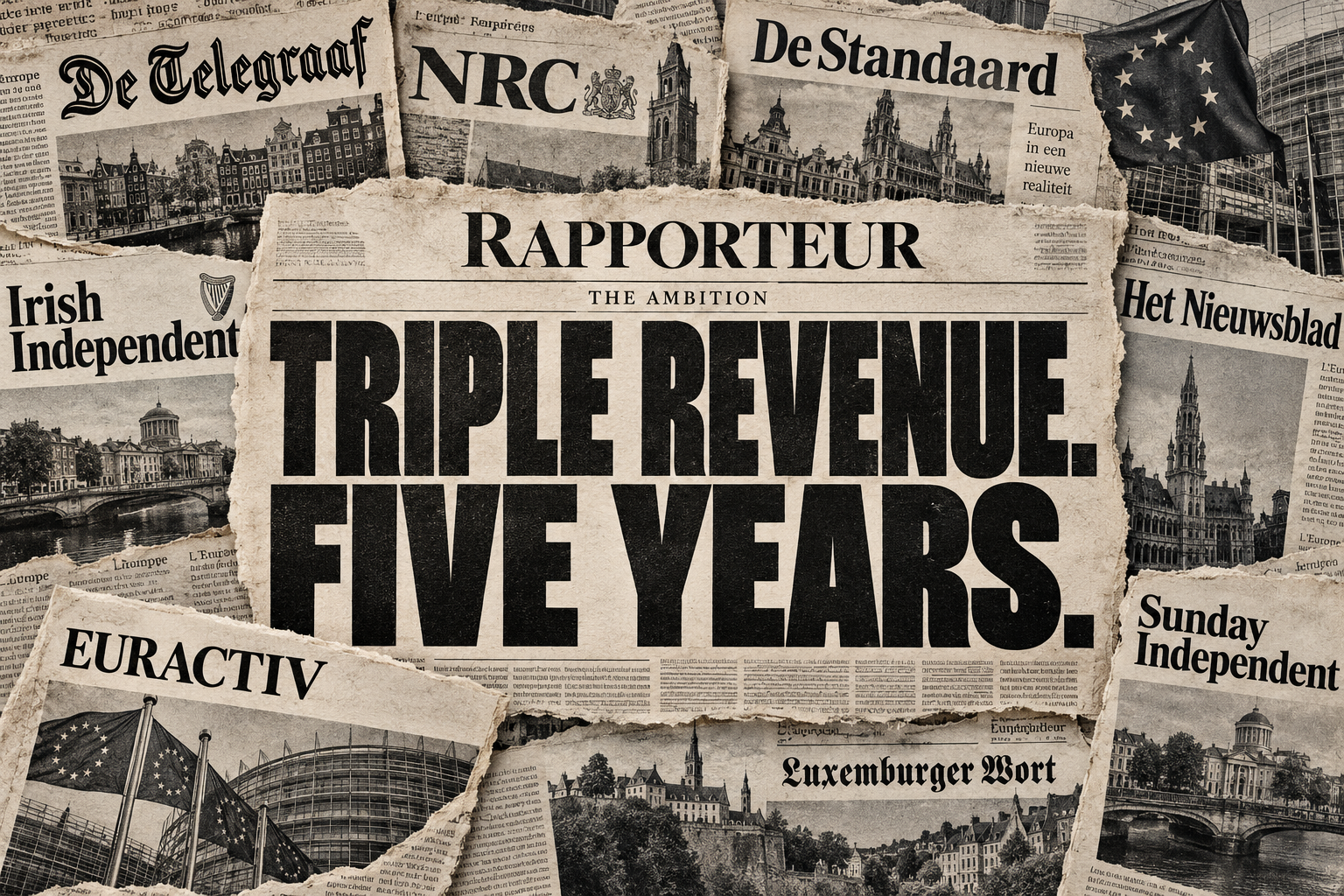
Euractiv’s relaunch as Rapporteur sharpens a European publisher’s ambitions in policy intelligence—and the tension between commercial value and public understanding.
On 29 September 2026, Euractiv became Rapporteur. Acquired by Mediahuis in 2023, the Brussels outlet is positioning itself around specialist reporting and European decision-making. The change highlights a commercial opportunity: serving organisations that need to understand policy before it affects their interests. It also raises a harder question: who will be able to afford that understanding?
Mediahuis already owns major national newspapers across several European markets. Rapporteur tests whether that publishing base can support a different business: journalism embedded in professional decisions.
🟦 Why retire a name with more than 25 years of recognition?
Changing an established name carries a cost: familiarity, search visibility and accumulated trust must survive the transition. Mediahuis is accepting that risk after rebuilding Euractiv’s newsroom, products and business model.
The new name also carries institutional meaning: in the European Parliament, a rapporteur drafts the responsible committee’s report on a dossier. It evokes command of the legislative process—a fitting association for a publication selling expertise in how decisions are made.
Rapporteur’s promise of specialist reporting follows the same commercial logic: become essential to consequential decisions. The test is whether that promise earns enough trust to justify abandoning the old identity.
🟦 What does Mediahuis’s newspaper portfolio actually buy it in Brussels?
Its national newspaper base includes these selected titles:
| Market | National newspaper titles |
|---|---|
| Netherlands | NRC, De Telegraaf |
| Belgium (Dutch-language market) | De Standaard, Het Nieuwsblad |
| Ireland | Irish Independent, Sunday Independent |
| Luxembourg | Luxemburger Wort |
Cooperation between Rapporteur and political desks at NRC, De Standaard and the Irish Independent could create valuable reporting in both directions. Brussels expertise could explain how legislation affects national economies; national reporting could reveal the domestic pressures shaping governments’ positions before negotiations begin.
That would be an advantage to develop, rather than an exclusive capability: rivals also cover national politics. Common ownership makes cooperation possible, but does not establish that it happens. Mediahuis must make those connections productive while preserving each newsroom’s independence.
🟦 Why would organisations pay more for policy journalism?
A change in procurement rules, energy legislation or defence policy can alter investment plans and market access. Reporting that identifies those changes early can therefore command a budget beyond an ordinary newspaper subscription.
At September’s INMA conference, Euractiv’s head of product described specialist subscriptions, company-specific pricing, subscriber briefings and a bundle incorporating AI-assisted summaries of EU documents.
The bundle suggests a broader competitive arena: platforms that help organisations monitor and process regulation. As journalism enters customers’ daily work, reliability, document coverage and traceability become part of the product’s value.
Automation may make policy easier to follow while making summaries easier to replicate. Original reporting and accountable interpretation must justify the premium. Professional relevance can fund deeper coverage, but also creates pressure to prioritise subjects with paying constituencies.
🟦 Can Rapporteur challenge Politico without becoming interchangeable with it?
Semafor describes the rebuilt outlet as a competitor to Politico Europe and reports that Mediahuis has expanded its newsroom to around fifty journalists.
The economic hurdle is substantial. Organisations already buying specialist information need a reason to add another supplier. More articles alone will struggle to justify the expense.
Rapporteur must establish where its reporting changes a reader’s understanding: stronger sources, deeper sector knowledge or better connections between Brussels negotiations and national implementation. Its competitive advantage will depend on information customers cannot readily obtain elsewhere.
🟦 Does European ownership guarantee an independent European perspective?
Mediahuis’s footprint gives Rapporteur a credible base for interpreting Europe through its institutions and national debates. Rapporteur explicitly presents independent journalism as central to its mission.
Yet geographical ownership cannot settle questions of editorial independence. A European publication must be able to scrutinise European institutions, industrial champions and integration policies with equal rigour.
The commercial relationship needs the same discipline. Customers buying policy intelligence may also be trying to influence the policies being covered. Subscription revenue can fund scrutiny; clear editorial boundaries must ensure that scrutiny extends to subscribers themselves.
🟦 What happens when understanding Europe becomes a premium product?
The commercial ambition is explicit. According to its INMA presentation, the business aims to triple annual revenue from roughly €7 million within five years. That is a target, rather than evidence that the model has already succeeded.
Financially sustainable specialist journalism can improve scrutiny of complex decisions. The public-interest tension concerns access: smaller civic organisations, independent researchers and citizens may struggle to buy the same depth of coverage as well-funded professional actors.
A premium model need not close all coverage. The harder question is whether the public layer offers enough depth to support scrutiny. Reporting may become more sophisticated while the capacity to use it becomes more unevenly distributed.
Signal
Rapporteur makes Mediahuis’s European ambition more concrete: build journalism that organisations regard as essential to their decisions. Success will depend on earning that position while retaining the freedom to challenge paying customers—and keeping enough of Europe’s decision-making intelligible to the wider public.
Credit
AI-generated illustration: OpenAI / Altair Media.
Caption
A conceptual newspaper collage connects Mediahuis’s national publishing base with Rapporteur’s ambition to triple revenue within five years—highlighting the growing commercial value of understanding European policy.
