Europe’s Photonics Test
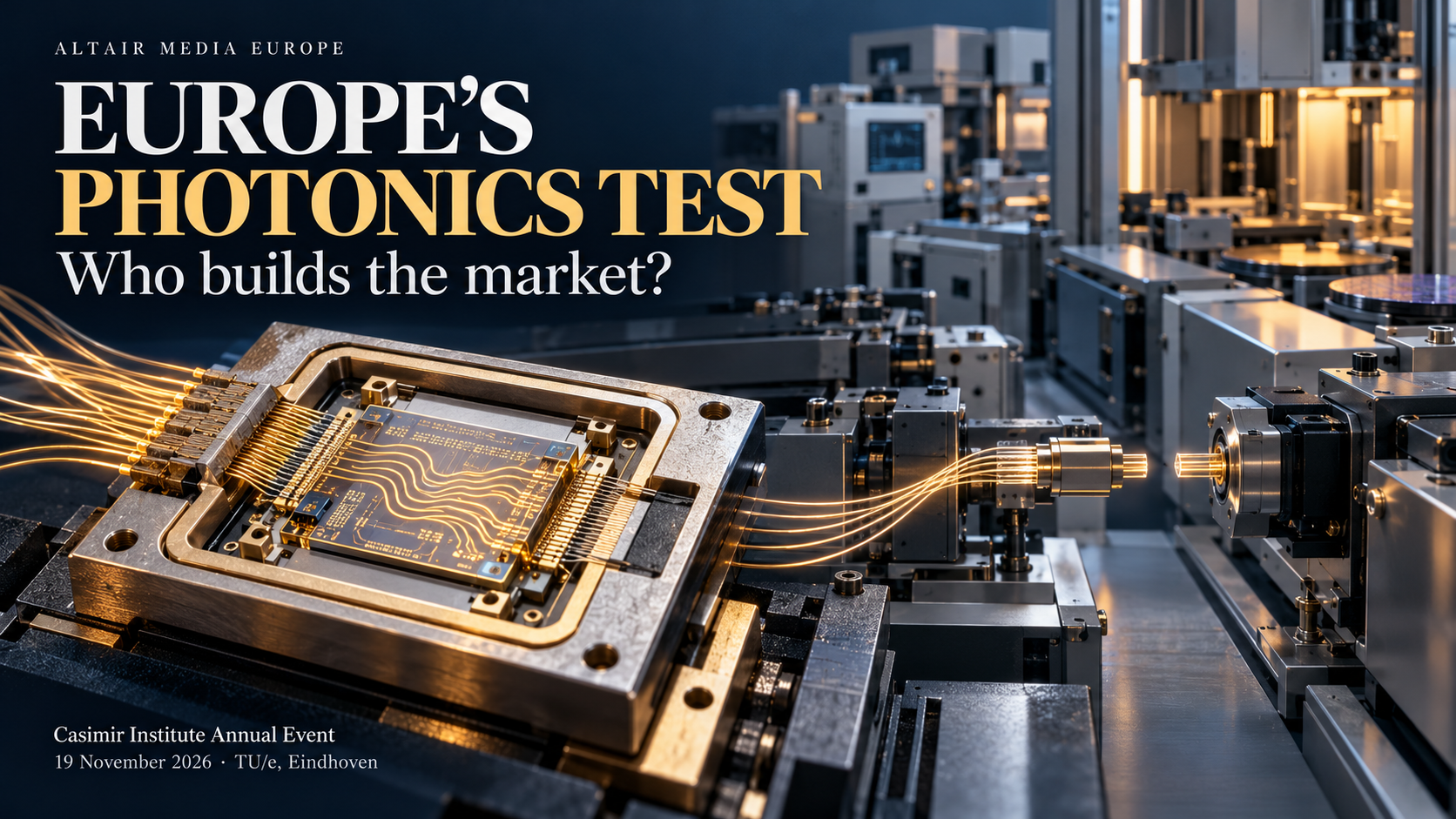
Who turns research, production capacity and industrial demand into a functioning market?
Europe is investing in photonic chips, pilot lines and research networks. The harder test is whether these capabilities become products that customers can buy, integrate and trust. As research and industry prepare to gather in Eindhoven, the question is who can connect European technology to industrial demand—and take responsibility for making the complete system work.
According to its managing director, 58 organisations have registered for the Casimir Institute’s 19 November event. Within this broader semiconductor community, photonics presents a practical industrial question: how do research expertise, production capabilities and customer requirements come together in a commercially dependable supply chain?
🟦 Who is the customer—and what are they actually buying?
A chip designer buying foundry capacity, an equipment manufacturer buying a sensing module and an infrastructure operator buying a complete system represent different markets. Success at one level does not automatically establish demand at the next.
The commercial test is specific: which customer problem justifies the cost and disruption of adopting photonics? Faster data transmission, more precise sensing and lower energy consumption become purchasing arguments only when the benefits survive integration into an operational system.
🟦 Does production capacity create a market?
PIXEurope brings together 20 institutions across 11 countries, with a €400 million budget and an ambition spanning design, fabrication, integration, packaging and testing. It addresses much of the infrastructure required to bring photonic technologies towards industrial production.
The tension is timing. Capacity must be available before customers can confidently commit, while investment becomes harder to justify without credible demand. Announced applications, development partnerships and repeat production orders offer different levels of evidence. Which will underpin the business case?
🟦 Who takes responsibility for the complete system?
A foundry can deliver a chip that meets its specifications while the finished product still misses its performance, reliability or cost targets. The difficulty may sit in packaging, electronic interfaces, software or thermal management.
Someone must translate the customer’s requirements into decisions across that chain—and resolve failures between suppliers. Research coordination and commercial responsibility are different obligations. Who controls the overall design, guarantees delivery and remains accountable when individually functioning components fail to produce a dependable system?
🟦 Could Siemens provide that industrial connection?
Siemens already has a concrete role in photonic design. CEA-Leti has worked with Siemens on photonic design kits. PhotonFirst also announced a partnership with Siemens Cre8Ventures in December 2024, aimed at integrating chip-based sensing technology into Siemens’ PAVE360 Aerospace and Defense Digital Twin Marketplace.
These connections make Siemens a serious party to examine. Their commercial significance depends on its role: supplying design tools, supporting integration, opening customer access or committing procurement. A platform partnership alone does not establish who will purchase the resulting product.
🟦 Who finances the interval between demonstration and repeat orders?
A successful demonstration leaves difficult work ahead: qualification, production consistency, customer testing and the changes required before a product enters regular service.
That creates a negotiation over risk. A small supplier needs a customer commitment to finance further development. The customer wants evidence of reliability and supply continuity before committing. Public funding can support development, but commercial adoption still requires agreement over who pays for qualification, absorbs redesign costs and finances the first production runs.
🟦 Where will Europe capture the value?
Siemens’ photonics activities also extend into its collaboration with TSMC, including design and verification support for TSMC’s COUPE technology. European expertise already participates in international industrial architectures.
That raises a more precise sovereignty question: which decisions, capabilities and customer relationships can European companies retain? Manufacturing capacity matters. So do control over product design, access to customers and influence over the standards that determine which suppliers can participate. Where will European firms have durable bargaining power?
The Signal
Watch for named applications, paying customers, qualified production routes and clear responsibility for delivery. Those commitments reveal how far a European photonics ecosystem has progressed towards a functioning market—and which organisations can turn collective capability into commercial value.
Image credit
AI-generated illustration / Altair Media Europe
Caption
Connecting photonic chips to industrial applications requires coordination across design, production and system integration. Conceptual illustration accompanying Europe’s Photonics Test, ahead of the Casimir Institute Annual Event in Eindhoven on 19 November 2026.
