Europe’s Invisible Infrastructure Reaches the Balkans
How Airbus, Vodafone and Albania are quietly becoming part of Europe’s emerging critical infrastructure architecture
Europe’s technological influence is not only shaped through AI models or semiconductor factories. Increasingly, it emerges through critical infrastructure networks — where telecom, security and operational coordination quietly converge into a new layer of strategic European architecture.
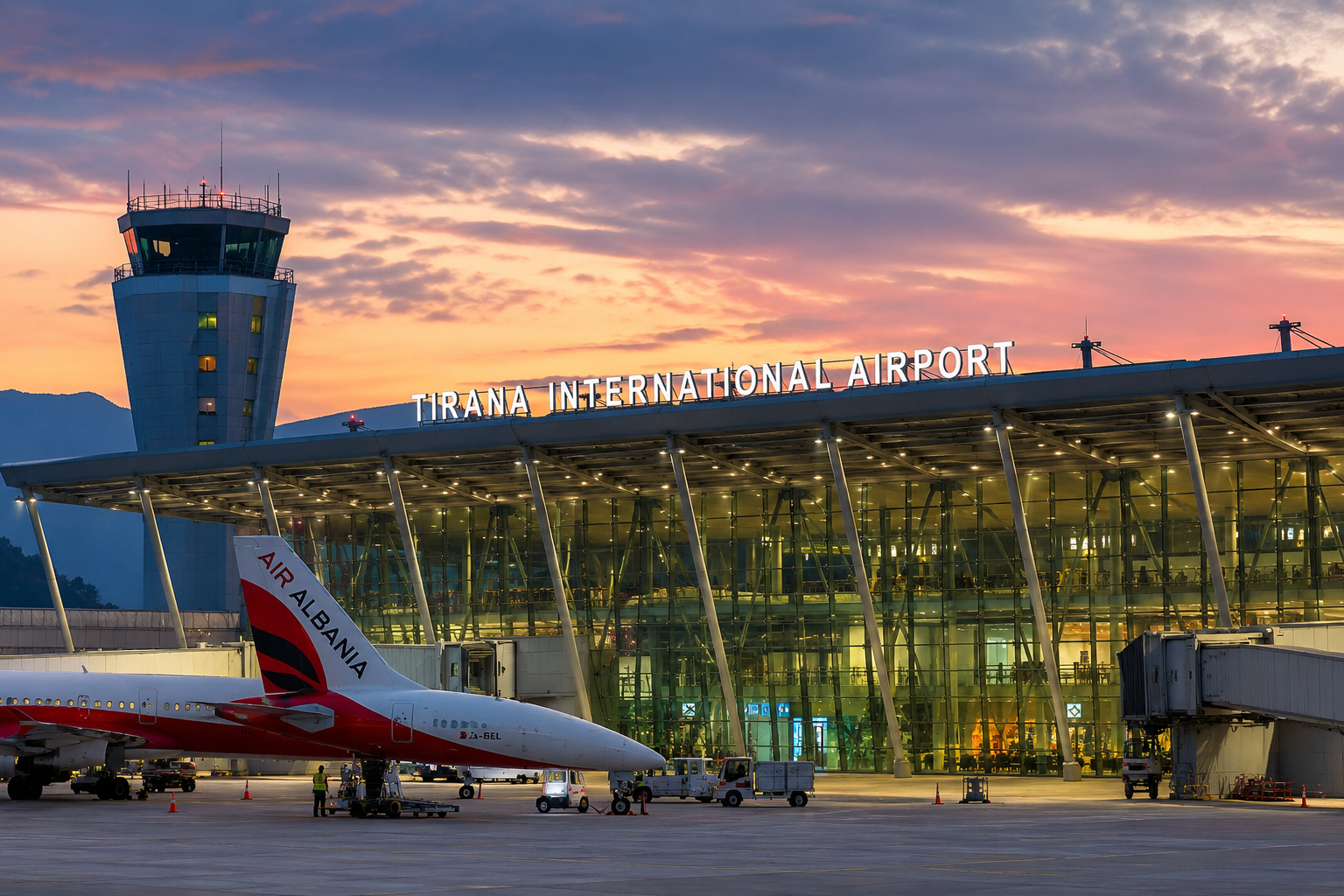
At first glance, Albania rarely appears at the center of discussions about European technological power. The country is more commonly associated with tourism growth, regional development or European integration than with advanced infrastructure systems. Yet a recent deployment at Tirana International Airport reveals something increasingly important about the future of Europe’s digital infrastructure landscape.
In partnership with Vodafone Albania and Airbus, Tirana International Airport has become the first airport in the Western Balkans to implement a mission-critical communications platform powered by Vodafone’s 5G network. The project introduces Airbus’ Agnet MCX platform — a secure push-to-talk and operational coordination system designed for aviation, emergency response and public safety environments.
On the surface, the announcement appears to be a straightforward telecom modernization project. In reality, it reflects a much broader transformation underway across Europe: the gradual convergence of telecom infrastructure, operational security and digital sovereignty.
From Connectivity to Operational Infrastructure
For decades, telecom operators primarily functioned as providers of connectivity. Their role was measured through coverage maps, mobile subscriptions and broadband speeds. Increasingly, however, telecom infrastructure is evolving into something far more strategic.
Modern airports, logistics hubs and emergency systems now depend on real-time operational coordination, resilient communications and secure digital environments. In this context, 5G no longer functions merely as a consumer technology. It becomes part of the operational nervous system underlying critical infrastructure itself.
That shift is particularly visible in the language surrounding the Tirana deployment. Vodafone Albania explicitly described its role not simply as a connectivity provider, but as a builder and integrator of critical infrastructure systems supporting airport security and operational resilience.
The distinction matters.
In practical terms, the new system allows airport security teams, ground operations, emergency responders and operational coordinators to communicate through secure priority voice channels, live data-sharing and real-time coordination during incidents or disruptions. Unlike traditional radio systems, the platform integrates voice, data and operational workflows into a single resilient communications environment.
As societies become increasingly dependent on digital coordination, telecom operators gradually move closer to the center of public infrastructure. Connectivity alone is no longer sufficient. Reliability, redundancy, prioritization and operational continuity become equally important.
“The role of telecom operators is quietly changing. They are no longer merely connecting societies — they are increasingly operating the infrastructure modern societies depend on.”
Kees Hoogervorst, Founder & Editor in Chief, Altair Media Europe
Airbus Beyond Aviation
The Tirana deployment also highlights Airbus’ gradual transformation beyond commercial aviation. While public attention remains focused on aircraft manufacturing, Airbus has steadily expanded into secure communications, public safety systems and critical digital infrastructure.
The Agnet mission-critical platform deployed at Tirana International Airport forms part of that wider transition. Originally rooted in emergency and security communications, these systems increasingly operate across airports, transportation infrastructure, crisis coordination networks and large-scale operational environments.
This places Airbus in a particularly interesting position within Europe’s technological ecosystem. The company now operates simultaneously across aerospace, defence, telecommunications and digital infrastructure — sectors that are becoming increasingly interconnected as geopolitical competition intensifies. In many ways, this reflects a wider European trend: infrastructure itself is becoming strategic again.
Why Smaller European States Matter
What makes the Albanian case especially interesting is its geographical and political context.
Large European economies often dominate debates surrounding technological sovereignty and infrastructure strategy. Yet some of the most revealing transformations are increasingly taking place at Europe’s edges — in smaller states where infrastructure modernization, economic development and geopolitical positioning intersect more visibly.
The Western Balkans occupy precisely such a space.
For Albania, projects like this are not only about airport modernization. They also signal deeper integration into European technological and operational systems. Critical communications infrastructure creates long-term dependencies, standards alignment and operational interoperability that extend far beyond individual technology deployments.
Many of these deployments increasingly align smaller European states with wider EU operational standards surrounding digital resilience, telecom security and critical infrastructure interoperability.
In that sense, infrastructure increasingly functions as a form of geopolitical integration.
Europe’s infrastructural expansion often becomes most visible not in Brussels or Paris, but in airports, logistics corridors and digital systems quietly embedded into everyday operations across peripheral regions.
“Critical infrastructure is becoming one of Europe’s most important forms of influence — not through spectacle, but through operational dependency.”
Kees Hoogervorst, Founder & Editor in Chief, Altair Media Europe
5G as Critical Infrastructure
The Tirana deployment also highlights a broader misconception surrounding 5G itself.
Public discussion around 5G frequently centers on faster smartphones, streaming speeds or consumer applications. Yet the long-term strategic value of 5G may lie somewhere else entirely: in the infrastructure layers built on top of it.
Airports, industrial systems, logistics networks, autonomous operations, emergency coordination and public safety increasingly require ultra-reliable low-latency communications capable of supporting real-time operational environments.
In such systems, communications failure is not an inconvenience. It becomes a security risk.
This is precisely why mission-critical communications are becoming strategically important across Europe. Governments and infrastructure operators are gradually recognizing that digital resilience depends not only on cybersecurity, but also on secure operational coordination during crises, disruptions or emergencies.
The result is a new infrastructure logic where telecom, security and governance increasingly overlap.
Europe’s Quiet Infrastructure Strategy
Much of today’s global technology debate revolves around AI competition, semiconductor supply chains and hyperscale computing infrastructure. Those developments are undeniably important. Yet Europe may be building influence through a quieter and less visible layer altogether.
Through companies such as Airbus, Vodafone, Nokia and Ericsson, Europe continues to possess deep capabilities in operational infrastructure, telecommunications and secure systems integration. These sectors rarely generate the same public excitement as consumer AI platforms, yet remain essential to the functioning of modern societies.
The deployment in Tirana illustrates this dynamic particularly well. A relatively small Balkan country becomes part of a wider European infrastructure ecosystem through telecom networks, operational standards and mission-critical coordination systems.
Infrastructure rarely attracts attention when it functions properly. Yet increasingly, Europe’s technological influence may depend precisely on these invisible systems societies cannot operate without.
Credit
Illustration generated by AI for Altair Media Europe
Caption
Tirana International Airport has become the first airport in the Western Balkans to implement Airbus’ mission-critical communications platform over Vodafone Albania’s 5G network — highlighting how telecom, security and critical infrastructure are increasingly converging into a new European operational architecture.
