EU Inc.: Can Europe Become One Market for Entrepreneurs?
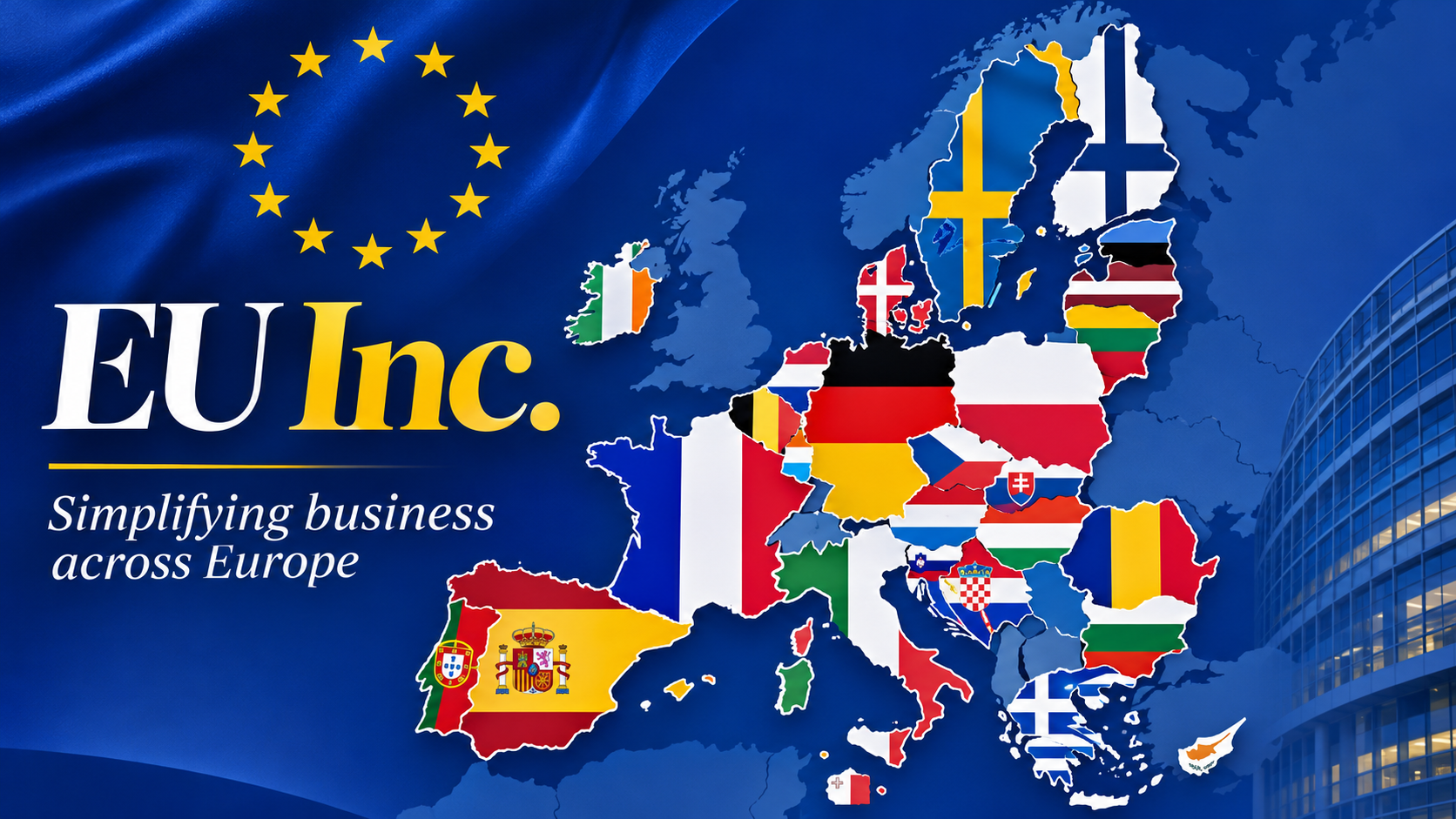
Removing the legal barriers to building and growing businesses across Europe.
One market, 27 legal systems
Europe has a single market of around 450 million consumers, yet starting and expanding a business across its borders remains surprisingly complicated. Entrepreneurs must navigate 27 national corporate legal systems and more than 60 different company forms, often involving different procedures, administrative requirements and costs.
This fragmentation has become part of the broader debate about European competitiveness. Reports by Enrico Letta and Mario Draghi have highlighted structural barriers that make it harder for European businesses to expand internationally, attract investment and compete with larger companies elsewhere.
The European Commission now wants to address part of this problem through EU Inc., a proposed common corporate framework introduced on 18 March 2026. On 23 October, the Council of the European Union adopted its negotiating position, moving the initiative further through the legislative process.
The objective is to make establishing, financing and growing a company across Europe considerably easier.
What is the 28th regime?
EU Inc. would introduce an optional European limited liability company framework alongside existing national structures such as the Dutch BV, German GmbH and French SARL. Businesses could choose the European framework without national company forms being abolished.
This explains the term 28th regime: an additional set of corporate rules available across all 27 EU member states.
Europe has attempted to establish a common company structure before. The Societas Europaea (SE), operational since 2004, was designed primarily for larger businesses and requires at least €120,000 in subscribed capital. EU Inc. takes a different approach, making a harmonised framework accessible to a much wider group of entrepreneurs.
Under the Commission’s proposal, entrepreneurs could register a company entirely online within 48 hours, at a maximum registration cost of €100 and without a minimum share capital requirement. The framework would also simplify digital share transfers, capital increases and administrative procedures throughout a company’s life cycle.
Another important element concerns employee stock options. A proposed common scheme, including deferred taxation, could help growing companies attract skilled employees without immediately paying the salaries offered by larger competitors.
Simplified liquidation and digital insolvency procedures would make closing a business less cumbersome.
These changes could prove particularly valuable for startups and scaleups seeking international investment. A more standardised corporate structure would make ownership arrangements and financing procedures easier for investors to understand.
However, EU Inc. would not be restricted to new technology companies. Existing businesses could also consider adopting the framework, including through conversion procedures.
Where harmonisation stops
Despite its ambitions, EU Inc. would not create a completely unified European business environment.
Corporate taxation would remain largely national, as would employment law, social security and many sector-specific regulations. A business operating in several member states would therefore still face different legal obligations, even with a harmonised corporate structure.
Employee participation has become one of the most contested aspects of the proposal.
The European Trade Union Confederation (ETUC) has warned that companies might establish their registered offices in countries with less demanding employee participation requirements while conducting substantial operations elsewhere. Such forum shopping could potentially undermine existing protections.
The Commission maintains that national employment and social legislation would continue to apply. The Council’s October position includes an optional mechanism allowing member states to address certain cross-border situations involving employee participation thresholds.
The disagreement illustrates the challenge facing European lawmakers: simplifying corporate rules while preserving effective national protections.
A common European company structure may reduce legal fragmentation, but it also raises questions about which national rules should apply when businesses operate across borders.
The road to implementation
EU Inc. remains a legislative proposal rather than an operational company form.
The Council’s negotiating position, adopted on 23 October 2026, supports the central objectives while proposing adjustments to registration procedures, employee stock options and safeguards against financial crime and other forms of abuse.
The European Parliament must establish its own position before negotiations on the final legislative text can proceed.
The Council also proposes giving member states 21 months to implement the regulation once it has been adopted. The Commission originally called for a political agreement before the end of 2026, although the timetable remains uncertain.
For entrepreneurs, the practical benefits are therefore not yet available. The final legislation will determine exactly how the framework operates and how it interacts with national corporate systems.
Can a legal form fix Europe’s competitiveness problem?
EU Inc. addresses an issue that receives considerably less attention than industrial subsidies, innovation programmes or technological sovereignty.
Europe invests heavily in research and technological development, but turning promising innovations into internationally competitive businesses remains difficult. Differences in corporate law add another layer of complexity, particularly for companies seeking investors and expanding across borders.
A common European framework could reduce some of these obstacles. Yet legal harmonisation alone cannot create deeper capital markets, attract venture capital or overcome shortages of skilled workers and industrial infrastructure.
There is also the question of adoption. National company forms are familiar to entrepreneurs, investors, banks and legal advisers. EU Inc. will need to offer meaningful practical advantages if businesses are to choose it over structures they already understand.
Its success may ultimately depend less on whether a company can be registered within 48 hours than on whether the new framework makes financing and international expansion genuinely easier.
The European Union has spent decades creating a single market for goods, services, capital and people. EU Inc. represents another attempt to bring the legal infrastructure of European business closer to that ambition.
The decisive test will not be whether Europe can create a new company form, but whether entrepreneurs find it useful enough to choose.
Image credit
Illustration: Altair Media / AI-generated
Image caption
EU Inc. aims to simplify doing business across Europe through a common corporate framework, while preserving existing national company structures.
