ASML Sells Nothing in Europe. But Europe Is Not Short of Customers.
Europe has the demand. What it lacks is a semiconductor market that behaves as one
SIGNAL | Five days ago, Altair Media argued that European semiconductor policy has a blind spot. Europe spends heavily on fabs, research and production capacity, but pays far less attention to the industrial demand that ultimately determines whether those investments become commercially viable.
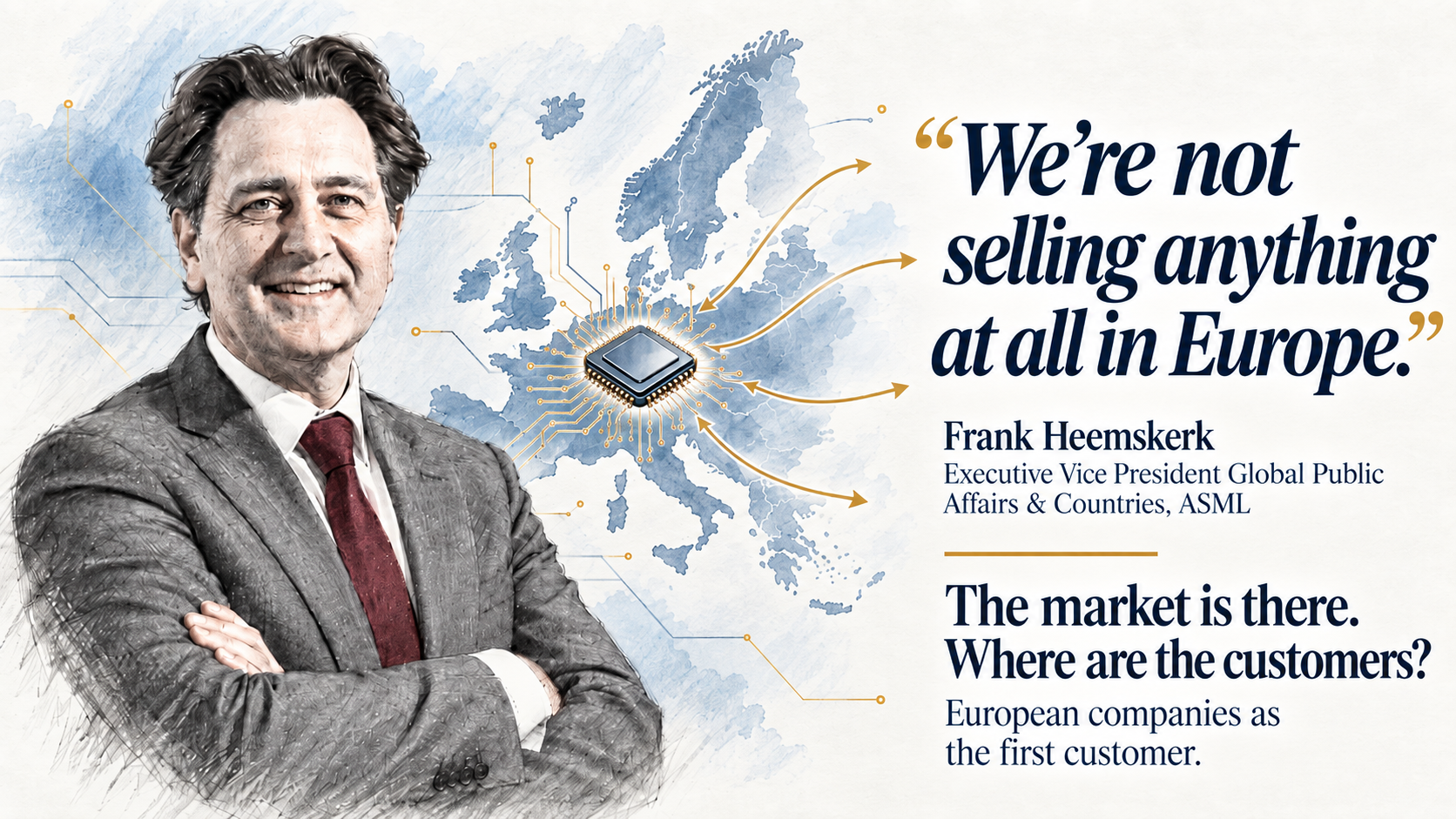
This week, ASML turned that abstract problem into a remarkably concrete one. Speaking in Amsterdam, Frank Heemskerk, Executive Vice President Global Public Affairs & Countries at ASML, described the situation in unusually blunt terms:
“We’re not selling anything at all in Europe.”
That is the paradox. Europe is home to ASML — and to some of the world’s largest automotive, industrial, telecom and aerospace companies. The demand for chips is clearly there.
So why does so little of it translate into semiconductor investment at home?
🟦 Why does Europe’s semiconductor equipment champion have almost no domestic market?
Because ASML sits near the end of the industrial chain. It does not need Siemens, BMW or Airbus to buy lithography machines. It needs semiconductor manufacturers to have a commercial reason to install substantial production capacity in Europe. That reason starts with customers.
A new fab requires billions in capital and confidence that sufficient demand will still exist once production begins. Subsidies can reduce investment risk. They cannot replace predictable volume.
If European industrial demand remains fragmented across thousands of separate procurement decisions, chipmakers see individual customers. They do not necessarily see a European market.
🟦 Where is Europe’s semiconductor demand hiding?
Almost everywhere. Siemens, Bosch, ABB and Schneider Electric depend increasingly on processors, sensors, power electronics and edge computing.
BMW, Mercedes-Benz, Volkswagen and Stellantis are rebuilding vehicle architectures around software, centralised computing and high-voltage power electronics.
Ericsson and Nokia depend on specialised silicon and optical technologies. Airbus, Thales and Leonardo require secure processing, sensing and RF technologies.
Europe therefore does not lack sophisticated semiconductor customers. What it lacks is sufficient coordination between them.
Each industry develops its own roadmap. Each company negotiates its own supply relationships. Each purchasing department optimises its own risks, prices and timelines.
Individually, those decisions are rational. Collectively, they can leave European semiconductor demand invisible.
🟦 Did Brussels create this problem — or did European companies?
Michiel Scheffer adds another layer to the discussion.The President of the European Innovation Council Board points to industrial choices stretching back to the 1990s: first at Philips, Siemens and Bull, and later at companies including NXP, Infineon and STMicroelectronics.
Europe’s current semiconductor position therefore cannot be explained by public policy alone. Governments invested heavily in semiconductor research and industry. Companies simultaneously decided where to invest, where to specialise and which segments of the global market they were prepared to leave.
Many European players concentrated on automotive, industrial, power and specialised semiconductors while the centre of gravity for leading-edge high-volume manufacturing shifted elsewhere.
Scheffer’s conclusion is therefore significant. Europe may not need to recreate the Asian foundry model. It may need to build stronger positions where European capabilities and future industrial demand already intersect: photonics, quantum technologies, lasers and advanced manufacturing systems.
🟦 Why haven’t fab subsidies solved the problem?
Because production capacity and market demand are not the same thing. A subsidised fab in Europe does not automatically cause European automotive, industrial or telecom companies to buy its chips.
Subsidies can reduce capital costs, accelerate construction and lower investment risk. But they cannot create customers. A semiconductor manufacturer still needs volume and visibility.
If major European industries continue making sourcing decisions independently through established global supply chains, European manufacturing capacity still has to compete for those orders after the factory has been built.
The missing piece is therefore not only production. It is demand organisation.
🟦 What is the missing link between European industry and European silicon?
Coordination. Not central planning. Not mandatory European sourcing. And not another layer of semiconductor bureaucracy.
The missing mechanism is a way to connect long-term European industrial demand to European technology development and manufacturing investment.
Automotive companies could identify semiconductor requirements that are converging across platforms. Industrial groups could connect future edge-computing architectures more closely to European designers. Telecom companies could link network roadmaps to European silicon, photonics and packaging capabilities. AI infrastructure could create anchor demand for processors, optical interconnects and advanced packaging.
Taken together, those separate demand signals could begin to form an industrial mechanism:
European industrial demand → technology roadmaps → predictable volume → chip design → manufacturing investment → semiconductor equipment.
ASML sits near the end of that chain. The customer sits at the beginning.
The European Commission can fund research. The EIC can help breakthrough companies scale. The EIB can provide capital. The Chips Act can improve investment conditions. But none of them can substitute for industrial customers willing to commit to technologies, volumes and markets.
Europe’s semiconductor companies should certainly continue talking to Brussels.
Europe’s industrial companies may need to spend considerably more time talking to each other.
Signal
ASML selling no new chipmaking machines in Europe is not evidence that Europe has no semiconductor demand. It reveals something more fundamental.
The demand already exists across automotive, industrial automation, telecom, aerospace, energy and healthcare. But it remains distributed across companies that largely behave as separate customers. That fragmentation matters because fabs are not built around abstract demand. They are built around expected volume.
Europe’s next semiconductor strategy therefore cannot begin and end with another factory announcement or subsidy package. It must connect the customer to the designer, the designer to the manufacturer, and the manufacturer to Europe’s equipment and technology base.
Europe is not short of customers. It is short of an industrial market that behaves as one.
Credit: Altair Media / AI-assisted editorial illustration
Caption: Frank Heemskerk of ASML says the company is currently selling no chipmaking machines in Europe. The paradox points to a deeper problem: Europe has industrial demand, but has yet to organise it into a semiconductor market that behaves as one.
