Europe’s Energy Champions
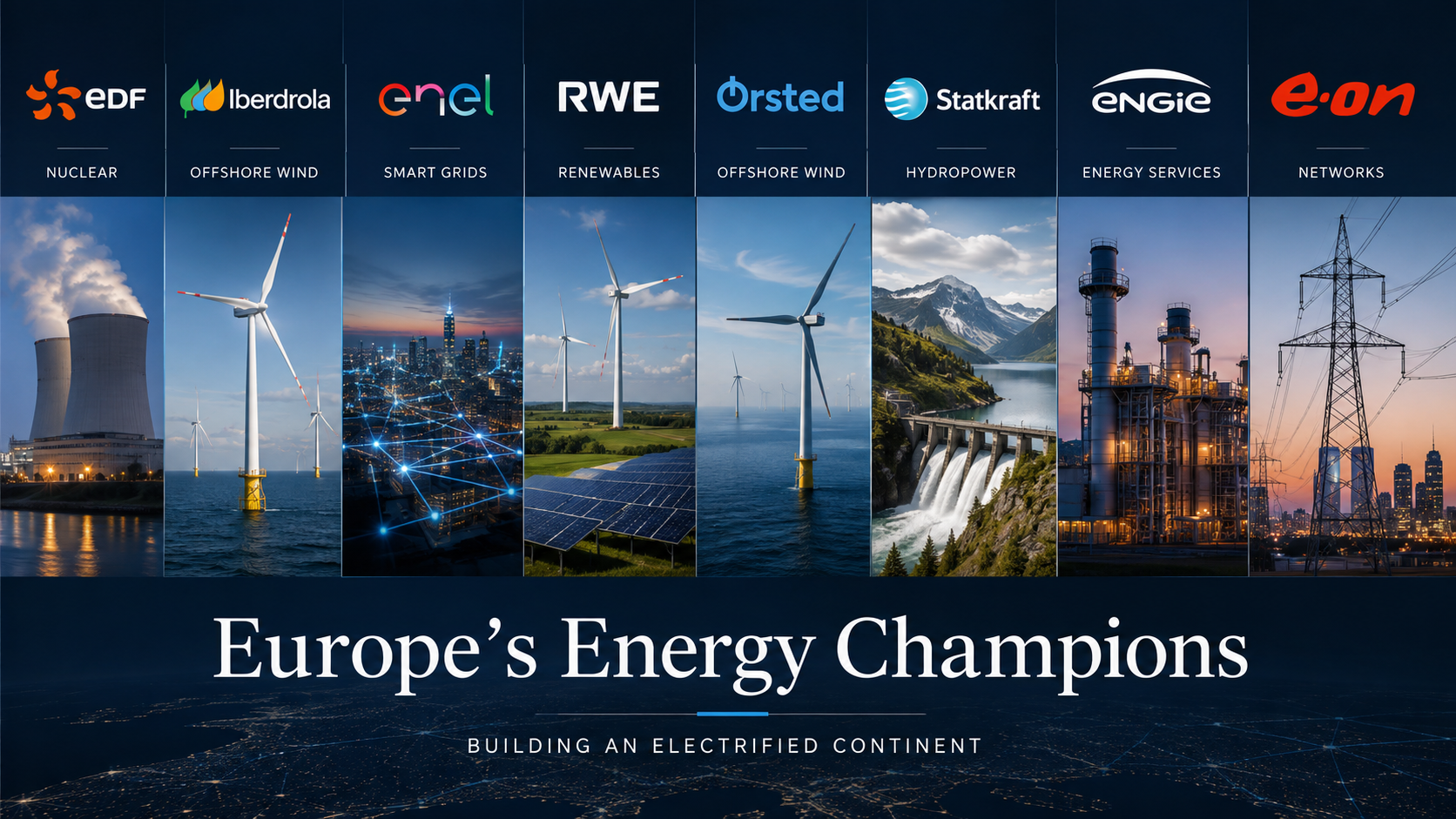
How Europe’s leading utilities are building an increasingly electrified continent
Strategic Briefing II
Europe’s transition towards an electro-powered continent will not be delivered by governments alone. Nor will it be driven solely by technological innovation.
Behind Europe’s electrification stands a relatively small group of energy companies whose investment decisions increasingly shape the continent’s economic future. Together they are committing hundreds of billions of euros to electricity networks, renewable generation, offshore infrastructure, nuclear power, digitalisation and system flexibility. Their role extends far beyond producing electricity. Increasingly, they determine how electricity is transported, balanced, stored and integrated into Europe’s wider industrial economy.
Europe’s energy transition will be shaped not only by new technologies, but by the organisations capable of building and operating them.
Companies such as EDF, Iberdrola, Enel, RWE, E.ON, Engie, Statkraft and Ørsted are therefore becoming much more than utilities. They are emerging as builders of Europe’s electro-powered continent.
From Utilities to System Builders
For much of the twentieth century, electricity companies fulfilled a relatively straightforward role. They generated electricity, transported it through national networks and supplied homes and industries. The system itself was largely predictable and so too were the organisations operating it. That reality is changing rapidly.
Electricity no longer flows in a single direction from large power stations towards passive consumers. Millions of households now generate electricity through rooftop solar panels. Electric vehicles charge according to price signals. Batteries store electricity for later use, while industrial consumers increasingly provide flexibility to the wider network.
The utility of the future will no longer simply deliver electricity. It will coordinate an increasingly intelligent energy system.
Managing this environment requires a fundamentally different type of organisation. Europe’s leading utilities are no longer simply operating infrastructure. They are redesigning the system itself.
Different Companies, One Continental Transition
Although these companies operate within the same European market, their strategies reflect very different national histories and geographical realities.
EDF continues to anchor France’s electricity system through nuclear power while expanding renewable generation. Iberdrola has become one of Europe’s largest investors in offshore wind and electricity networks. Enel increasingly focuses on digital electricity systems, smart grids and distributed energy management, while RWE is rapidly transforming from a conventional power producer into one of Europe’s largest renewable investors.
Other companies contribute different capabilities. Ørsted has helped establish offshore wind as a strategic European industry. Statkraft builds upon Norway’s hydropower expertise to provide flexibility across European markets. Engie and E.ON increasingly concentrate on energy services, customer solutions and the digital coordination required by an increasingly decentralised electricity system.
Not every company builds the same part of Europe’s energy future. Some primarily invest in generation. Others strengthen electricity networks or develop digital services. Together, however, they are constructing different layers of the same continental architecture.
Investment Becomes Strategy
Perhaps the defining characteristic of Europe’s energy champions is no longer the electricity they produce. It is the infrastructure they finance.
In the age of electrification, capital is no longer simply financing infrastructure. It is determining how quickly Europe can build it.
Electrification requires transmission corridors, stronger distribution networks, offshore connections, digital control systems, storage capacity and new industrial energy infrastructure. These investments demand planning horizons measured not in quarters, but in decades.
At the same time, these companies operate within a uniquely European reality. Their investments increasingly support a continental electricity system, yet permitting procedures, regulation and political priorities remain largely organised at national level. The result is a continuous balancing act between European system integration and national decision-making.
Capital allocation has therefore become a strategic capability in its own right.
Beyond Electricity
Perhaps the greatest misconception surrounding Europe’s energy transition is that it is primarily about producing more electricity. Generation remains essential. But generation alone no longer guarantees resilience.
Electricity must be transported efficiently across borders, balanced in real time, stored when supply exceeds demand and coordinated through increasingly intelligent digital systems. Software, forecasting and automated market platforms are becoming as important to system performance as substations, transformers and transmission lines.
Electricity is gradually evolving from a commodity into a coordinated service. That transformation fundamentally changes the role of Europe’s utilities.
Europe’s New Energy Champions
Europe’s leading electricity companies are no longer simply competing within energy markets. Increasingly, they are helping to shape those markets.
Europe’s energy champions are no longer defined by the electricity they produce, but by the infrastructure they make possible.
Their investment decisions influence where new industries emerge, where electricity infrastructure expands and how rapidly Europe can reduce its dependence on imported fossil fuels. They increasingly operate at the intersection of industrial policy, infrastructure investment and technological innovation.
Electrification therefore depends not only upon political ambition or scientific breakthroughs. It also depends upon organisations capable of translating long-term strategy into functioning infrastructure.
Strategic Outlook
Europe’s energy transition is often explained through technologies. Solar panels. Wind turbines. Hydrogen. Batteries. Artificial intelligence. Each is important. Yet none of these technologies builds itself.
Behind every offshore wind farm, every electricity network and every digital balancing platform stands an organisation capable of financing, constructing and operating complex infrastructure over decades.
Europe’s leading utilities are therefore becoming much more than energy companies.
They are becoming strategic builders of Europe’s electro-powered continent.
Strategic Takeaways
- Europe’s leading utilities are evolving from electricity suppliers into long-term infrastructure builders.
- Different business models increasingly contribute to one interconnected European energy architecture.
- Investment capability has become as strategically important as electricity generation.
- Digital coordination now complements physical infrastructure as a core utility function.
- Europe’s energy transition depends as much upon organisational capacity as technological innovation.
Building Europe’s Electro-Powered Continent is an ongoing Strategic Briefings series within the Innovation & Technology Lab, examining how Europe’s diverse energy landscape, industrial capabilities, infrastructure and innovation ecosystem are converging into the foundations of an increasingly electrified continent.
Credit
Altair Media / OpenAI Image Generation
Caption
Europe’s leading energy companies are playing an increasingly strategic role in the continent’s transition towards an electro-powered future. Through investments in electricity networks, renewable generation, offshore wind, digital energy systems and industrial infrastructure, they are helping to build the foundations of Europe’s emerging energy architecture.
