Iceland and the Advantage of Self-Reliance
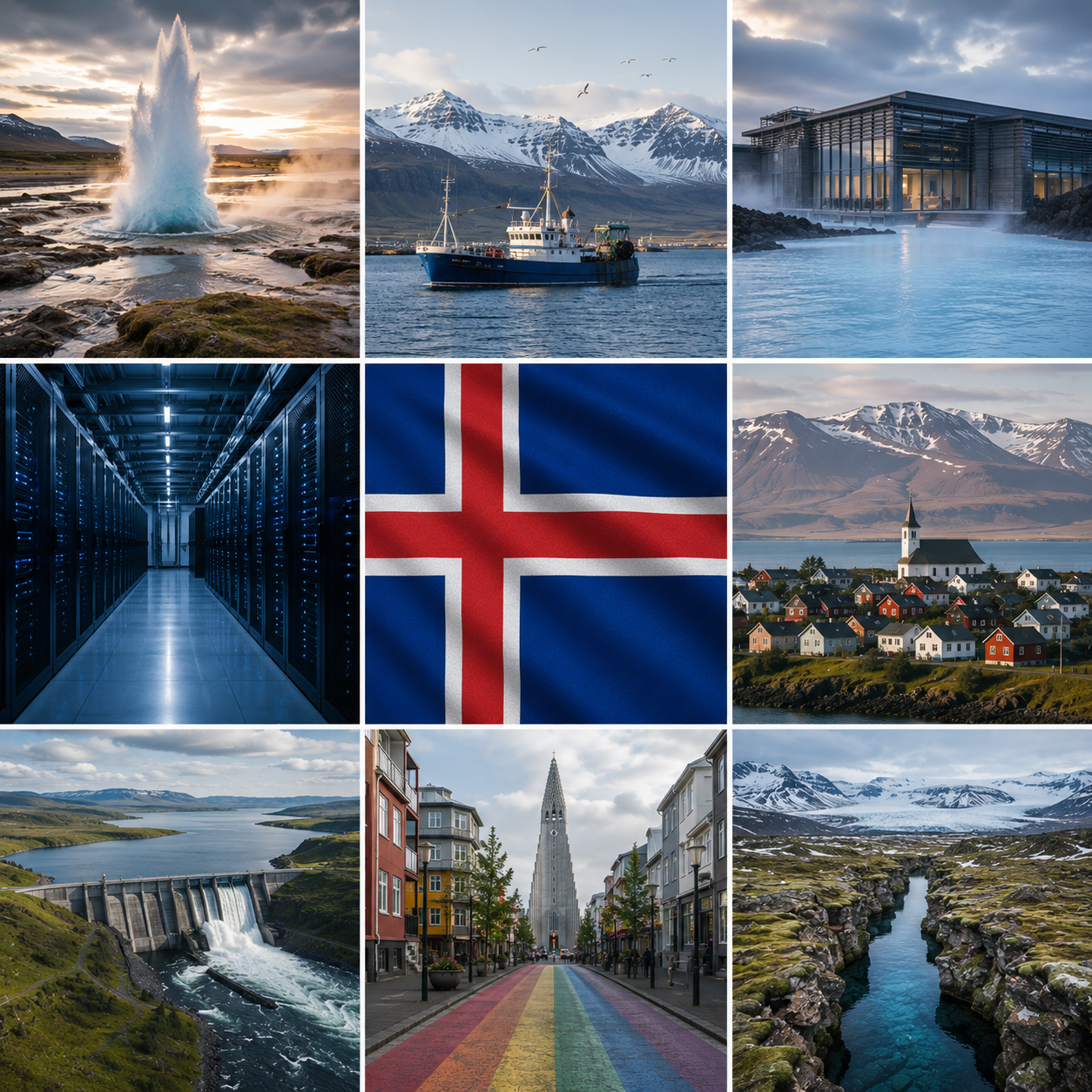
How Can a Small Society Remain Resilient in a Connected World?
Iceland is often overlooked in discussions about Europe’s economic future. Its population is small. Its domestic market is limited. Its distance from continental Europe creates structural constraints. Yet Iceland has repeatedly demonstrated that scale alone does not determine resilience.
The country’s significance lies elsewhere. Iceland functions as a laboratory. A society where geography, energy and small-scale governance have combined to produce distinctive forms of adaptability and self-reliance.
The Icelandic story is therefore not primarily about size. It is about autonomy.
Geography and Isolation
Geography has shaped Iceland more profoundly than perhaps any other Nordic country. Volcanic activity. Harsh weather. Long distances. Dependence upon maritime connections.
For centuries, Iceland developed under conditions that demanded self-sufficiency. Communities learned to adapt to limited resources, environmental uncertainty and geographic isolation. This historical experience continues to influence contemporary economic choices.
Iceland demonstrates that resilience can emerge not despite isolation, but because of it.
Self-reliance is not simply an economic strategy. It has become part of Iceland’s political culture.
Energy Independence
Few countries possess energy resources comparable to Iceland. Geothermal energy and hydropower supply the overwhelming majority of domestic electricity demand. This abundance of renewable energy has given Iceland an unusual advantage. Energy security is largely a domestic capability.
Dependence upon imported fossil fuels remains relatively limited compared with many European economies. What began as a response to geography gradually evolved into a strategic asset.
For Iceland, energy independence is not an ambition. It is an existing reality.
Today, Iceland illustrates how local energy resources can underpin national resilience.
Fisheries and Resource Management
Fishing has long formed the backbone of Iceland’s economy. Yet Iceland’s fisheries sector offers lessons that extend beyond maritime industries alone.
Rather than focusing exclusively on extraction, Iceland increasingly emphasises long-term resource management, technological innovation and sustainability.
The country has become an example of how natural resources can be governed in ways that support long-term prosperity. In many respects, Iceland approaches fisheries in the same manner that Norway approaches sovereign wealth. As a resource to be preserved rather than merely consumed.
A New Geography for Data
Iceland’s abundant renewable electricity and cool climate have attracted growing interest from data centre operators. As artificial intelligence expands, access to stable and affordable electricity is becoming increasingly important.
Countries capable of providing reliable low-carbon energy may acquire new strategic significance. Iceland therefore occupies an intriguing position. It lacks scale. But it possesses resources increasingly valued in the digital economy. Energy. Cooling capacity. Political stability. Renewable power.
Iceland exports relatively little electricity through cables. Instead, it increasingly exports energy indirectly. Aluminium production transformed renewable electricity into industrial output.
The future value of Iceland may lie not only beneath the ground, but in the energy that powers the digital economy.
Data centres may increasingly transform renewable electricity into computation. In an economy shaped by artificial intelligence, compute itself may become a tradable resource.
Small Scale as an Advantage
Small societies often face constraints. But they may also possess advantages. Decision-making can be faster. Institutions can remain relatively agile. Policies can be adjusted more quickly. Experiments can be implemented with fewer barriers.
Small scale can also accelerate learning. Feedback loops are shorter. Institutions remain closer to citizens. Decision-makers often operate within highly interconnected networks. Under these conditions, societies can test, adapt and revise policies more rapidly than larger systems.
Iceland therefore functions not only as a country. It increasingly resembles a societal sandbox. Whether responding to financial crises, investing in renewable energy or adapting to changing economic conditions, the country often behaves as a laboratory for policy innovation.
In Iceland, small scale is not merely a constraint. It is an accelerator of experimentation.
Scale can limit resources. But it can also increase flexibility.
Prosperity and Pressure
Iceland’s model is not without vulnerabilities. Its economy remains relatively concentrated. Tourism has become increasingly important. Small economies can also become vulnerable more quickly.
External shocks often reverberate throughout the entire system. Financial crises, volcanic eruptions or disruptions in tourism can have disproportionate effects on employment, infrastructure and public finances. Self-reliance in Iceland is therefore not an ideological choice. It is a practical necessity.
Climate change is reshaping Arctic dynamics. Geopolitical competition in the North Atlantic is intensifying. At the same time, maintaining self-reliance in a highly interconnected world requires continuous adaptation.
Iceland demonstrates that resilience is not about avoiding exposure. It is about remaining capable despite exposure.
The challenge for Iceland is therefore not preserving isolation. It is preserving autonomy while remaining connected.
Looking Ahead
Iceland occupies a unique position within Northern Europe. It combines renewable energy abundance, resource management, institutional flexibility and social cohesion in ways rarely found elsewhere.
As societies search for new models of resilience, Iceland offers an important lesson. Small scale does not necessarily imply vulnerability. Under the right conditions, it can become an advantage.
The Icelandic experience suggests that resilience is not simply the capacity to withstand shocks. It is also the capacity to learn from them.
Iceland demonstrates that self-reliance is not the rejection of globalisation. It is the ability to participate in it on your own terms.
The central question facing Iceland therefore remains:
How can a small society remain resilient in a connected world?
For much of its modern history, Iceland’s answer has been remarkably clear. By transforming constraints into capabilities.
Iceland — The Advantage of Self-Reliance
Series — Economic Europe: Northern Europe
This article is part of Economic Europe, a United Europe series exploring the economic architectures that shape modern Europe. The Northern Europe chapter examines how Denmark, Sweden, Norway, Finland and Iceland have built distinctive models of resilience through trust, innovation, institutional capacity and long-term adaptation.
Credit
Illustration generated by OpenAI’s DALL·E for Altair Media Europe
Caption
Iceland demonstrates how a small society can transform geographic constraints into strategic advantages. Through geothermal energy, sustainable fisheries, renewable electricity and emerging digital infrastructure, the country offers a distinctive model of resilience built upon self-reliance, adaptability and long-term stewardship.
