Brainport Eindhoven — Europe’s Deep Tech Engine
Why Europe’s Next Telecom Infrastructure Begins Long Before the Network
Telecommunications are often associated with mobile towers, fibre-optic networks and wireless standards. Yet every communications network begins much earlier. Before data can travel, the technologies that make transmission possible must first be invented, engineered and manufactured. Few European regions illustrate this better than Brainport Eindhoven.
Over the past decades, the Eindhoven region has evolved into one of Europe’s most concentrated deep-tech ecosystems. Rather than specialising in a single industry, Brainport brings together semiconductors, integrated photonics, advanced manufacturing, precision engineering and systems integration. Together, these capabilities increasingly underpin not only telecommunications, but also artificial intelligence, quantum technologies and Europe’s wider digital infrastructure.
Telecommunications no longer begin with antennas. They begin with the technologies that make communication physically possible.
The Infrastructure Behind Infrastructure
Modern telecommunications are becoming increasingly dependent on technologies that remain largely invisible to end users. Every advance in connectivity relies on breakthroughs in materials science, chip design, manufacturing equipment, optical communications and energy-efficient computing.
Telecom networks therefore do not begin with operators. They begin inside deep industrial ecosystems capable of continuously producing enabling technologies.
Brainport demonstrates this relationship particularly well. It is less a telecommunications cluster than a technological foundation supporting multiple strategic industries simultaneously.
Semiconductors as the Foundation
Every communications network ultimately depends upon semiconductor technology. Processors manage network traffic. Radio-frequency chips enable wireless communication. Sensors collect environmental information. Power electronics improve energy efficiency. Without continuous advances in semiconductor manufacturing, progress in telecommunications would inevitably slow.
Brainport concentrates many of Europe’s leading capabilities in this field. Rather than producing consumer electronics, companies across the region develop the equipment, components and production technologies upon which the global electronics industry depends.
Innovation here is rarely visible to consumers, yet it quietly shapes virtually every digital system built upon it.
Photonics Changes the Network
One of Brainport’s most significant contributions lies at the intersection of light and computing: integrated photonics.
As artificial intelligence, cloud computing and future communication networks continue to expand, conventional electronic interconnects are approaching fundamental physical limits. Bandwidth, heat generation and energy consumption increasingly constrain further scaling.
Optical communication offers a different path. By transmitting information through light rather than electrical signals, integrated photonics delivers dramatically higher bandwidth while consuming significantly less energy.
Every network is ultimately constrained by physics. The regions that shape materials, chips and photonics increasingly shape the future of connectivity itself.
Brainport is helping develop precisely these technologies. Rather than simply improving individual components, the ecosystem is contributing to a broader architectural shift—from electronic interconnects towards optical infrastructures that may increasingly underpin data centres, backbone networks and future wireless systems.
A Network of Institutions
Brainport’s strength does not originate from a single company. Its competitive advantage emerges through continuous interaction between universities, research institutes, multinational companies, suppliers, startups, scale-ups and specialised manufacturers. Knowledge circulates between education, research and industry, allowing innovation to accumulate over decades rather than through isolated breakthroughs.
This long-term institutional continuity is difficult to replicate elsewhere. Ecosystems cannot simply be constructed through investment alone; they evolve through sustained collaboration and shared expertise.
From Regional Cluster to Strategic Control Point
Brainport is no longer simply a successful regional economy. It has become one of Europe’s strategic technological control points.
As geopolitical competition increasingly revolves around supply chains, manufacturing capabilities and enabling technologies, ecosystems such as Brainport acquire significance far beyond their geographical boundaries. The technologies developed here influence sectors ranging from telecommunications and AI to healthcare, defence, mobility and quantum computing.
This gives Europe something increasingly valuable: leverage. Control over enabling technologies creates strategic influence long before finished products reach global markets.
Beyond Eindhoven
Brainport’s importance therefore extends well beyond the Netherlands. The region illustrates a broader European reality. Technological leadership is becoming less dependent on individual companies and increasingly determined by regional ecosystems capable of continuously generating knowledge, industrial capability and innovation.
Digital sovereignty is not built on software alone. It is forged where physics, engineering and manufacturing converge.
The future of telecommunications will be shaped not only by operators or software platforms, but also by the regions capable of advancing the physical technologies that make digital infrastructure possible.
Conclusion
The future of telecommunications will not be determined solely by spectrum auctions, software platforms or network operators. It will increasingly be defined by the physical technologies that power them.
Brainport Eindhoven demonstrates that Europe’s competitive advantage begins long before the first signal is transmitted. It resides within an ecosystem where semiconductors, photonics, advanced manufacturing and scientific research converge to create the foundations upon which future communications infrastructure will depend.
As the Regional Rising series continues across Paris-Saclay, the Nordic Axis, Munich-Berlin, Barcelona-Madrid and Milan-Turin, one lesson becomes increasingly clear: Europe’s digital future is not being built in isolation. It is emerging through interconnected regional ecosystems whose influence extends far beyond national borders.
This article is part of Regional Rising, an Altair Media series exploring the regional innovation ecosystems shaping Europe’s strategic industries and future infrastructure.
Credit
Illustration by Altair Media (AI-assisted visualisation)
Caption
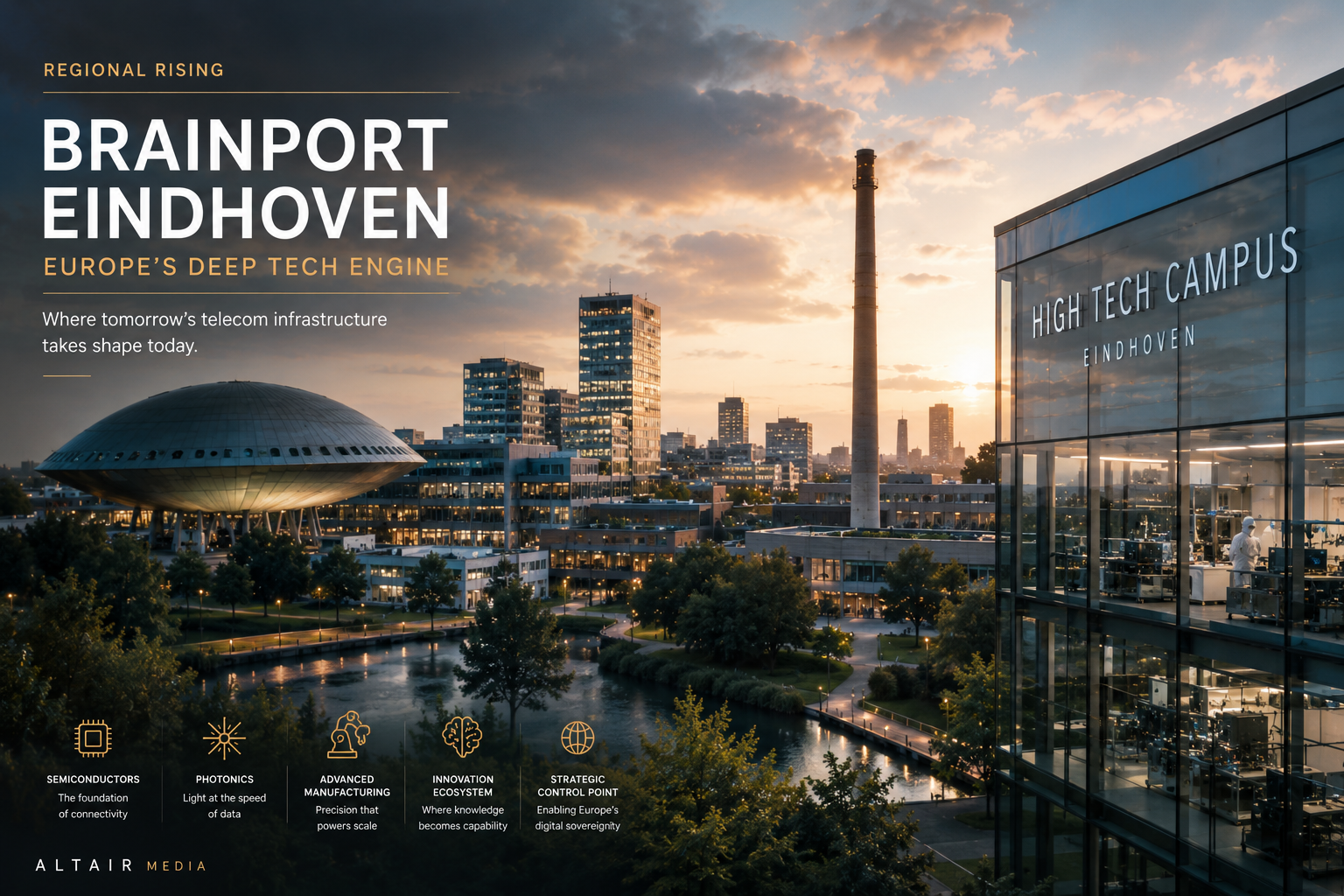
Brainport Eindhoven has become one of Europe’s strategic deep-tech ecosystems. By combining semiconductors, photonics, advanced manufacturing and research excellence, the region increasingly provides the enabling technologies that underpin future telecommunications, artificial intelligence and Europe’s broader digital infrastructure.
