Who Governs Physical Limits?
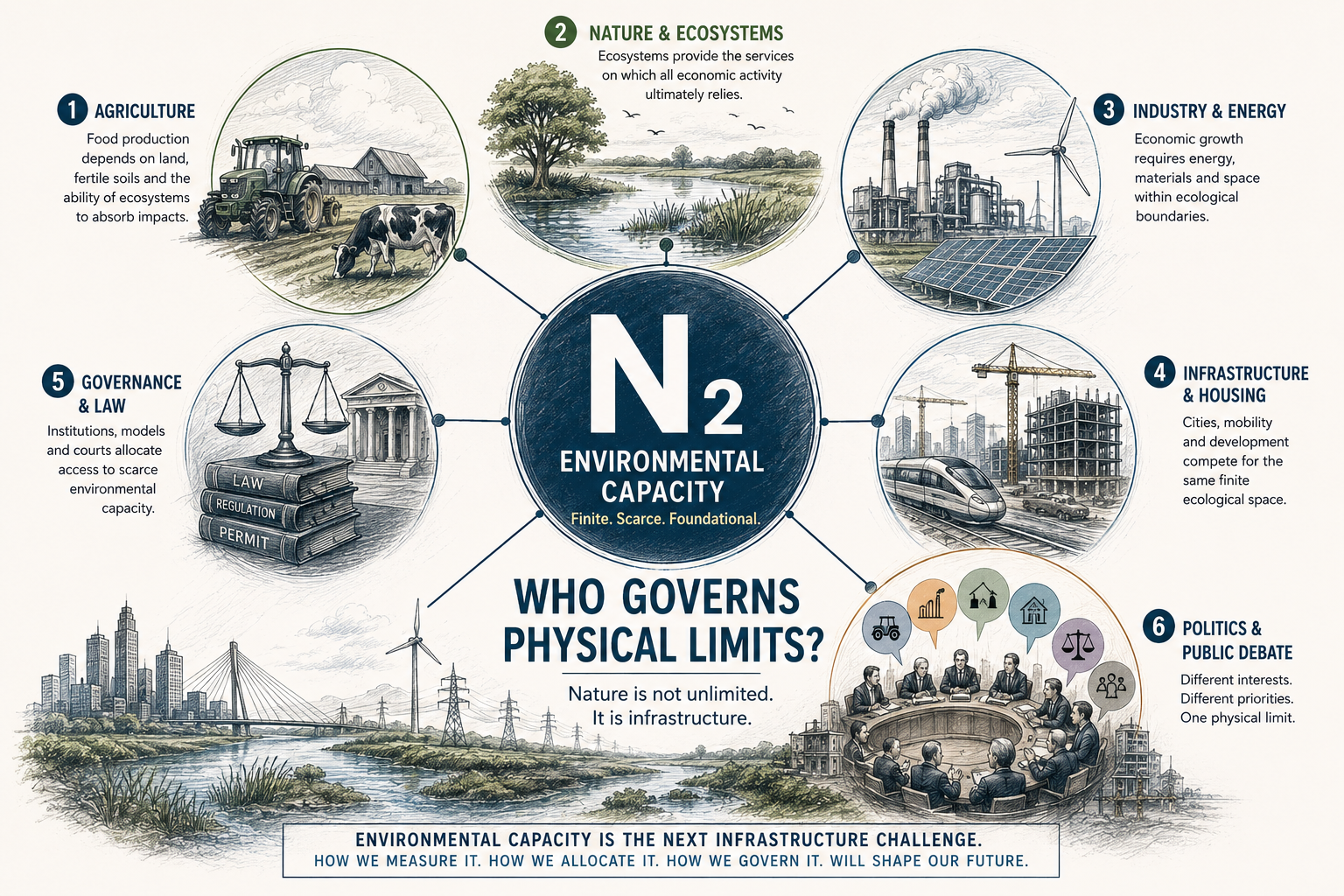
From Environmental Policy to Infrastructure Governance
Infrastructure is usually understood as something societies build. Roads connect cities. Ports facilitate trade. Electricity grids distribute power. Telecommunications networks transmit information. Together, these systems provide the physical foundations upon which modern economies operate.
Yet every infrastructure system depends upon another layer that often remains invisible.
The natural environment.
For decades, environmental policy was largely treated as a separate domain, balancing economic development against ecological protection. Increasingly, however, that distinction is becoming difficult to maintain. Environmental capacity itself is beginning to function as infrastructure.
The Dutch nitrogen debate offers an early illustration of why.
Infrastructure Beyond Concrete
When infrastructure reaches its limits, economic activity slows. Electricity grids experience congestion. Ports reach maximum throughput. Airports operate at full capacity. Road networks become saturated.
In each case, the constraint is physical. Less visible, however, are the ecological systems that support these activities. Healthy soils regulate water cycles. Wetlands absorb floods. Forests stabilise ecosystems.
Atmospheric systems can absorb emissions only up to certain thresholds. Natural habitats provide resilience that cannot easily be engineered once lost.
For much of the twentieth century, these systems appeared effectively limitless. Their capacity rarely constrained economic expansion. That assumption is gradually disappearing.
The Emergence of Environmental Capacity
Public debate often presents nitrogen as a conflict between agriculture and environmental regulation. Yet the underlying issue extends far beyond farming.
Housing developments encounter delays. Industrial projects face increasingly complex permitting procedures. Energy infrastructure competes for scarce spatial capacity. Transport projects experience prolonged legal review. Even defence investments increasingly intersect with environmental constraints.
These sectors are commonly discussed in isolation. In reality, they increasingly compete for access to the same finite resource. Environmental capacity.
A New Layer of Infrastructure
Infrastructure has traditionally been measured through physical assets. How many kilometres of railway? How much electricity transmission capacity? How many container terminals Increasingly, another question is becoming equally important. How much environmental capacity remains available?
How much environmental capacity remains available?
Unlike roads, cables or industrial facilities, ecological resilience cannot simply be expanded through investment. Environmental systems recover over decades. Sometimes centuries. Once exceeded, recovery is often uncertain, costly and slow.
Environmental capacity therefore resembles other forms of critical infrastructure. It possesses finite limits. It requires long-term stewardship. And once congested, it constrains multiple sectors simultaneously.
The Infrastructure Behind Every Permit
Modern permitting increasingly reflects this reality. Every housing project. Every industrial expansion. Every logistics hub. Every energy installation. Every transport corridor. Each depends not only upon engineering feasibility or financial capital, but upon whether sufficient environmental capacity remains available.
Permits are no longer merely regulatory instruments. They are increasingly mechanisms for allocating access to scarce ecological infrastructure. The legal process reflects a deeper physical condition.
The Measurement Layer
For decades environmental systems largely remained background conditions. Today they are increasingly measured, quantified and incorporated into administrative systems.
Models estimate emissions. Algorithms calculate deposition. Databases assess cumulative impacts. Permits translate environmental capacity into legal rights. The implication is profound.
Environmental capacity is not merely becoming infrastructure. It is becoming managed infrastructure.
Like every critical infrastructure system, it depends upon institutions capable of measuring scarcity, allocating access and balancing competing demands.
Yet this introduces a new paradox. Physical reality remains immutable. Administrative representations remain interpretative. The carrying capacity of ecosystems is ultimately biophysical. Access to that capacity, however, is increasingly mediated through scientific models, legal frameworks and regulatory abstractions.
Modern societies therefore face a new challenge. Not merely managing environmental systems. But governing the representations through which environmental systems become economically visible.
The New Control Points
Throughout history economic power has often emerged around bottlenecks. Ports controlled trade. Railways controlled mobility. Electricity networks controlled energy distribution. Telecommunications networks controlled connectivity. Semiconductor firms increasingly control access to advanced computation. Environmental capacity may represent the next strategic bottleneck.
If ecosystems possess finite carrying capacity, then institutions capable of measuring, certifying and allocating that capacity effectively become gatekeepers of future development.
Courts. Environmental agencies. Spatial planning authorities. Monitoring systems. Scientific models. These increasingly function as the control points through which economic expansion must pass.
The defining question therefore becomes increasingly political. Not whether environmental limits exist. But how societies choose to govern them.
From Environmental Policy to Infrastructure Governance
For decades environmental policy sought primarily to reduce pollution. The emerging challenge is different. Governments are increasingly required to manage environmental capacity as a strategic asset.
Housing. Agriculture. Manufacturing. Transport. Energy. Digital infrastructure. Defence. All increasingly depend upon the same ecological foundation.
This suggests a fundamental shift in perspective. Infrastructure is no longer limited to what societies build. It also includes the natural systems that determine what remains possible to build.
Perhaps the nitrogen debate therefore asks a much larger question than is commonly recognised. Not whether a particular sector should expand or contract. But who governs physical limits in societies where economic activity increasingly depends upon scarce ecological capacity.
For generations, infrastructure meant creating new capacity. The coming decades may increasingly require something different. Learning how to govern the capacity that already exists.
Because the defining constraint of the twenty-first century may no longer be technological capability. It may be the carrying capacity of the physical systems upon which every technology ultimately depends.
Caption
Nature is no longer merely protected space. It is becoming infrastructure: a finite physical capacity that increasingly determines what societies can build, expand and sustain.
Credit
Illustration by Altair Media (AI-generated)
