Who Designs Europe’s Industrial Future?
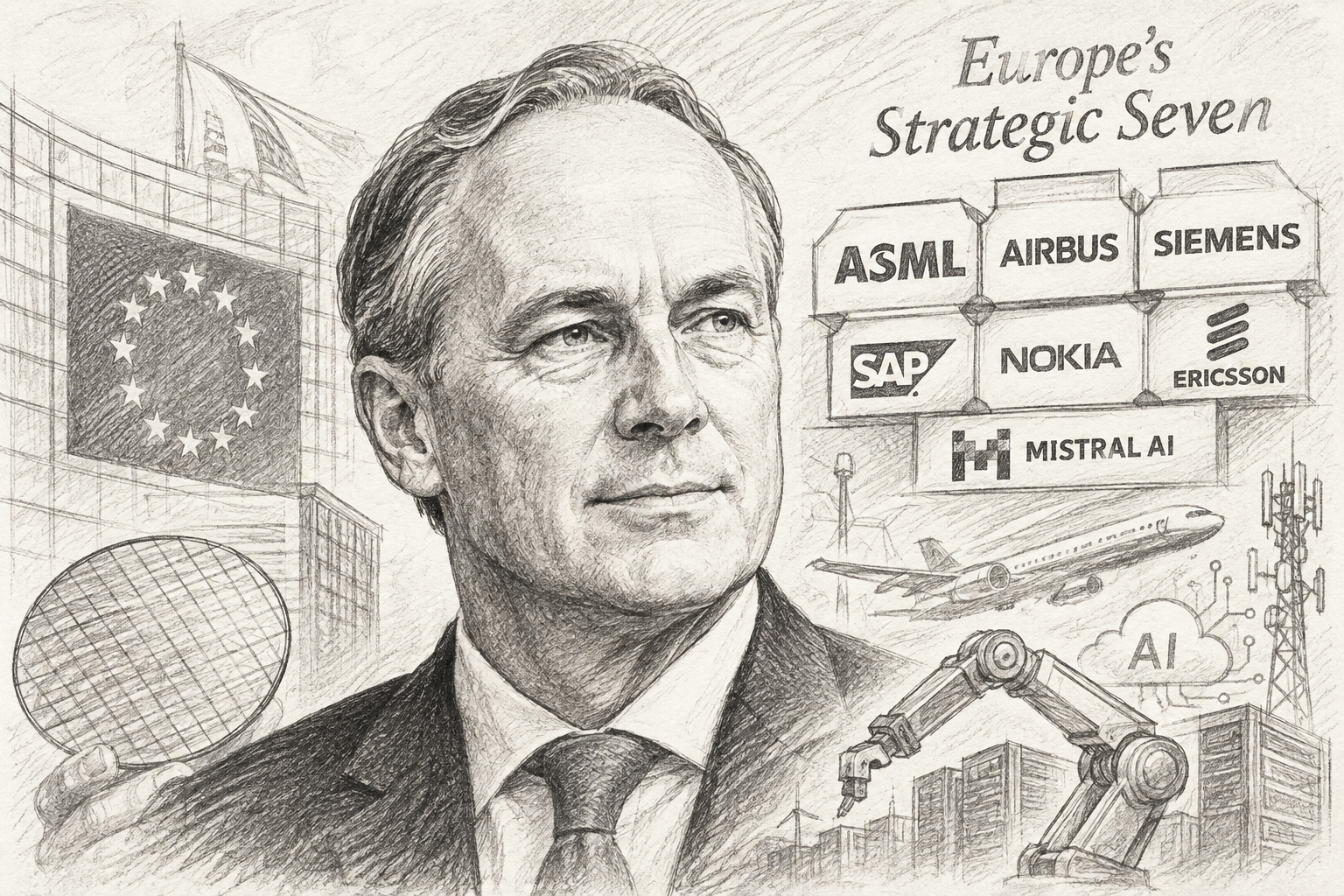
The Strategic Seven and Europe’s Search for a New Industrial Governance
For decades, Europe has exercised global influence in a distinctive way. Rather than building industrial champions through state direction, it built markets through regulation. Competition law, the Single Market and later the General Data Protection Regulation (GDPR), the Digital Markets Act (DMA), the Digital Services Act (DSA) and the AI Act demonstrated Europe’s ability to shape global technology by writing the rules.
This regulatory approach became known as the Brussels Effect: Europe’s capacity to influence global markets not through economic scale alone, but through the power of its legal framework. Today, however, Europe faces a different challenge.
Writing the rules is no longer enough. Artificial intelligence, semiconductor manufacturing, quantum technologies and advanced industrial systems require physical infrastructure, long-term investment and coordinated industrial capabilities. That reality is beginning to reshape Europe’s relationship with its own industries.
The Strategic Seven are not simply asking Europe to regulate the future. They are asking Europe to help build it.
The European Commission has brought together the leaders of seven of Europe’s most influential technology companies—ASML, Airbus, Siemens, SAP, Nokia, Ericsson and Mistral AI—while appointing Siemens Chairman Jim Hagemann Snabe as Special Envoy for Industrial Artificial Intelligence.
Taken separately, these appear to be ordinary policy announcements. Taken together, they suggest something far more significant. Europe is quietly experimenting with a new model of industrial governance.
From Regulator to Builder
For decades, Europe’s institutional reflex has been to regulate markets rather than actively shape them. Its strength lay in creating fair competition, protecting consumers and ensuring market openness. Industrial policy remained relatively limited compared with the large-scale state coordination seen elsewhere.
The Strategic Seven challenge that philosophy. Their message is straightforward: Europe cannot remain globally competitive if it continues to organise its economy primarily through regulation while its competitors organise theirs through coordinated investment, industrial partnerships and long-term strategic planning.
Their proposals—including more flexible competition rules, reduced regulatory complexity and faster investment in industrial AI, semiconductor ecosystems and digital infrastructure—are therefore about much more than corporate interests. They reflect a broader argument that Europe must complement regulatory excellence with industrial capacity.
In other words, Europe is beginning to ask whether it should not only regulate the market, but also help build the strategic capabilities on which that market depends.
Industrial AI is not about replacing people with algorithms. It is about connecting artificial intelligence to Europe’s factories, energy systems, telecommunications and critical infrastructure.
That transition, however, is not without risks. Europe has traditionally been cautious about governments actively supporting individual industrial champions or appearing to “pick winners”. The emergence of the Strategic Seven therefore raises an important governance question. Can Europe strengthen the industries that underpin its technological future while preserving open markets, fair competition and democratic legitimacy? Finding that balance may become one of the European Commission’s defining institutional challenges during the coming decade.
More Than a Lobby
The Strategic Seven are frequently described as a lobbying coalition. Technically, that description is accurate. Strategically, however, it misses the larger picture. Traditional lobbying focuses on sector-specific regulation or commercial interests.
The Strategic Seven argue instead for a different model of European competitiveness itself. Their central concern is that Europe’s technological sovereignty cannot depend solely on excellent research or world-class engineering. It also requires companies capable of scaling globally, attracting capital and investing across decades rather than quarterly reporting cycles.
The discussion therefore extends well beyond regulation. It is becoming a debate about the architecture of European industrial power.
Industrial AI Is Different
It is also worth examining who sits around this table. With the exception of Mistral AI, these are not primarily consumer technology companies. They design and operate much of Europe’s physical industrial infrastructure.
ASML enables semiconductor manufacturing. Siemens builds industrial automation systems. Airbus represents aerospace and advanced manufacturing. Nokia and Ericsson operate at the heart of Europe’s telecommunications infrastructure. SAP provides the enterprise software that connects much of Europe’s industrial economy.
Rather than representing seven unrelated companies, the Strategic Seven collectively span many of Europe’s most important industrial capabilities—from semiconductor manufacturing and telecommunications to aerospace, industrial automation, enterprise software and artificial intelligence. Their significance therefore lies not only in who they are individually, but in the strategic systems they represent together. This distinction matters.
Much of today’s public discussion focuses on consumer-facing artificial intelligence and large language models. Europe’s comparative advantage may lie elsewhere.
The real question is not whether industry should advise government. It is whether Europe can organise that partnership without compromising democratic legitimacy.
Industrial AI—the integration of artificial intelligence into factories, telecommunications, energy systems, logistics, semiconductor manufacturing and critical infrastructure—aligns closely with Europe’s existing industrial strengths.
Seen from this perspective, Jim Hagemann Snabe’s appointment as Special Envoy for Industrial Artificial Intelligence becomes far more understandable. His mandate is not simply about AI. It concerns the digital transformation of Europe’s industrial base.
Capital Is Part of the Architecture
Industrial strategy cannot exist without capital strategy.
The United States combines deep capital markets with large-scale public investment through programmes such as the CHIPS and Science Act.
China mobilises state banks, industrial planning and public investment to support strategic sectors.
Europe possesses substantial financial resources, including some of the world’s largest pension funds and institutional investors.
Yet much of that capital continues to finance innovation and technological expansion outside Europe. This has become one of the central frustrations expressed by industrial leaders.
Building globally competitive industries requires not only technological excellence but also patient capital capable of supporting industrial scale over decades. Governance, industrial policy and capital allocation are therefore becoming increasingly interconnected.
A Different Relationship Between Government and Industry
The appointment of Jim Hagemann Snabe has also generated criticism. Civil society organisations and transparency advocates have questioned whether appointing the chairman of one of Europe’s largest industrial companies to advise on industrial AI policy creates an unacceptable conflict of interest. These concerns deserve serious consideration.
Democratic legitimacy depends upon transparency, accountability and robust safeguards. Yet the international context deserves equal attention.
China openly integrates industrial policy, state financing and corporate development within long-term national strategies.
The United States, while operating through different institutions and a market-oriented economy, also maintains close cooperation between government, research institutions and strategic industries through defence programmes, public procurement, research funding and industrial policy.
Europe has historically maintained greater institutional distance.
The current debate therefore reflects something larger than one appointment. It reflects Europe’s search for its own model—one that strengthens strategic coordination without abandoning democratic oversight or competitive markets.
Governance as Infrastructure
Artificial intelligence increasingly depends upon physical infrastructure. Data centres. Energy networks. Semiconductor production. Telecommunications. Cloud computing. But physical infrastructure alone is insufficient. It must be accompanied by institutions capable of coordinating regulation, capital, research, industrial policy and long-term investment.
Governance itself becomes infrastructure. Competitiveness increasingly depends not only on technology or capital, but also on institutional velocity—the ability of governments to make timely decisions, coordinate investment, approve strategic infrastructure and adapt policy as technologies evolve. In that sense, bureaucratic delay becomes a form of strategic latency. Just as delays reduce the performance of digital networks, slow decision-making can reduce a continent’s capacity to innovate.
In an increasingly competitive geopolitical environment, institutional agility may prove just as important as computing power. The ability to make timely decisions, coordinate investment and align public and private capabilities is becoming a strategic asset in its own right.
The Strategic Seven are more than a coalition of companies. They represent Europe’s search for a new model of industrial governance.
The Strategic Seven may therefore be remembered not simply as an alliance of major companies, but as an early experiment in building that institutional capacity.
Final Reflection
The emergence of the Strategic Seven and the appointment of Jim Hagemann Snabe signal more than a new advisory structure for artificial intelligence. They represent a broader institutional shift.
For decades, Europe believed that regulating markets would be sufficient to shape technological development. Today, it increasingly recognises that regulation alone does not build semiconductor ecosystems, industrial AI platforms or strategic infrastructure.
The Strategic Seven are therefore about more than seven prominent European companies. They represent an experiment in how Europe chooses to organise its industrial future.
The challenge is no longer simply whether governments or markets should lead. It is whether Europe can develop a governance model capable of aligning democratic legitimacy, industrial expertise, long-term capital and technological ambition.
The United States relies largely on market dynamism reinforced by strategic public investment. China relies on state coordination. Europe appears to be searching for a third path—one that combines industrial partnership with democratic accountability.
Whether the Strategic Seven become the foundation of that model or merely a temporary experiment, may help determine Europe’s industrial position in the twenty-first century.
Image Credit
Illustration: ChatGPT / OpenAI (graphite pencil illustration), concept by Altair Media.
Caption
Jim Hagemann Snabe, the European Commission’s Special Envoy for Industrial Artificial Intelligence, stands at the centre of a broader debate about Europe’s industrial future. The Strategic Seven—ASML, Airbus, Siemens, SAP, Nokia, Ericsson and Mistral AI—symbolise Europe’s growing effort to align industrial expertise, governance and technological sovereignty in an increasingly competitive geopolitical landscape.
