When Private Capital Hesitates, Should Public Capital Step In?
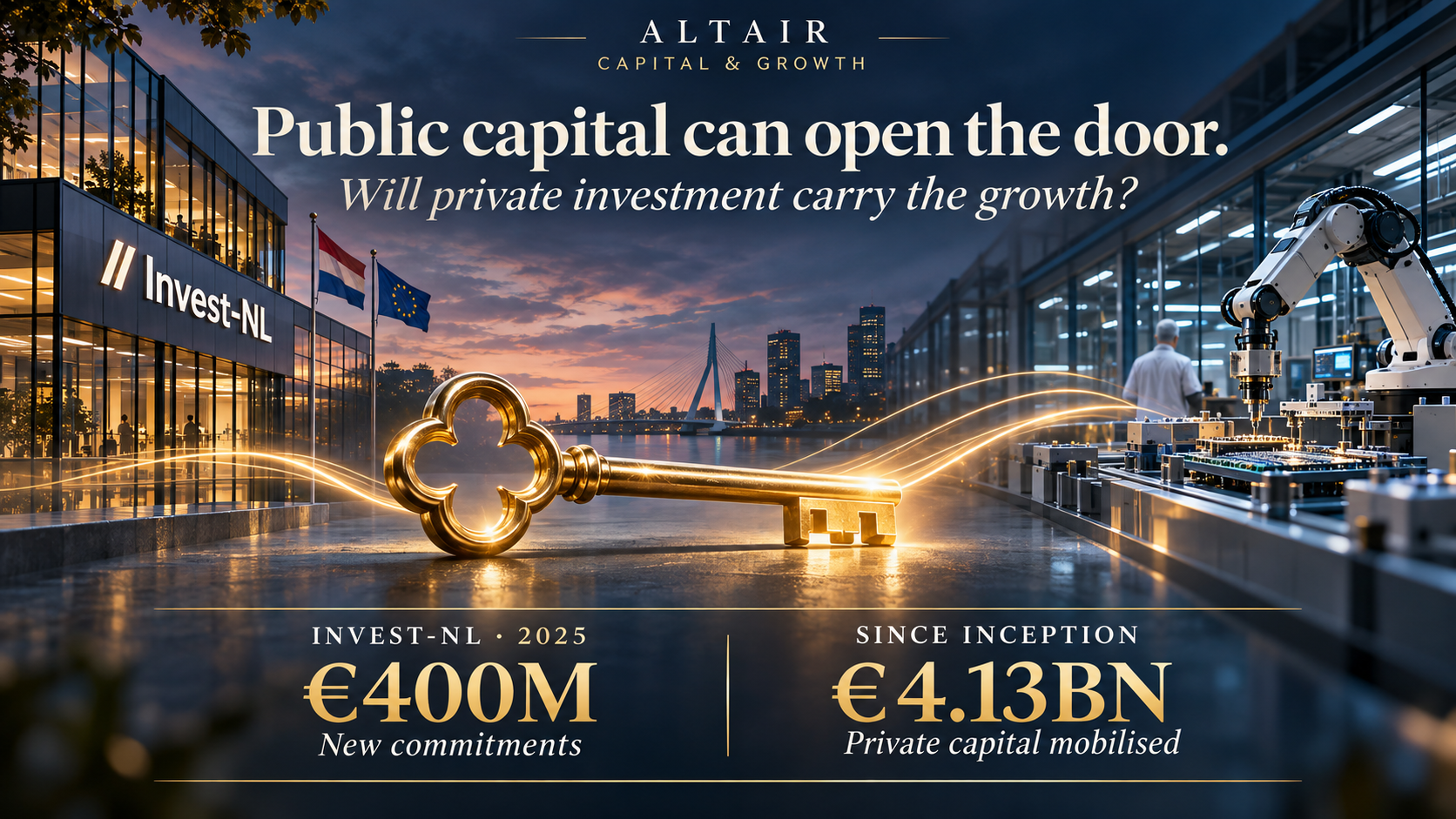
Invest-NL committed €400 million to new investments in 2025 and reports €4.13 billion in private capital mobilised since its creation. But how much additional investment does public money really unlock?
Europe has no shortage of ambitious technology companies or institutions seeking to finance them. Yet promising businesses often encounter a difficult gap between developing a new technology and attracting the capital needed to bring it to market.
In the Netherlands, Invest-NL was created to help address precisely that problem. Its task is not simply to provide public money, but to make investments possible where commercial financing remains insufficient.
Its 2025 results offer a revealing starting point. Invest-NL committed €400 million to new investments during the year, while reporting €4.13 billion in private capital mobilised since its establishment. These figures measure different activities over different periods, but together they raise an important question about the relationship between public investment and private financial markets.
After examining Atomico, Euronext, APG and PGGM, and Europe’s new Institutional Investors Pact, Capital & Growth now moves from the institutions organising capital towards those making concrete investment decisions.
Five questions reveal how public investment can support private markets — and where its limits lie.
🔑 1. Why does the Netherlands need a public investment institution?
Private investors normally finance businesses when they believe the expected returns justify the risks. But some investments require substantial capital long before commercial success becomes likely, particularly in advanced technology, industrial manufacturing and the energy transition.
A company may possess promising intellectual property without having a proven manufacturing process. Another may need to construct expensive production facilities before attracting enough customers to make the business financially sustainable. These are not necessarily unattractive businesses, but their risks may be too high, their development periods too long or their financing requirements too complex for conventional investors.
Invest-NL seeks to address these financing gaps through direct investments, specialised funds and the development of new financial instruments. Its objective is to help make economically and strategically important projects financeable, rather than permanently replacing the private market.
That distinction is central to its public mandate. By participating in investments that commercial financiers are reluctant to undertake alone, Invest-NL can potentially improve the conditions under which other investors are prepared to participate.
The underlying ambition is to help businesses move towards a stage where they can attract sufficient financing on commercial terms.
- The tension: Public capital can help businesses overcome financing barriers, but it should not replace investments the private market would have made anyway.
🔑 2. How does €400 million in public investment help mobilise billions?
Invest-NL’s financial results illustrate why investment figures require careful interpretation.
In 2025, the institution committed €400 million to new investments, including €327 million in direct investments and €73 million through investment funds. This represented a 69% increase compared with the previous year.
Its annual report also records €884 million in private capital mobilised during 2025, bringing the cumulative total to €4.13 billion since its establishment.
The distinction is fundamental. The €400 million represents Invest-NL’s own new investment commitments during a single year, while the €4.13 billion represents private capital attributed to its activities over several years.
It would therefore be misleading to suggest that €400 million invested in 2025 generated €4.13 billion in additional financing.
The mechanism behind these figures is nevertheless important. When Invest-NL participates in a financing round alongside commercial investors, its involvement may help distribute risks, strengthen confidence or make a larger transaction possible. Investment funds can extend this effect by pooling capital from several investors, while guarantees and blended-finance structures can alter the distribution of financial risks.
However, the amount of private capital participating in these transactions is a measure of mobilisation, not necessarily of investment that would otherwise have been impossible. Establishing that difference requires a more demanding assessment of what would have happened without public involvement.
The figures therefore demonstrate the scale of Invest-NL’s financing activities and its ability to attract co-investors, while leaving open the question of precisely how much new investment its participation creates.
- The tension: Mobilising private capital is a measurable achievement, but demonstrating how much investment would otherwise have been lost is more difficult.
🔑 3. What happens when public and private investors finance a real company?
A concrete example comes from Eindhoven-based Keiron Printing Technologies.
In July 2026, the company announced a €20.7 million Series A financing round, co-led by Invest-NL, DeepTechXL and Waves Capital. Other participants included Ramphastos Investments, ATUM Ventures, Cottonwood Technology Fund and TNO Ventures.
Invest-NL contributed €6.9 million, representing exactly one-third of the financing round. The remaining €13.8 million came from the other participating investors.
Keiron develops advanced laser-based printing technology for electronics manufacturing. Its process improves the precision with which solder paste is deposited onto printed circuit boards, addressing an increasingly demanding challenge as electronic components become smaller and more complex.
Unlike a software company that can often expand its customer base without substantial physical infrastructure, an industrial technology business must demonstrate that its equipment performs reliably in real production environments. That requires investment not only in research and engineering, but also in manufacturing capabilities, commercial partnerships and international expansion.
Keiron’s financing round illustrates how public and private capital can come together around such an opportunity. Invest-NL’s participation provides a substantial financial contribution, while specialist technology investors bring additional capital and commercial expertise.
The precise public contribution also makes the structure easier to understand. A €6.9 million public investment accompanied €13.8 million from other investors, creating a financing package three times the size of Invest-NL’s individual contribution.
This does not establish that the other investors would have withdrawn without Invest-NL. It does show how a national public investment institution can participate in a substantial industrial technology financing round alongside private partners.
The next question is what the company can achieve with that capital: whether its technology reaches wider industrial adoption, attracts customers and ultimately becomes capable of financing further growth.
- The tension: Public investment can help anchor industrial technology financing, but the lasting value of that participation will depend on the company’s commercial development.
🔑 4. Who carries the risk when public investment goes wrong?
Public investment institutions occupy a difficult position. They are expected to support projects that commercial markets find challenging, while also managing public capital responsibly.
Those responsibilities can create tensions, particularly when investments involve technologies with uncertain development paths and long periods before commercial returns become available.
Invest-NL reported a consolidated net loss of €38.4 million for 2025, compared with €23.3 million in 2024. According to the institution, the result was mainly influenced by negative revaluations within its investment portfolio, reflecting the risks associated with young businesses and technologies still under development.
A negative financial result does not automatically mean that an investment has failed to create public value. Some technologies may require many years to become commercially successful, while investments can contribute to industrial capabilities, innovation and economic resilience before producing financial returns.
Nevertheless, public benefits cannot simply be assumed because a company operates in a strategically important sector. Financial losses represent genuine exposure, and the potential economic benefits must be evaluated alongside the capital committed and the risks undertaken.
The distribution of those risks also depends on how investments are structured. In some transactions, public and private investors participate on comparable terms. In others, guarantees or blended-finance arrangements deliberately allocate different levels of risk to different participants.
Such structures can make challenging projects financeable, but they also raise questions about who absorbs losses, who benefits from successful investments and whether the public contribution is proportionate to the expected benefits.
For institutions like Invest-NL, financial discipline and public purpose are therefore not competing objectives that can be considered separately. They are two requirements that must be balanced within the same investment decisions.
- The tension: Public investors may need to accept risks that private markets avoid, but those risks must be matched by credible economic and financial benefits.
🔑 5. How do we know whether public investment actually works?
The long-term success of Invest-NL cannot be established through investment volumes or financial mobilisation alone. Its contribution also needs to be assessed through the development of the businesses and projects it supports.
The institution’s 2025 annual report states that its portfolio companies spent €334 million on research and development and employed approximately 14,250 full-time-equivalent workers.
Invest-NL attributes €52 million of those R&D expenditures and 1,250 fte to its own participation, based on its ownership interests and the size of loans provided.
This distinction is important. Rather than claiming the entire economic activity of its portfolio companies, Invest-NL uses a proportional method to estimate the share associated with its financing.
Yet proportional attribution is not the same as demonstrating causality. It identifies a share of economic activity connected to Invest-NL’s financial participation, but does not establish how much research or employment would have been absent without that investment.
Assessing the longer-term results therefore requires following the companies themselves. Do they successfully commercialise their technologies? Can they expand production, attract customers and achieve sustainable growth? And can they eventually raise capital without continued dependence on public support?
The financial performance of investments matters as well. Successful exits can return capital for reinvestment, while unsuccessful investments reduce the resources available for future projects.
These questions are becoming increasingly relevant as Invest-NL broadens its financial instruments. Its strategy for 2026–2028 places greater emphasis on project finance, structured finance and blended finance, alongside its venture capital activities.
That development creates a potential connection with the institutional investors examined in previous Capital & Growth Signals. Pension funds, insurers and other long-term investors generally require more established businesses, predictable financial prospects and investment structures suited to their responsibilities.
National investment institutions can help companies move towards that stage by supporting difficult early phases of industrial and technological development.
The strongest evidence of success may therefore emerge years after the initial investment, when companies attract larger pools of commercial capital and demonstrate that public participation helped create businesses capable of standing on their own.
- The tension: The strongest evidence of public investment success may not be how much money an institution commits, but how many businesses eventually become financeable without it.
The Altair Signal
Public capital has an important role in Europe’s growth economy — not simply to increase investment volumes, but to help make complex, capital-intensive businesses financeable.
Invest-NL’s 2025 results capture both sides of that responsibility. Its investment commitments are expanding, and €4.13 billion in private capital has been mobilised since its establishment. At the same time, a €38.4 million annual net loss and the difficulty of demonstrating genuine additionality underline the importance of evaluating results over time.
Investments such as Keiron Printing Technologies show how public institutions can help finance industrial innovation alongside private investors. The longer-term test comes when those companies seek further growth capital from commercial markets, specialist funds and institutional investors such as the pension managers examined earlier in this series.
Public capital can open the door. But will private investment eventually carry the growth?
This article is part of Altair Capital & Growth, an Altair Insights series examining how capital is raised, invested and distributed across the European economy. Following Atomico, Euronext, APG/PGGM and the Institutional Investors Pact, this fifth Signal explores the role of national public investment institutions in making European growth financeable.
References
- Invest-NL – Annual Report 2025, financial results
- Invest-NL – Complete Annual Report 2025, financial and impact data
- Invest-NL – Keiron Printing Technologies, 21 July 2026
- Invest-NL – Annual reports and financial accountability
Image Credit
AI-generated editorial illustration for Altair Media. Financial figures based on Invest-NL’s Annual Report 2025.
Caption
Public capital can open the door. But will private investment carry the growth? Invest-NL committed €400 million to new investments in 2025 and reports €4.13 billion in private capital mobilised since its establishment. The figures reflect different periods and measures, illustrating the challenge of turning public investment into lasting private-sector growth.
