UBS: Who Keeps the Human in Control?
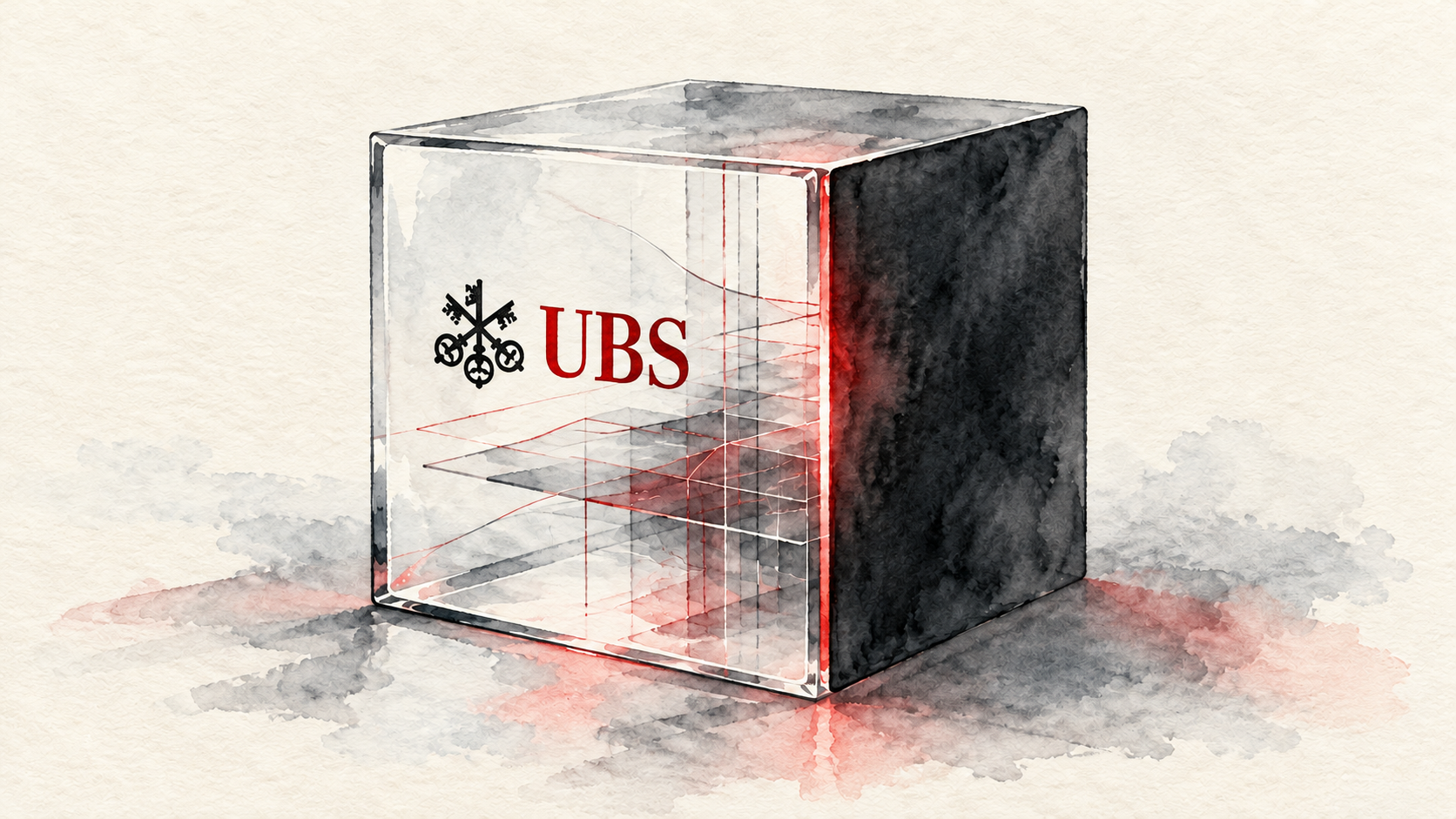
As AI reshapes advice and client relationships, UBS puts human autonomy at the centre of its approach. The test is whether people retain the power to challenge the system.
UBS presents artificial intelligence as a way to strengthen human advice, improve productivity and deepen client relationships. Its public policies explicitly recognise human autonomy and oversight. That creates a demanding question: as AI shapes what advisers see, recommend and prioritise, how can the bank demonstrate that human judgement remains effective, independent and accountable in practice?
The tension begins before the final decision. A person may approve the advice while the system has already shaped the available choices.
🟦 Is human control a working safeguard — or a reassuring promise?
UBS’s 2025 Sustainability Report classifies AI used to provide investment recommendations, advice or research to clients as a high-risk use case, requiring human oversight and risk management. This is the bank’s own risk classification; it should not be confused with a legal determination under the EU AI Act.
Its published AI principles also emphasise human autonomy, harm prevention, fairness and transparency. These commitments establish a basis for scrutiny.
The operational question is harder: can an adviser inspect the relevant evidence, recognise a weak recommendation and reject it without unreasonable pressure?
Human approval has limited protective value if the reviewer lacks time, information or authority. The test is whether intervention can change the outcome.
🟦 Does AI create more time for clients — or more clients for each adviser?
UBS says its internal assistant, Red, has been rolled out to around 100,000 employees. It combines UBS information with tools for searching, summarising, drafting and translation.
Faster access to information can improve preparation and reduce administrative work. But the destination of the saved time matters: longer conversations, closer review or a larger caseload?
This question sits alongside substantial integration pressures. In its second-quarter 2026 results, UBS reported USD 12.6 billion in gross cost savings since the end of 2022 and an ambition of approximately USD 13.5 billion by year-end. These are Credit Suisse integration figures, not savings attributable to AI.
Efficiency can support better care. It can also raise expectations of output until the time available for difficult cases contracts again.
🟦 When AI identifies a client opportunity, whose opportunity comes first?
UBS’s US adviser materials describe AI identifying liquidity needs, property sales and prospective client connections. Their examples include bringing externally held money to UBS and securing investment proceeds after a home sale. The commercial purpose is explicit.
These signals can help advisers offer timely, useful support. Yet a moment that creates a sales opportunity may also be a moment of uncertainty for the client.
The crucial distinction is between identifying an opportunity for the bank and establishing an appropriate course of action for the person. They can coincide; they require separate assessment.
A demanding governance test would ask how recommendations are checked for suitability, how conflicts are managed and whether success includes decisions that produce no immediate sale.
Personalisation becomes more credible when it can recommend restraint.
🟦 Can a human adviser still be operating inside a black box?
Yes. A person can communicate a recommendation without understanding sufficiently how the system produced it.
UBS acknowledges in its 2025 Sustainability Report that opaque models, particularly large language models, create compliance risks. It describes processes intended to make systems interpretable and auditable, including measures addressing hallucinations and source attribution.
That recognition matters. It does not establish that every application or recommendation is fully explainable.
FINMA’s December 2024 AI guidance identifies explainability, documentation and independent review as supervisory concerns. It also discusses monitoring instances where users ignore or change model outputs. These are sector-wide observations, not findings about UBS.
For clients, the useful explanation connects the recommendation to their circumstances, the evidence used and the alternatives considered. A plausible narrative alone cannot demonstrate a sound decision.
🟦 If governance is extensive, what would show that it actually works?
UBS describes a Group AI policy, an AI Operating & Risk Committee and mandatory annual training. Its sustainability reporting places AI within the bank’s wider board and executive governance framework.
These are meaningful structures. Their effectiveness depends on what happens when commercial priorities and risk concerns collide.
An external assessment should seek evidence of recommendations being challenged, applications being restricted, errors being corrected and recurring complaints informing system changes. These are proposed tests, not a claim that UBS currently fails them.
Counts require context: few overrides might reflect reliable output or reluctant reviewers. Many might show healthy challenge or a weak system.
The most revealing evidence is what the bank learns from disagreement — and whether that learning changes its operations.
🟦 When AI-influenced advice causes harm, who can secure a correction?
In Switzerland, FINMA can use complaints to identify possible systematic breaches, but it does not decide individual clients’ compensation claims. The Swiss Banking Ombudsman offers independent information and mediation; it does not issue binding legal judgments. Civil courts provide a separate route. Other jurisdictions have their own arrangements.
Those routes make records essential. A disputed recommendation should be traceable through the information available, the system’s contribution, the adviser’s assessment and the advice ultimately delivered.
Responsibility can become difficult to establish when each participant sees only part of that chain. An accessible adviser helps; accessible evidence and the authority to correct an error are equally necessary.
Human accountability must survive the complaint, not merely appear in the original conversation.
Signal
UBS makes human autonomy an explicit part of its AI approach. The decisive test is whether advisers can challenge the system, clients can obtain a meaningful explanation and mistakes lead to timely correction. Human judgement remains protective when it has the information, time and authority to change what happens next.
Credit
Illustration: Altair Media / AI-generated with ChatGPT.
Caption
A glass cube in UBS colours explores the tension between transparency and opacity — and the human judgement needed to challenge automated recommendations.
