Theater Strahl and the Search for Identity
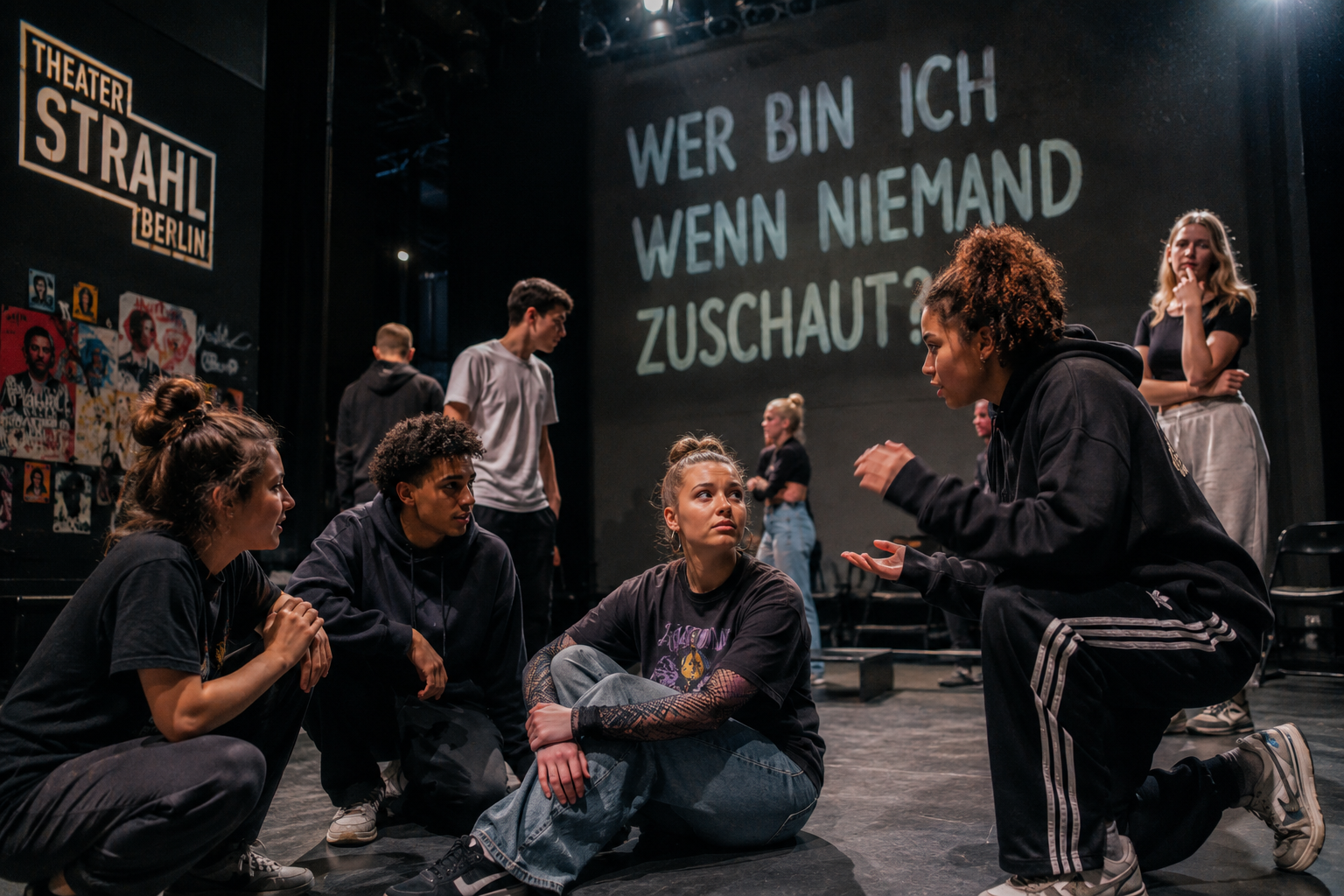
Why Berlin’s youth theatre tradition offers insights into how young Europeans discover who they are
When discussions about young people focus on education, employment or digital skills, another dimension often receives far less attention. Identity. Who am I? Where do I belong? How do I relate to others? Across Europe, organisations approach these questions in different ways.
Belgium often emphasises artistic exploration. Scandinavian countries frequently focus on participation and democratic engagement. Germany has long approached youth development through reflection, dialogue and Bildung.
In this series exploring Europe’s creative spaces, we look at how Berlin’s distinct urban environment has helped shape an approach to theatre that places identity, belonging and social understanding at its centre. One of the organisations working in this tradition is Theater Strahl.
Who Is Theater Strahl?
Based in Berlin, Theater Strahl has established itself as one of Germany’s most distinctive youth theatre organisations. Rather than treating theatre solely as artistic production, the organisation approaches performance as a space for dialogue, reflection and social engagement. Its productions frequently explore themes such as identity, belonging, friendship, inequality, family dynamics and social change.
Young audiences are not simply invited to watch performances. They are invited to recognise themselves within them.
For Theater Strahl, theatre becomes less about entertainment and more about asking questions that many young people are already carrying with them. Questions about becoming. Questions about society. Questions about the future.
Why Identity Matters
Adolescence has always been a period of exploration. Yet contemporary young people are growing up in societies that are becoming increasingly interconnected, visible and demanding.
Digital environments shape perceptions. Social media creates opportunities for expression while simultaneously increasing pressure to perform. Communities are becoming more diverse. Expectations continue to evolve.
Young people encounter multiple identities, cultures and perspectives at once. The challenge is no longer simply gaining access to information. The challenge is understanding oneself within a world overflowing with information.
Organisations such as Theater Strahl recognise that identity formation requires time, experimentation and environments where uncertainty is allowed to exist. Theatre offers one such space.
Why Theatre?
Theatre allows young people to encounter experiences different from their own. It encourages empathy. It introduces alternative perspectives. It provides opportunities to explore emotions that may be difficult to discuss directly.
Through stories, dialogue and performance, participants can engage with questions that often remain abstract in traditional educational settings. What does belonging mean? How do social expectations shape behaviour? How do people respond to exclusion? How do we understand ourselves in relation to others?
Rather than providing answers, theatre creates opportunities for reflection. Perhaps that is its greatest value. In a society increasingly oriented toward measurement and performance, theatre still allows room for ambiguity. And identity often grows precisely within that ambiguity.
Learning Beyond Educational Outcomes
Across Europe, youth development is frequently discussed through measurable indicators. Educational attainment. Digital competencies. Employment prospects. These dimensions matter.
Yet organisations such as Theater Strahl remind us that development is also relational. Young people learn through participation. Through dialogue. Through experimentation. Through collaboration. Through shared experiences.
Listening. Communicating. Reflecting. Understanding different perspectives. These capacities may not always appear in statistics, yet they remain essential for democratic societies.
For this reason, theatre can be understood as more than a cultural activity. It can also function as a form of social infrastructure. Not infrastructure that moves goods, energy or information. But infrastructure that supports identity formation, belonging and participation.
Beyond Performance
The work of Theater Strahl raises a broader question for Europe. As societies invest heavily in digital transformation, artificial intelligence and economic competitiveness, how much attention should also be given to spaces where young people can explore who they are becoming?
Technological progress can shape economies. But identity shapes participation. And participation shapes society.
Europe invests in roads, universities and digital networks. Yet it also invests in theatres. Places where young people learn not only what they know, but who they are becoming.
For organisations such as Theater Strahl, theatre is therefore not simply about producing performances. It is about creating environments where young people can understand themselves, understand others and imagine their place within a changing Europe.
Culture as Infrastructure
Theater Strahl also invites us to rethink the role of cultural institutions more broadly. Universities cultivate knowledge. Financial systems allocate capital. Energy systems coordinate time. Digital networks enable communication. Cultural institutions cultivate identity.
They provide spaces where young people can experiment, express themselves, encounter different perspectives and develop a stronger sense of belonging. In that sense, theatre is not merely cultural production. It is social infrastructure for identity formation.
About This Article
This article is part of Europe’s Creative Spaces, an ongoing Altair Media series exploring how cultural institutions across Europe contribute to identity, participation, confidence and human development.
Rather than examining culture solely through the lens of artistic production, the series investigates how creative environments help shape the social foundations of contemporary European societies.
The article is based on publicly available information and is intended as an independent analysis of broader developments and trends.
Credit
Illustration inspired by Theater Strahl Berlin and generated with AI for Altair Media’s Europe’s Creative Spaces series.
Caption
Young people explore identity, dialogue and belonging through theatre. For organisations such as Theater Strahl, performance becomes a space where young Europeans can discover not only what they know, but who they are becoming.
