The Strategic Shift Behind Chips Act 2.0
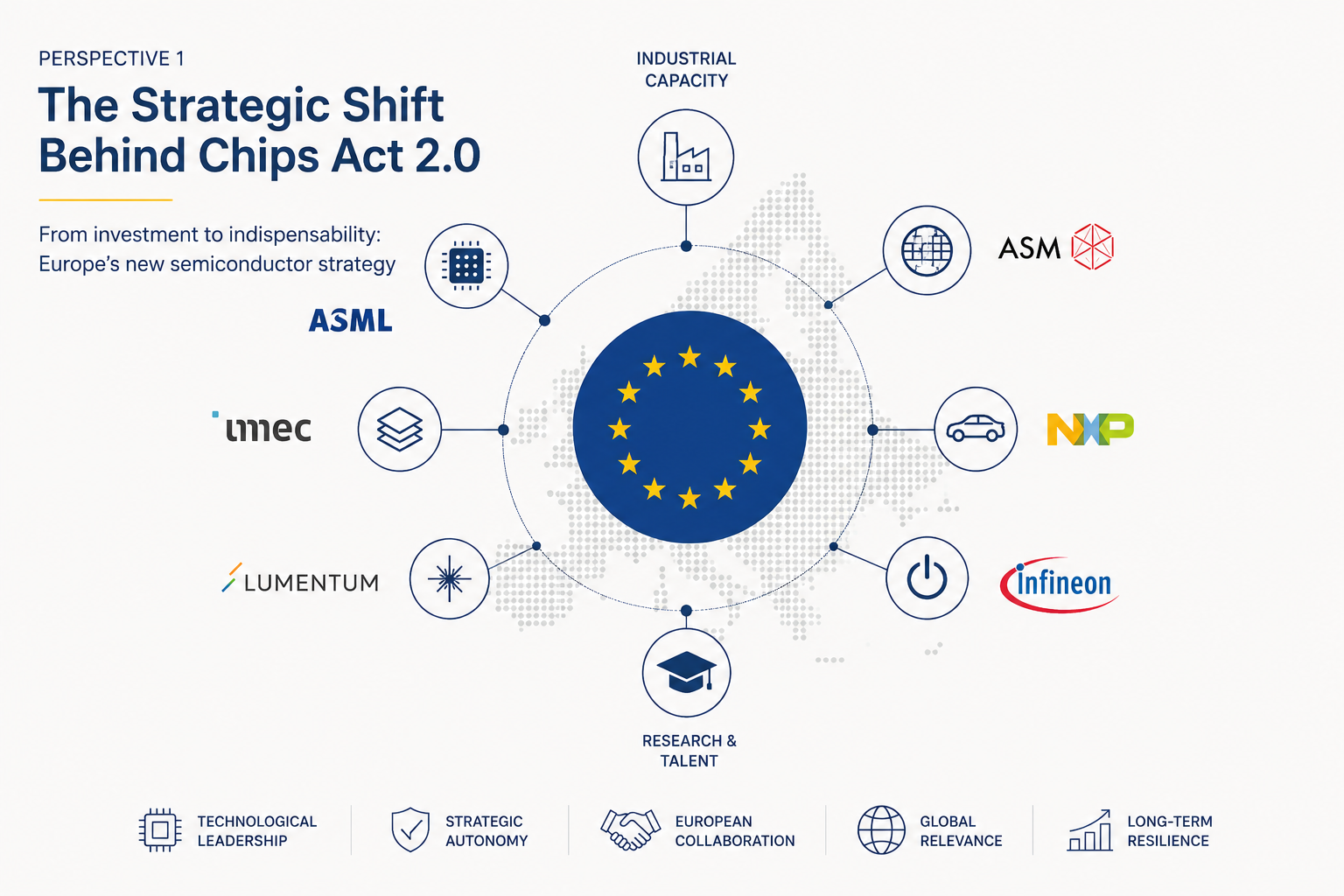
Europe’s search for technological indispensability
For years, Europe approached semiconductor sovereignty largely as a question of manufacturing capacity. The debate revolved around fabs, production scale and the fear that Europe had become too dependent on Asia and the United States for advanced chips.
Chips Act 2.0 may signal something far more profound than another industrial subsidy program. It may represent a deeper strategic shift in how Europe understands technological power itself.
The paradox of sovereignty
The first European Chips Act emerged during a period dominated by disruption and panic. Pandemic shortages, geopolitical tensions around Taiwan and rising competition between the United States and China created enormous pressure to secure semiconductor access.
The political instinct was understandable: Europe needed more domestic production. But semiconductors are not steel plants.
The global semiconductor chain has become so technologically specialized, capital intensive and internationally interconnected that no region — not even the United States or China — can realistically reproduce every critical layer alone. That reality appears to be reshaping European thinking.
A new doctrine is slowly emerging inside Europe’s industrial strategy: sovereignty may no longer mean controlling everything yourself.
Instead, sovereignty may increasingly mean controlling the layers the rest of the world cannot function without.
That is a fundamentally different philosophy.
Not autarky.
Not isolation.
But technological indispensability.
Or as some strategists increasingly understand it: the goal is not to build walls around Europe, but to become the critical gateway nobody can bypass.
Beyond the mega-fab narrative
Much of the public discussion around semiconductor policy still focuses on fabs, subsidies and manufacturing announcements. But the semiconductor ecosystem is vastly more complex than fabrication plants alone.
Advanced semiconductor systems depend on deeply interconnected technological layers:
- lithography,
- deposition,
- advanced materials,
- packaging,
- software,
- industrial machinery,
- photonics,
- AI integration,
- research ecosystems.
Europe already occupies highly strategic positions within several of these layers — often far more influential than broader public discussions acknowledge.
The real strategic question may therefore no longer be:
Can Europe manufacture everything itself?
Instead:
Which technological layers can Europe make globally indispensable?
That distinction changes the entire architecture of industrial policy.
The machine layer: Europe’s upstream leverage
The clearest example of Europe’s strategic leverage remains ASML. The Dutch company effectively controls one of the most critical chokepoints in modern computing through its dominance in EUV lithography systems required for advanced chip manufacturing.
Without ASML, the global roadmap for advanced semiconductors slows dramatically. But ASML also reveals something larger about European industrial power. Its strength does not emerge from isolation. It emerges from interconnected specialization.
The company depends on an ecosystem involving optics, materials science, precision engineering, software, suppliers and research institutions distributed across Europe. Its power lies not merely in manufacturing machines, but in orchestrating a technological system that remains extraordinarily difficult to replicate.
That same upstream logic increasingly applies to ASM International. While less publicly visible than ASML, ASM occupies highly strategic positions in Atomic Layer Deposition (ALD) technologies — systems essential for next-generation semiconductor architectures.
As chip scaling approaches physical limits, control over atomic-level engineering becomes increasingly critical.
In many ways, ASML draws the patterns.
ASMI builds the material reality beneath them. Together, they represent a broader European strength: mastery over the enabling infrastructure of advanced manufacturing itself.
Industrial AI and the physical economy
Europe’s semiconductor relevance also increasingly extends beyond hyperscale computing.
NXP Semiconductors demonstrates another strategic European position: semiconductors connected to the physical world.
As artificial intelligence expands into factories, energy systems, mobility infrastructure and industrial automation, the importance of edge architectures, mixed-signal chips and industrial connectivity is rapidly increasing.
The future AI economy will not operate exclusively through cloud platforms and datacenters. It will increasingly depend on computation embedded inside real-world systems: vehicles, power grids, robotics, telecommunications, industrial machinery and smart infrastructure.
That shift potentially strengthens Europe’s position. Because Europe’s industrial base remains deeply connected to manufacturing, automotive systems, energy infrastructure and engineering ecosystems that are difficult to replicate elsewhere.
The semiconductor race may therefore increasingly become a competition over the integration between digital intelligence and the physical economy itself.
Imec and the architecture of collaboration
Europe’s semiconductor strength also depends heavily on collaborative research ecosystems rather than isolated corporate dominance alone.
imec in Belgium has become one of the world’s most influential semiconductor research hubs precisely because it functions as a neutral coordination layer between governments, universities and global industry players.
TSMC, Intel, Samsung and ASML all participate inside overlapping research environments connected to imec. That model may offer an important clue about Europe’s future strategy.
Where the United States often emphasizes platform scale and China emphasizes vertically integrated state coordination, Europe’s comparative advantage may increasingly lie in ecosystem orchestration:
- connecting industrial clusters,
- coordinating research,
- integrating specialized capabilities,
- translating scientific knowledge into industrial infrastructure.
Under Chips Act 2.0, institutions like imec may become even more strategically important as Europe attempts to bridge the gap between research excellence and scalable industrial deployment.
The next infrastructure layer
The deeper strategic shift becomes even more visible in emerging fields such as photonics, advanced packaging and industrial AI.
Photonics is rapidly becoming critical for the future of AI infrastructure, telecommunications and energy-efficient compute architectures.
As datacenters face growing energy constraints, the transition from electrons toward photonic interconnects may become less of a technological luxury and more of an infrastructural necessity.
Europe already possesses significant expertise in integrated photonics through universities, suppliers and specialized industrial ecosystems.
Advanced packaging represents another rapidly emerging chokepoint. As Moore’s Law slows, future performance gains increasingly depend on heterogeneous integration: combining multiple chiplets, memory systems, photonic layers and specialized processors into integrated architectures.
In this environment, packaging becomes strategic infrastructure rather than industrial afterthought.
The future of semiconductor competition may therefore depend less on producing the biggest chip — and more on controlling how entire systems are integrated together.
From autonomy to strategic indispensability
None of this means Europe is abandoning sovereignty. But the meaning of sovereignty itself appears to be evolving.
The earlier European debate often implied that technological independence required reproducing the entire stack domestically. That ambition increasingly appears economically unrealistic and strategically inefficient inside a deeply interconnected global system.
Instead, Europe may now be moving toward something more pragmatic:
- strategic specialization,
- infrastructural leverage,
- ecosystem resilience,
- technological indispensability.
Under such a model, Europe may not need to dominate every technological layer. But it does need to ensure that certain critical layers of the global system cannot function properly without European capabilities, standards, infrastructure or coordination. That is a very different form of power. And perhaps also a far more sustainable one.
A broader European transformation
Ultimately, Chips Act 2.0 may turn out to matter less as an industrial policy document than as a signal of a broader psychological transformation inside Europe itself.
For decades, Europe struggled to define its position between American platform capitalism and Chinese state-driven industrial expansion. But semiconductors are now forcing Europe to confront deeper questions:
- What should Europe still build itself?
- Which dependencies are acceptable?
- Which infrastructures are strategically critical?
- And how should technological power be organized in democratic societies?
Those questions extend far beyond chips alone. They increasingly concern the future architecture of Europe itself.
This article is part of Europe’s Semiconductor Reset — a four-part Perspective series by Altair Media Europe exploring how Chips Act 2.0 is reshaping Europe’s technological, industrial and geopolitical strategy.
The series examines Europe’s emerging semiconductor architecture through the lens of ecosystems, infrastructure, photonics, Industrial AI, advanced packaging and technological indispensability.
Credit
Illustration generated with AI for Altair Media Europe
Caption
A conceptual visualization of Europe’s emerging semiconductor architecture, where infrastructure, industrial ecosystems and strategic technologies increasingly shape geopolitical relevance.
