The Photonics Scale Test
Five questions for Europe’s photonics industry ahead of PIC Summit Europe 2026
Integrated photonics is moving into a demanding phase: turning technical capabilities into products that customers can adopt, suppliers can deliver and investors can finance. Ahead of PIC Summit Europe in Eindhoven on 3–4 November 2026, the central question is how Europe will convert its expertise into reliable production, repeat orders and lasting industrial value.
The programme puts industrialisation, supply-chain readiness and customer requirements at the centre of the discussion. Altair will examine what those ambitions require in practice through five questions about delivery, adoption and risk.
🟦 When does a successful pilot become an industrial business?
Europe is investing in the transition. PIXEurope brings together 20 partners across 11 countries, with approximately €400 million in planned investment to develop photonic technologies and transfer processes towards industrial production. That is a substantial commitment to reducing technical barriers. It is not a measure of commercial sales.
Pilot infrastructure can establish whether a process is viable. A business must establish whether it can deliver repeatedly at a price that supports both customer adoption and its own survival.
Prototype pricing also needs to be separated from the cost of a qualified product at volume. PHIX identifies packaging, assembly and testing as significant cost factors, with automation and component choices shaping competitiveness.
The relevant evidence therefore changes as a technology matures: from a working prototype to qualified products, predictable delivery and repeat orders. Different applications will reach those stages at different speeds.
A pilot reduces uncertainty. An industrial business must learn to operate within what remains.
🟦 What if the chip works, but the product is not ready?
A photonic chip is part of a wider system. Packaging must provide protection, optical and electrical connections, and thermal management; integration determines how the component works with the rest of the product. PhotonDelta’s value-chain description makes those responsibilities explicit.
For a customer, the distinction matters. A component with strong technical performance can still be difficult to assemble, test, maintain or source reliably.
The commercial question is who takes responsibility across those interfaces. Does the customer receive a dependable product, or inherit the task of making several suppliers’ components work together?
That is where industrial coordination becomes tangible. Research, fabrication and assembly may each advance while the complete product remains costly to deliver.
The customer buys a working system. Every unresolved interface becomes part of its cost.
🟦 Why should a customer change what already works?
Technical superiority is an opening argument. Adoption requires a business case.
A modest improvement may not justify the disruption of switching. The case becomes stronger when an existing approach struggles to meet the customer’s requirements for bandwidth, energy use, size or precision—or when photonics enables a function the customer could not previously obtain.
For a prospective user, the calculation includes the purchase price, integration work, qualification, maintenance and the risk of changing an established system. A claimed gain in speed or energy efficiency must survive that calculation. Where energy savings are central, the meaningful comparison is the performance of the complete system under relevant operating conditions.
This creates a tension for suppliers. They need customers to validate their products; customers want evidence before committing engineering time and money.
The useful questions in Eindhoven are therefore specific: what problem is being solved, against which alternative, and with what demonstrated benefit?
A promising application identifies an opportunity. A purchasing decision reveals whether the proposed solution is worth adopting.
🟦 Who carries the risk before the orders become predictable?
PhotonDelta reports €152 million in public and private investment across its ecosystem in 2025. That indicates substantial funding activity. It does not tell us how much commercial demand is secure, or whether each company has the funding required for its next production stage.
For a company preparing to expand, the difficult interval may lie between customer interest and dependable revenue. Equipment, staff, testing and inventory require money before the resulting products are paid for.
An investor may seek firmer orders. A customer may seek evidence that production can scale. The supplier has to satisfy both.
The question is which combination of equity, public support, strategic investment and customer commitments can bridge that interval—and what milestones justify each commitment.
Someone must finance the capacity before dependable demand can pay for it.
🟦 Does European technology also mean European control?
European location is one part of the answer. The harder test is whether companies can retain valuable capabilities, serve global customers and remain credible suppliers as their markets develop.
PIXEurope’s stated objectives include transferring technologies to European manufacturers, increasing production capacity and strengthening supply chains. Those are practical ambitions against which progress can eventually be assessed. cordis.europa.eu
For Altair, the questions follow from that: which capabilities remain accessible in Europe, who controls critical production decisions, and where does value accumulate when the product reaches the customer?
International partnerships can help build scale. Their industrial significance depends on the capabilities they strengthen and the dependencies they create.
European strength becomes commercially meaningful when customers can rely on it and European businesses can sustain it.
Signal
PIC Summit Europe offers a moment to examine the connection between technical progress and industrial performance. The evidence to look for is concrete: products customers can qualify, suppliers that can deliver, and financing linked to credible milestones. Europe’s next photonics chapter will be shaped by how those commitments come together.
This article opens Photonics at Scale, Altair Media Europe’s four-part Featured Stories series around PIC Summit Europe 2026, examining the factories, customers and capital behind industrial scale.
Credit
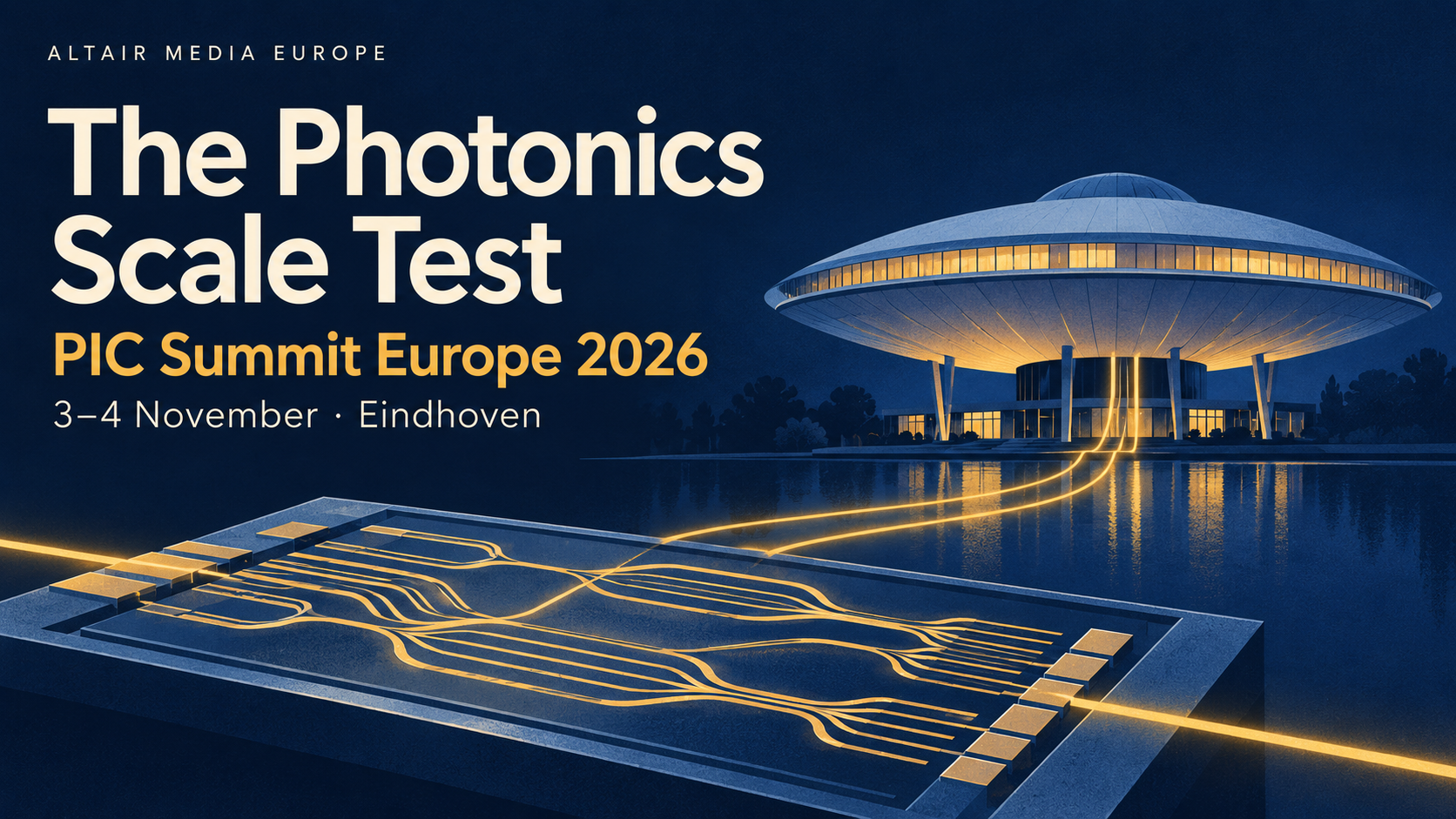
AI-generated editorial illustration created with OpenAI for Altair Media Europe.
Caption
A stylised photonic chip connects to Eindhoven’s Evoluon, illustrating the production, customer and financing challenges examined in The Photonics Scale Test, ahead of PIC Summit Europe, 3–4 November 2026.
