The Industrial War
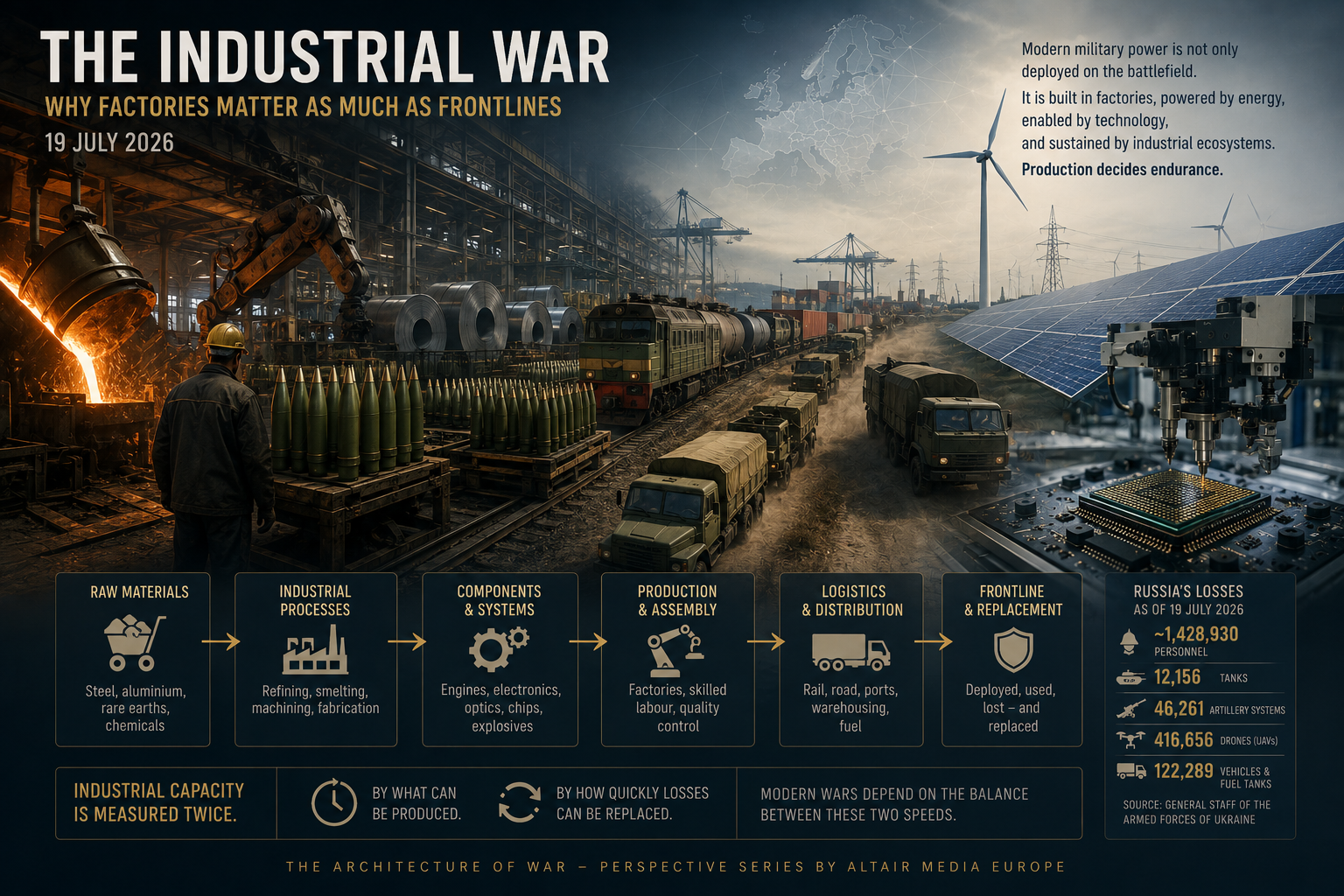
Why Factories Matter as Much as Frontlines
For more than four years, the war in Ukraine has demonstrated that modern conflicts consume extraordinary quantities of military equipment. Every day, tanks are destroyed, artillery shells are fired, drones are intercepted and military vehicles require repair or replacement. The battlefield attracts most of the attention. Yet every loss immediately raises another question. Who can build the replacement?
That question increasingly defines the strategic balance between nations. Modern conflicts are rarely decided by military skill or technological superiority alone. They are sustained by the speed and scale at which industrial systems can replace lost capability. Factories, energy networks, raw materials, skilled labour and global supply chains have become part of a single strategic ecosystem.
The war in Ukraine has therefore become more than a military confrontation. It has evolved into a test of industrial resilience—not only for Ukraine and Russia, but also for the countries that support them.
Beyond the Battlefield
A destroyed tank represents far more than the loss of a single vehicle. Replacing it requires steel, specialised alloys, electronics, optics, engines, semiconductors and precision manufacturing. Ammunition depends upon explosives, chemicals and metals. Military trucks require engines, tyres and transmissions. Even relatively inexpensive drones contain sensors, processors, batteries and communications equipment sourced from complex international supply chains.
Every military loss therefore triggers an industrial response. The battlefield consumes. Industry replenishes.
Industry as Strategic Infrastructure
Industrial production is often associated with economic growth and employment. During wartime, however, industry becomes strategic infrastructure.
Factories determine how quickly damaged equipment can be replaced. Energy systems influence industrial output. Engineers become as essential as soldiers. Railways, ports and logistics networks connect production with the battlefield, while suppliers of machine tools, electronics and advanced materials quietly become part of the wider defence ecosystem.
Military capability is therefore inseparable from industrial capability.
The Ecosystem of Production
Modern defence production is often described in terms of factories. In reality, factories represent only one visible component of a much larger industrial ecosystem.
Steel mills require enormous quantities of electricity. Semiconductor manufacturing depends upon ultrapure chemicals, sophisticated lithography equipment and highly specialised suppliers. Ammunition production relies on explosives, metals and precision engineering. Every production line ultimately depends upon transport infrastructure, skilled workers, stable financing and reliable access to raw materials.
Industrial capacity therefore cannot be expanded overnight. It emerges from ecosystems that often take decades to build.
Europe’s Industrial Challenge
For decades, European industry was optimised for efficiency. Global supply chains reduced inventories, manufacturers eliminated excess capacity and production increasingly followed just-in-time principles. From an economic perspective, these developments improved competitiveness and reduced costs.
From a strategic perspective, however, they also reduced resilience. Military preparedness follows a different logic. It requires reserve capacity, secure supply chains and production facilities that may appear economically inefficient during peacetime, yet become indispensable when demand suddenly accelerates. The war in Ukraine has exposed this structural tension.
Across Europe, governments are investing heavily in ammunition production, defence manufacturing and industrial capacity. Factories are expanding, new production facilities are being announced and long-term investments are returning to sectors that had previously been shaped primarily by commercial demand.
The challenge extends well beyond weapons. It concerns the industrial ecosystem that supports them.
Chips, Steel and Energy
Modern military equipment combines traditional heavy industry with advanced digital technology. Steel remains indispensable. So do explosives, engines and precision engineering.
At the same time, semiconductors, artificial intelligence, communications systems and advanced sensors have become equally essential.
Every modern weapon ultimately represents a conversion of raw materials and energy into military capability. Steel production requires enormous quantities of electricity. Semiconductor fabrication depends upon stable energy supplies, ultrapure water and highly specialised manufacturing equipment. Without reliable energy there is no industrial production. Without industrial production there is no modern defence capability.
Industrial resilience therefore begins long before manufacturing starts.
Strategic Partnerships
Industrial capacity rarely exists within national borders alone. Russia depends upon external suppliers for components, technology and trade routes. Ukraine relies heavily on industrial and military support from European and North American partners. European manufacturers themselves remain connected to global supply chains for raw materials, semiconductors and specialised equipment.
Modern military production has therefore become an international ecosystem. Strategic partnerships increasingly determine how resilient that ecosystem remains under pressure.
Reflection
Wars are often measured by the number of tanks destroyed or missiles launched. Yet those numbers tell only part of the story.
Behind every battlefield lies an industrial ecosystem responsible for replacing what has been lost. Factories manufacture. Energy powers production. Supply chains deliver materials. Engineers design new capabilities. Industrial networks transform raw materials into military capability.
The decisive question is therefore no longer simply how much equipment can be deployed. It is how quickly lost capability can be replaced. The battlefield remains where wars are fought. Increasingly, however, they are sustained by the industrial ecosystems that stand far behind it.
Understanding modern conflict therefore requires understanding industry—not simply as an economic sector, but as critical infrastructure underpinning national resilience, technological sovereignty and long-term strategic power.
Part of The Architecture of War — a Perspective series examining how logistics, industry, energy, communications and digital infrastructure have become the hidden architecture of modern military power.
Credit
Credit: Altair Media Europe | AI-generated editorial illustration
Caption
Behind every tank, drone or artillery system lies a far larger industrial ecosystem. The Industrial War examines how factories, energy networks, raw materials, semiconductors, logistics and skilled labour together determine the ability of nations to sustain military capability over time.
