The Global Balance Sheet
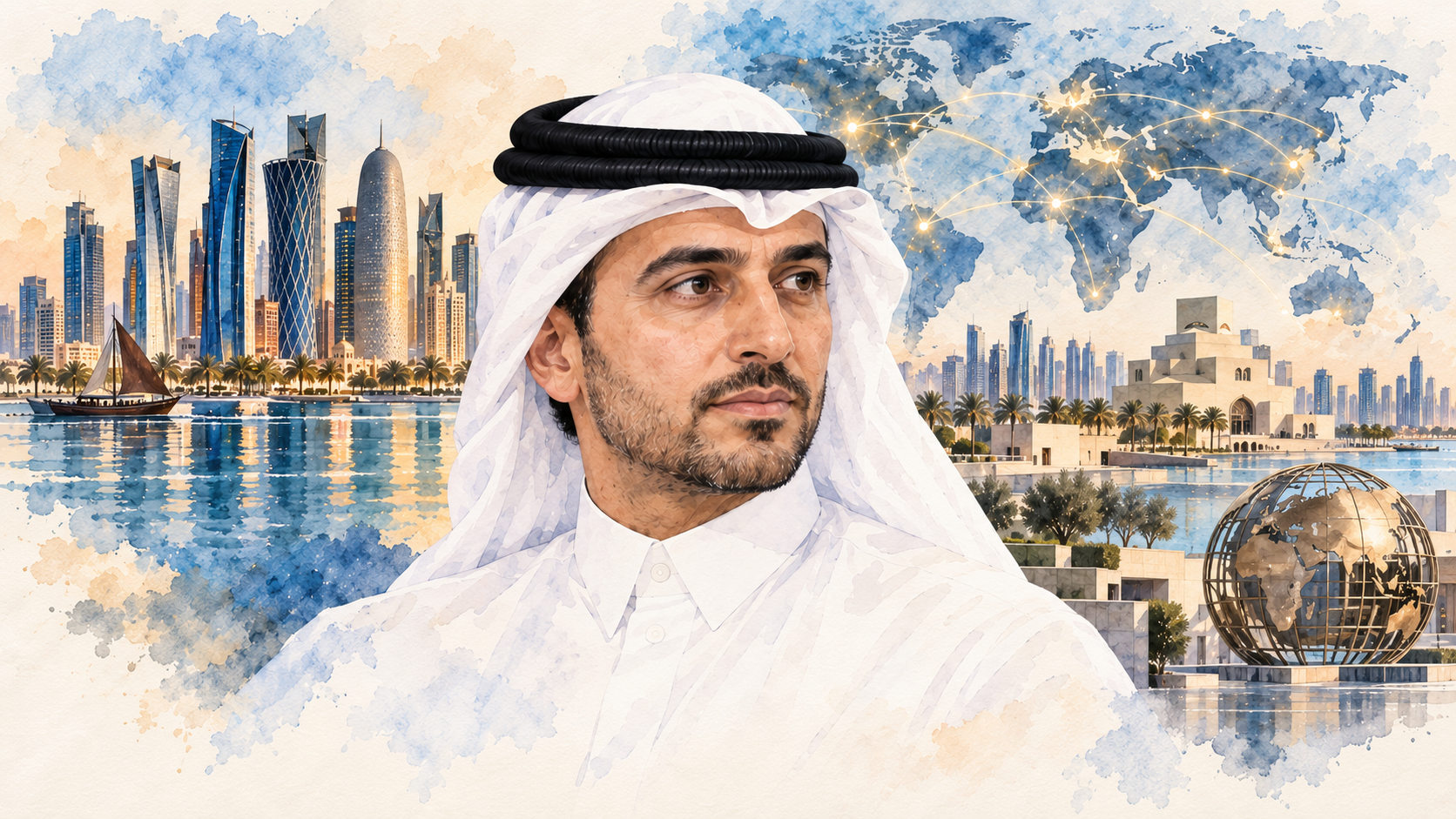
Mohammed Al-Sowaidi and Qatar’s strategy for investing beyond geography
Investing beyond Qatar
Qatar’s wealth originates in a very specific place and industry. Its investment strategy cannot afford to do the same. As CEO of the Qatar Investment Authority, Mohammed Saif Al-Sowaidi oversees the conversion of national surpluses into a portfolio spread across countries, sectors and generations. For Qatar, diversification is not simply an investment preference. It is a way of turning temporary resource wealth into permanent financial capacity.
Al-Sowaidi became CEO of QIA in November 2024 after spending much of his career inside the institution itself. He previously led its Americas portfolio and headed teams across private equity, technology, media and telecommunications, and industrials. Before returning to Doha, he spent five years building QIA’s advisory presence in New York.
That background matters because QIA operates according to a different logic from many sovereign investors.
Qatar has enormous hydrocarbon revenues but a relatively small domestic economy. There are limits to how productively that wealth can be reinvested at home without concentrating risk or distorting the local market. QIA therefore exists partly to move national wealth beyond Qatar’s geographic boundaries.
Its mandate is explicit: preserve and increase the state’s financial assets, support Qatar’s economy when necessary and create long-term value for future generations. Diversification across asset classes, sectors and countries sits at the centre of that mission.
The result is a sovereign balance sheet whose economic reach is much larger than the country that owns it.
A portfolio without an expiry date
QIA’s institutional structure reinforces that long horizon. The fund operates without the short-term liabilities that constrain many commercial investors. Returns can be reinvested, while the underlying assets are intended to preserve and expand national wealth over generations rather than satisfy quarterly redemption pressure. That gives Al-Sowaidi something unusually valuable: time.
QIA can remain invested through technological change, restructuring or corporate transformation that may take years to produce results. The 2026 take-private of Janus Henderson illustrates the approach. QIA joined Trian, General Catalyst and other investors in a $7.4 billion transaction intended to give the asset manager greater freedom to invest in technology, artificial intelligence, talent and new products away from the pressures of public markets.
Al-Sowaidi described QIA as a long-term financial investor supporting the company’s next phase of growth. Patient capital here does not mean avoiding change; it means being able to finance change without requiring an immediate exit.
Diversification is becoming more strategic
A globally dispersed portfolio can still become concentrated in the wrong risks. That is increasingly important as artificial intelligence, energy infrastructure and private markets absorb larger amounts of capital. QIA has become more active across all three.
In 2026 it agreed a strategic partnership with Goldman Sachs Asset Management targeting up to $25 billion across funds and co-investments, with AI, fintech, digital infrastructure and private credit among the areas highlighted. QIA has also invested directly in AI infrastructure companies including Crusoe, Positron and SambaNova, while backing European power-grid investment through RWE’s financing of transmission operator Amprion.
These investments are geographically dispersed, yet increasingly converge around the same underlying infrastructure: computing, electricity, finance and automation. That changes the meaning of diversification.
For an earlier generation of sovereign funds, diversification often meant avoiding excessive exposure to one country, currency or asset class. For Al-Sowaidi, it increasingly also means spreading exposure across different technological and economic futures.
A portfolio can own assets in twenty countries and still be vulnerable to the same technological cycle. True diversification therefore requires understanding what actually drives the assets beneath their geographic labels.
Distance creates its own discipline
Global investing creates another challenge for a sovereign institution.
QIA has to remain financially connected to governments, companies and markets around the world while preserving confidence that individual investments are made according to commercial criteria. Its governance structure formally separates overall national strategy from day-to-day portfolio decisions: strategic direction is established at the state level, while the board and executive management are responsible for investment decisions.
For a globally active sovereign investor, that distinction is important. The further capital travels from its home market, the more counterparties need predictable governance, financial discipline and clarity about how decisions are made. Scale alone cannot provide that credibility.
Al-Sowaidi’s challenge is therefore not simply to identify attractive assets. He has to maintain a portfolio capable of absorbing political shocks, technological transitions and changing market cycles without losing its underlying investment logic.
Long-term capital only remains powerful if patience is matched by discipline.
The global balance sheet
This makes QIA different from the other institutions in The New Architecture of Gulf Capital.
Yasir Al-Rumayyan uses sovereign capital to build markets inside Saudi Arabia. Khaldoon Al Mubarak uses international investment to connect Abu Dhabi to global capabilities. Sultan Al Jaber allocates capital across the physical energy systems underpinning the economy. Al-Sowaidi begins from a different problem.
Qatar already derives extraordinary wealth from one concentrated economic advantage. QIA’s task is to ensure that the country’s future does not remain equally concentrated.
That means turning gas revenues into ownership of companies, infrastructure and financial assets whose value is generated elsewhere, through different industries and across much longer periods.
The portfolio effectively becomes an alternative economic territory for the country. Its success cannot therefore be judged simply by how much QIA owns abroad. The deeper measure is whether those investments make Qatar’s future prosperity progressively less dependent on the economic conditions that created the wealth in the first place.
For a country whose wealth began beneath its own territory, diversification succeeds when its future no longer depends on geography.
This article is part of The New Architecture of Gulf Capital, an Altair Media series examining how sovereign wealth, energy and private enterprise are shaping the region’s post-oil economy.
Credit
Illustration: Altair Media / OpenAI
Caption
Mohammed Saif Al-Sowaidi, CEO of the Qatar Investment Authority. His role is to turn Qatar’s concentrated resource wealth into a globally diversified portfolio — spreading risk across geographies, industries and generations.
