The Energy Behind AI
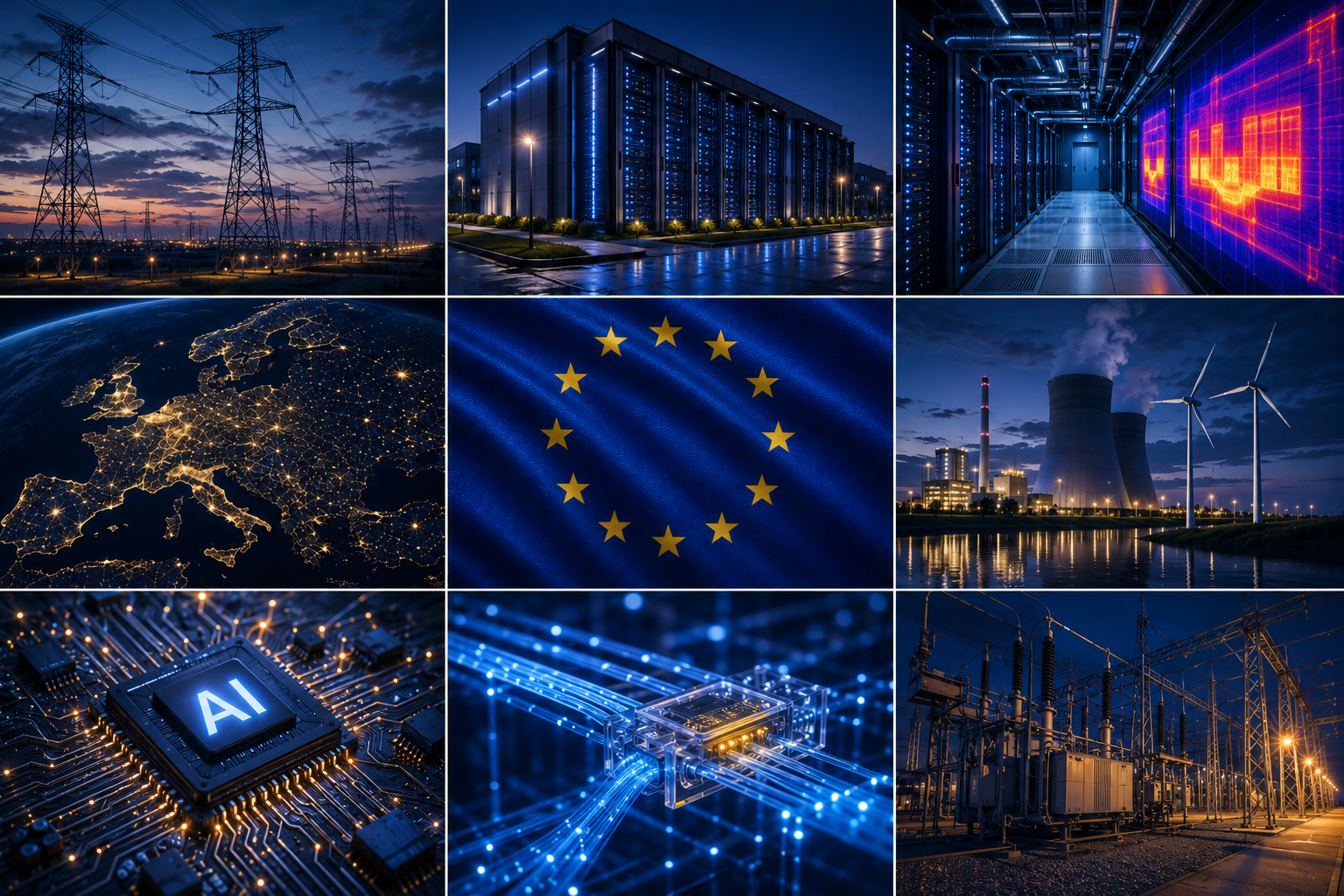
Can Europe build AI leadership without securing the energy required to power it?
Artificial intelligence is often discussed in terms of algorithms, computing power and investment. Governments announce new AI strategies. Companies compete to develop more capable models. Technology firms invest billions in data centres and cloud infrastructure.
Yet beneath the excitement lies a more fundamental question. Where will the energy come from?
As Europe accelerates its ambitions in artificial intelligence, cloud infrastructure and technological sovereignty, the challenge is becoming increasingly clear. Building an AI economy is not simply a digital project. It is also an energy project.
Artificial intelligence may be built with software, but it runs on electricity.
The European debate surrounding AI often focuses on innovation, competitiveness and investment. These are important considerations. But they risk obscuring a more basic reality.
The Material Constraint
Every AI model requires computing power. Computing power requires data centres. Data centres require electricity.
As AI systems become more advanced, demand for computing capacity continues to grow. Training models, operating cloud services and processing vast amounts of data all consume significant amounts of energy. This creates a challenge that extends far beyond the technology sector.
Europe is already undergoing a broader process of electrification. Industry is becoming more dependent on electricity. Transportation is shifting towards electric vehicles. Heating systems are increasingly moving away from fossil fuels.
Artificial intelligence is entering an energy system that is already under pressure. Across Europe, electricity grids are facing growing constraints. Grid congestion, delays in new connections and the need for major infrastructure upgrades increasingly illustrate that energy is no longer simply a technical issue. It is becoming a strategic one.
Unlike software, energy infrastructure cannot be scaled with a software update. It requires physical networks, physical assets and time. The digital economy may scale rapidly. Physical infrastructure does not.
The Infrastructure Beneath Intelligence
In the previous article of this series, cloud infrastructure emerged as a strategic pillar of technological sovereignty. Yet cloud infrastructure itself depends upon another layer of infrastructure. Data centres. Electricity grids. Transmission networks. Cooling systems. Power generation.
These systems rarely attract the same attention as AI models or semiconductor factories. Yet without them, the digital economy simply cannot function.
The growing demand for artificial intelligence is therefore forcing policymakers to think beyond software and hardware. Increasingly, the conversation is shifting towards the physical infrastructure that makes digital activity possible.
Every discussion about artificial intelligence eventually becomes a discussion about energy.
This shift reflects a broader reality. Technology may appear weightless and virtual. In practice, it depends upon a vast physical system operating largely out of sight.
The Physics of Efficiency
The challenge is not only generating enough energy. It is also using that energy more efficiently. At its core, the problem is one of physics.
Moving electrons through microchips creates resistance. Resistance generates heat. As computing demands continue to rise, increasing amounts of energy are required not only for processing information, but also for cooling the systems that perform those calculations.
The more advanced AI systems become, the more important this challenge is likely to become. This helps explain why Europe is placing growing emphasis on advanced technologies that can improve the efficiency of future computing systems.
One of those technologies is integrated photonics.
Unlike conventional electronic systems, which rely upon electrical signals, photonic technologies use light to transmit and process information. Because light does not encounter electrical resistance in the same way as electrons moving through conductive pathways, photonic systems have the potential to reduce energy consumption while improving performance in specific applications.
In that sense, photonics is not simply another emerging technology. It represents an attempt to overcome a growing physical bottleneck. For Europe, this is particularly relevant.
The continent already possesses strong research ecosystems in photonics, including clusters in the Netherlands, Belgium and Germany. As the energy demands of artificial intelligence continue to grow, these capabilities may become increasingly strategic.
The future of computing may depend not only on faster processors, but on more efficient ways of moving information.
The Green AI Paradox
Artificial intelligence creates an interesting dilemma for Europe. The continent wants to accelerate digital innovation. It also wants to reduce emissions. Those objectives are not necessarily incompatible. But they do create tensions that will require careful management.
Expanding cloud infrastructure, increasing computing capacity and building new data centres all require energy. At the same time, Europe remains committed to ambitious climate goals and the transition towards cleaner sources of power.
The challenge is therefore not simply whether Europe can build enough AI infrastructure. The challenge is whether it can build that infrastructure sustainably.
Europe wants more computing power and lower emissions at the same time. The long-term success of its AI strategy may depend on achieving both.
This tension is likely to become one of the defining policy questions of the coming decade.
Sovereignty Requires Power
The growing focus on technological sovereignty often centres on semiconductors, cloud services and artificial intelligence. Yet all of these ambitions ultimately depend upon a less visible foundation. Energy. Semiconductors require factories. Artificial intelligence requires computing capacity. Cloud services require data centres. All of them require electricity.
This is why Europe’s sovereignty debate is gradually expanding beyond technology policy alone. Increasingly, it touches energy systems, infrastructure planning and industrial strategy.
The future of AI may be written in code. But it will be powered by electricity.
This article is part of the series Europe’s Sovereignty Moment: Chips, Cloud, AI and the Infrastructure of Independence. In Part IV — The Distributed Ecosystem — we explore why Europe’s technological future may depend less on national champions and more on networks of specialised innovation clusters across the continent.
Credit
Illustration created for Altair Media using AI-assisted editorial artwork inspired by European energy systems, artificial intelligence infrastructure, cloud computing and technological sovereignty.
Caption
Europe’s AI ambitions depend on more than algorithms and computing power. Data centres, electricity grids, energy generation and emerging technologies such as photonics are becoming increasingly important foundations of technological sovereignty, digital resilience and long-term competitiveness.
