STACKIT — Industrial Germany Enters the Cloud
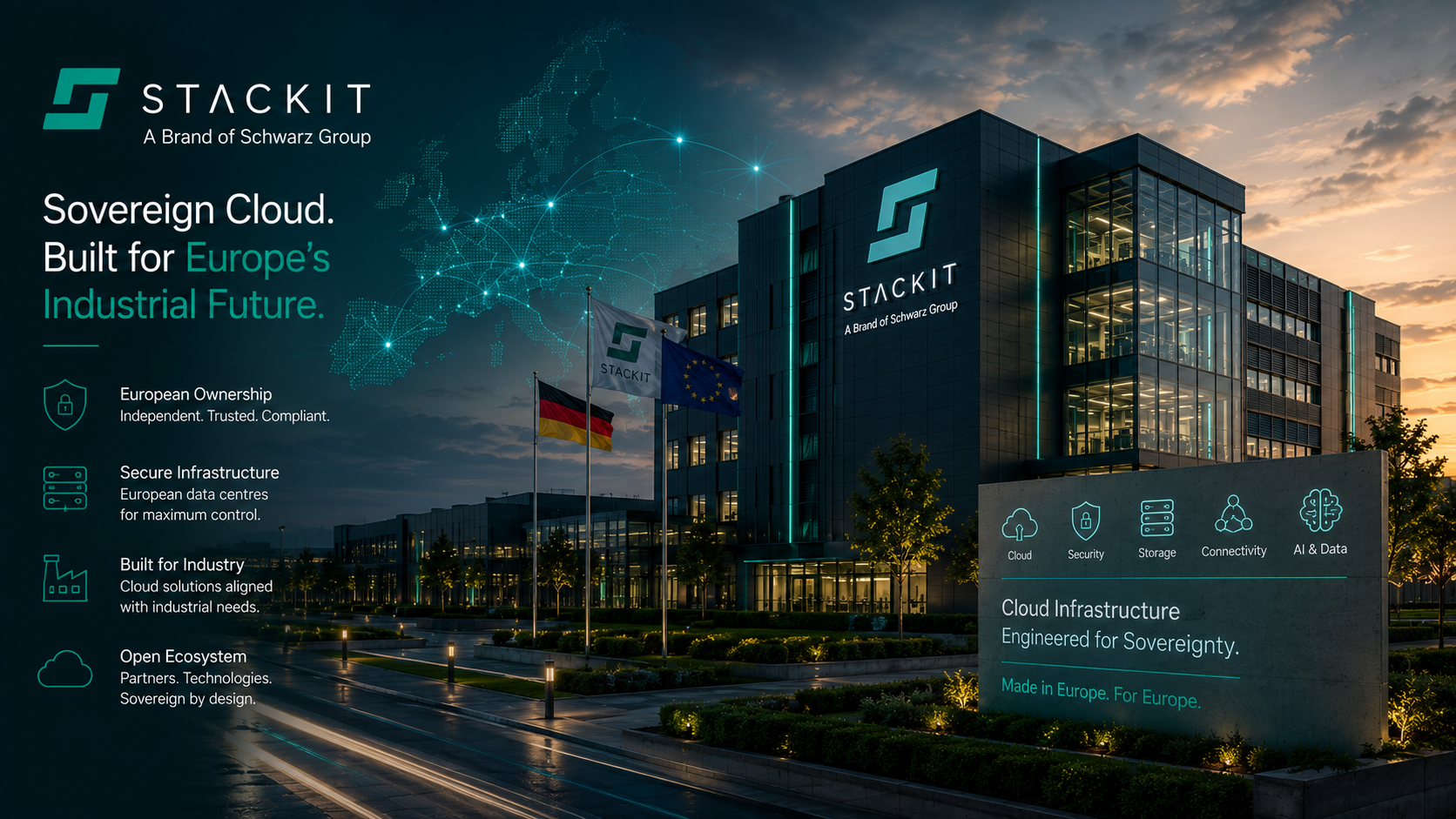
Building sovereign infrastructure for Europe’s industrial economy
Strategic Briefing
Cloud computing is often associated with technology companies, software platforms and global hyperscalers. Yet another model is beginning to emerge in Europe: cloud infrastructure developed by industrial actors seeking greater control over their own digital environments.
Few companies illustrate this shift more clearly than STACKIT.
Originally established to support the digital transformation of one of Germany’s largest retail and industrial groups, STACKIT has evolved into a broader sovereign cloud initiative aimed at enterprises, public institutions and regulated sectors. Its development reflects a wider European trend in which cloud is increasingly viewed not merely as an IT service, but as a strategic capability closely linked to industrial resilience and technological autonomy.
If cloud has become critical infrastructure, should Europe’s industrial champions participate in building it?
Overview
Headquarters
Neckarsulm, Germany
Founded
2018
Ownership
Part of Schwarz Group
Parent Company
Schwarz Group
Strategic Focus
Sovereign cloud services, enterprise computing and industrial digitalisation
Primary Markets
Germany, Austria, Switzerland and broader Europe
Positioning
European cloud provider designed around sovereignty, compliance and industrial requirements
Geographic Footprint
STACKIT remains predominantly focused on Europe. Its infrastructure is designed to operate under European jurisdiction while supporting organisations with strict requirements related to governance, security and data localisation.
Its strongest markets include:
- Germany
- Austria
- Switzerland
Expansion efforts increasingly target:
- public administration
- manufacturing
- healthcare
- regulated industries
- European enterprises seeking alternatives to global hyperscalers
Unlike many cloud providers, STACKIT emerged from an industrial ecosystem rather than from hosting services or startup communities. This heritage shapes much of its strategic positioning.
Infrastructure & Capabilities
STACKIT has gradually expanded its cloud portfolio.
Services include:
- Public cloud
- Private cloud
- Kubernetes
- Container services
- Managed databases
- Storage
- Networking
- Security services
- AI-oriented infrastructure
- Enterprise cloud environments
The company places particular emphasis on operational control, compliance and trusted infrastructure. Its architecture is intended to support organisations operating in sectors where regulatory certainty and governance considerations remain essential.
Sovereignty Assessment
STACKIT has become one of the most visible examples of Europe’s sovereign cloud ambitions. Its profile reflects several characteristics increasingly associated with digital autonomy.
European ownership ★★★★★
European governance ★★★★★
European jurisdiction ★★★★★
European datacentres ★★★★★
Industrial ecosystem integration ★★★★★
Enterprise orientation ★★★★★
Global scale competitiveness ★★★☆☆
AI readiness ★★★☆☆
Its principal advantage lies not necessarily in scale. Rather, it resides in alignment.
STACKIT appears designed to address the needs of European organisations seeking infrastructure governed according to European legal and institutional frameworks.
Competitive Position
STACKIT occupies a distinctive niche. It is neither a global hyperscaler nor a traditional hosting company.
Instead, it increasingly positions itself as a provider of sovereign infrastructure for Europe’s industrial economy.
Its competitors include:
- AWS
- Microsoft Azure
- Google Cloud
Its closest European peers are:
- OVHcloud
- IONOS Cloud
- Scaleway
- T-Systems
Yet its origins within Schwarz Group provide an unusual strategic advantage.
STACKIT was initially created to serve the internal needs of a large industrial organisation. It subsequently evolved into a commercial infrastructure platform.
This trajectory mirrors broader developments in cloud computing, where control over digital environments is increasingly regarded as a strategic asset.
Strategic Significance
STACKIT may represent a particularly European approach to cloud development. Its emergence suggests that sovereignty need not solely depend upon replicating hyperscaler scale.
It may instead arise through industrial ecosystems capable of building trusted infrastructure aligned with regional priorities.
For Germany, this question carries broader significance.
Europe possesses globally competitive manufacturers. It possesses advanced engineering capabilities. It possesses substantial demand for secure cloud environments.
The remaining challenge is whether these capabilities can be transformed into computing infrastructure operating at meaningful scale.
STACKIT provides one possible answer.
Strategic Outlook
Cloud infrastructure is becoming increasingly intertwined with industrial policy.
Artificial intelligence, automation, supply chains and advanced manufacturing all depend upon access to reliable compute resources.
In this environment, providers such as STACKIT may become strategically important not because they seek to dominate global markets, but because they contribute to Europe’s capacity to retain control over critical digital systems.
As cloud evolves from a technology service into infrastructure, STACKIT illustrates how industrial Europe is beginning to participate directly in shaping its computing future.
Part of Building Europe’s Cloud Architecture — an Innovation & Technology Lab series exploring cloud not as software, but as infrastructure.
Credit
Artwork: Altair Media / AI-generated visualisation
Caption
Developed within the Schwarz Group ecosystem, STACKIT represents an emerging model of European cloud infrastructure where sovereignty, industrial capability and trusted governance converge to shape Europe’s computing future.
