Signal | Who Owns the Map?
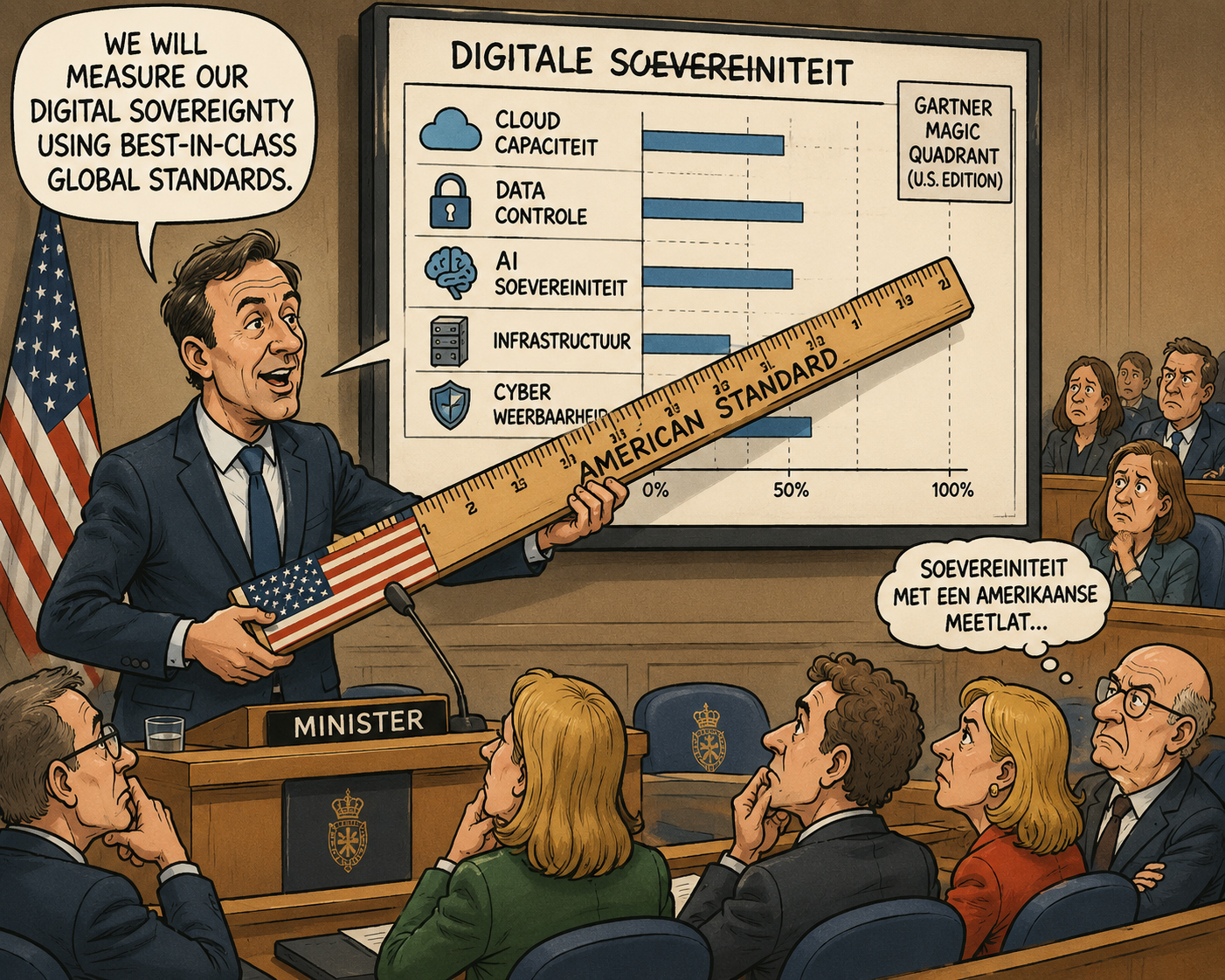
Europe wants digital sovereignty. But why does it still measure itself with an American ruler?
The Dutch parliament recently voted for sovereign technology ambitions, from GPT-NL to domestic AI factories. Yet part of the debate leaned on Gartner, an American research institution. It exposes the uncomfortable irony: Europe wants technological independence, but still measures progress with an imported ruler.
Sovereignty is not only about owning datacentres, chips or AI models. It is also about the power to define markets, establish standards and determine what technological leadership means.
Infrastructure is not merely physical. Infrastructure is cognitive. If Europe does not design the map, it will keep navigating territory drawn by others.
■ Can Europe become digitally sovereign if its definition of technological success remains dependent upon foreign analytical frameworks?
Europe discusses autonomy in terms of hardware, compute and cloud capacity. But ecosystems are also shaped by those who classify markets, define maturity and guide investment flows.
Perhaps the most strategic question is not who owns the infrastructure. Perhaps it is who owns the metrics.
■ Who decides what counts as technological leadership?
Governments consult analysts. Investors follow rankings. Procurement processes rely on market classifications. Companies compete to become leaders within categories they did not create. If sovereignty matters, should technology assessment, benchmarking and strategic foresight also be treated as strategic capacities?
■ Europe invests billions in chips and AI factories, but who is investing in Europe’s capacity to interpret structural change?
Europe has world-class universities, strong research institutes and industrial capabilities. Yet it has few institutions capable of shaping the global narrative around technology at scale.
Europe is funding the hardware of the future. But does it possess the analytical institutions required to interpret that future?
■ Is Europe’s deepest dependency technological, financial — or epistemological?
Europe understands the strategic nature of energy sovereignty, food security and physical supply chains.
The next frontier may be recognising knowledge infrastructure as part of that same defensive architecture.
True autonomy concerns more than ownership. It concerns interpretation.
Credit
Illustration by Altair Media (AI-generated)
Caption
Europe wants sovereign infrastructure. But can sovereignty be achieved if the metrics, benchmarks and maps used to measure progress are still imported?
