Paris-Saclay — Europe’s Intellectual Core of 6G
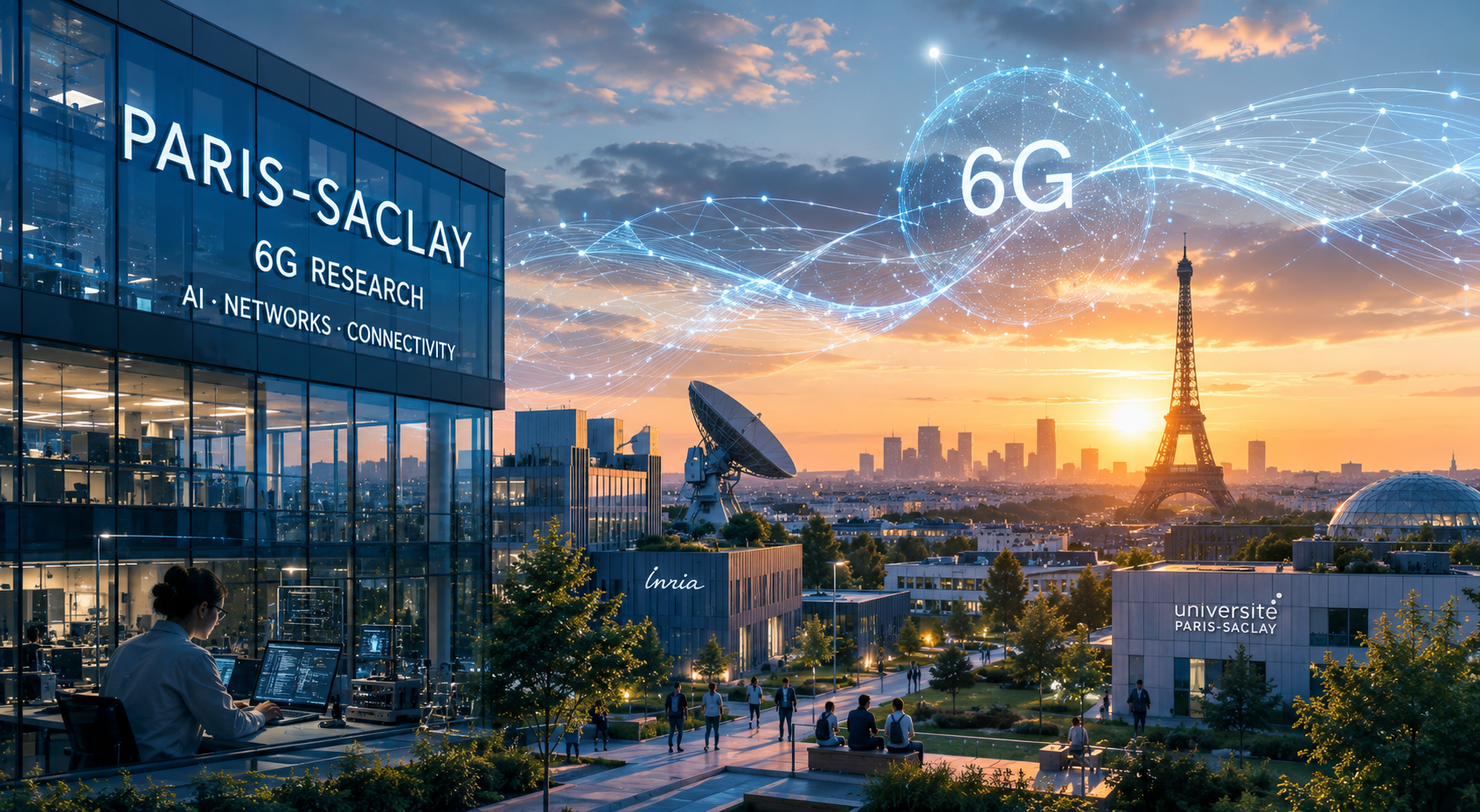
Why Europe’s Future Networks May Be Designed Before They Are Built
The Science Behind Connectivity
Telecommunications are often associated with antennas, spectrum auctions and industrial capability. Yet the next generation of connectivity may depend just as much on mathematics, artificial intelligence and software as it does on hardware. Few European regions illustrate this transformation better than Paris-Saclay.
Located south of Paris, the Saclay plateau has quietly evolved into one of Europe’s most concentrated scientific ecosystems. Universities, laboratories, engineering schools and research institutes together form an environment where the future architecture of communications networks is increasingly being imagined, modelled and designed.
Future networks will not simply be faster. They will increasingly become adaptive, autonomous and intelligent systems.
If Brainport Eindhoven represents the physical layer of Europe’s telecom future, Paris-Saclay increasingly embodies its intellectual foundations.
For decades, telecommunications revolved around radio engineering, transmission technologies and spectrum efficiency. The coming generation of networks is likely to be defined by something different. Networks are gradually evolving into intelligent systems capable of learning, adapting and optimising themselves.
Artificial intelligence is becoming embedded within network management. Distributed architectures are changing how computing resources are allocated. Software-defined infrastructures are enabling greater flexibility, while machine learning introduces new possibilities for efficiency, resilience and automation.
Telecommunications is therefore becoming more than an engineering discipline. It is increasingly a field where computer science, applied mathematics, data science and systems theory converge.
From Infrastructure to Intelligence
Traditional networks were designed around predictable traffic flows and static configurations. Future communications systems may behave very differently.
Networks could dynamically allocate resources based on demand. Artificial intelligence may optimise performance in real time. Digital twins might simulate network behaviour before physical deployment, allowing operators to anticipate bottlenecks, vulnerabilities and energy consumption. Connectivity itself is becoming computational.
Telecommunications is gradually becoming a discipline where physics meets computation.
The network is no longer merely a conduit for information. It is gradually evolving into an intelligent environment capable of sensing, interpreting and responding to changing conditions.
This transformation requires a different kind of ecosystem. Rather than manufacturing hardware, regions such as Paris-Saclay increasingly generate concepts, frameworks and scientific models that shape technological trajectories long before products reach the market.
Cognitive Infrastructure
Paris-Saclay increasingly functions as a form of cognitive infrastructure. Its institutions contribute to advances in artificial intelligence, distributed computing, cybersecurity, software-defined architectures and future communications systems. Research produced within the ecosystem increasingly feeds into European collaborative programmes exploring next-generation connectivity, edge computing and intelligent infrastructure.
Unlike industrial clusters, its outputs are often intangible. They take the form of algorithms, theoretical models, simulation environments and scientific insights.
Technological leadership is no longer determined only at the point of production. It is increasingly determined at the point of conception.
Yet these intellectual assets can prove just as strategically important as factories or manufacturing capacity. Knowledge itself is becoming strategic infrastructure.
Technological leadership is increasingly determined long before products reach the market. It emerges at the point of conception, where architectures are defined, models are developed and future technological trajectories are imagined.
A Different Type of Ecosystem
Innovation ecosystems do not all perform the same function. Some manufacture enabling technologies. Others generate the knowledge upon which entire industries eventually depend.
Brainport Eindhoven excels at transforming scientific advances into components, production technologies and physical capabilities.
Some ecosystems manufacture technologies. Others manufacture the ideas upon which entire industries are later built.
Paris-Saclay operates further upstream. Its contribution lies in creating the intellectual environment where new ideas can emerge, mature and eventually influence industrial systems across Europe.
The relationship between the two ecosystems is therefore complementary rather than competitive. One engineers the technologies. The other engineers the concepts.
Beyond Paris
Paris-Saclay illustrates a broader shift taking place within Europe’s strategic industries. As telecommunications become increasingly software-driven and intelligence-enabled, scientific ecosystems capable of producing new paradigms may become as valuable as regions producing semiconductors, photonic chips or advanced manufacturing equipment.
This gives ecosystems such as Paris-Saclay significance far beyond France. They increasingly function as intellectual control points within Europe’s innovation landscape.
Their influence extends not through exports or production volumes, but through their ability to shape future technological trajectories, influence architectures and contribute to the conceptual foundations upon which future communications systems will depend.
Manufacturing capability and cognitive capability are becoming equally important components of technological leadership.
Conclusion
The future of telecommunications will not be determined solely by spectrum auctions, operators or network equipment. It will increasingly depend upon the ecosystems capable of imagining new architectures for connectivity.
Brainport Eindhoven demonstrates how Europe builds technological capability. Paris-Saclay demonstrates how Europe develops technological understanding. Together they reveal a deeper reality. Future telecommunications will emerge through the interaction between physical ecosystems and intellectual ecosystems.
Some regions manufacture enabling technologies. Others manufacture the ideas that determine how those technologies will eventually be used. Regional leadership, in this sense, is no longer only industrial. It is increasingly cognitive.
Brainport engineers the hardware. Paris-Saclay engineers the ideas.
Regional Rising explores the European ecosystems where future industries are imagined, engineered and brought to scale.
Credit
Illustration: Altair Media (AI-assisted visualisation)
Caption
Paris-Saclay has emerged as one of Europe’s most concentrated scientific ecosystems. Through advances in artificial intelligence, software-defined architectures and next-generation communications research, the region increasingly contributes to the intellectual foundations of Europe’s future telecommunications infrastructure.
