Europe Has One Currency but Many Capital Markets

Why monetary union did not create financial union
Europe’s single currency is one of the most visible achievements of European integration. Every day, millions of Europeans use the euro without giving it much thought. Businesses trade across borders, people travel freely and companies increasingly operate within what appears to be one integrated European economy.
Yet beneath that shared currency lies a much more fragmented reality. Europe has one currency. But it does not have one capital market.
A common currency can unite economies. Only integrated capital markets can finance their future.
At first glance, the distinction may appear technical. In reality, it influences how European companies grow, how innovation is financed and how investment flows across the continent. While the euro unified monetary policy, it never fully unified the financial system that supports Europe’s economy.
Read MoreWhy Does Europe Need a Capital Markets Union?

Why Europe’s single market still lacks a truly integrated financial system.
Europe has spent decades building roads, railways, ports, electricity grids and digital networks that connect its economies. Goods move freely across borders. Millions of Europeans live, study and work in other Member States. Nineteen countries share a common currency, while the European Union increasingly speaks of competitiveness, industrial resilience and technological sovereignty as defining priorities for the decades ahead.
Yet one essential form of infrastructure remains remarkably fragmented. Not transport. Not energy. Not digital networks. But capital. Roads move goods. Energy grids move electricity. Digital networks move information. Capital markets move investment.
Capital markets are not simply financial institutions. They are the infrastructure through which investment becomes economic growth.
Like every other form of infrastructure, financial markets connect people, institutions and opportunities. They determine how savings become investment, how ideas become businesses and how innovation finds the long-term financing required to grow. While roads and railways connect Europe’s physical economy, capital markets connect its financial one.
For many Europeans, the term Capital Markets Union (CMU) sounds technical, distant or confined to financial institutions. In reality, it addresses one of the most fundamental questions facing Europe’s economy.
How can Europe ensure that its own savings help finance its own future?
Read More
Nordic Axis — Where Europe Designs the Future of Connectivity
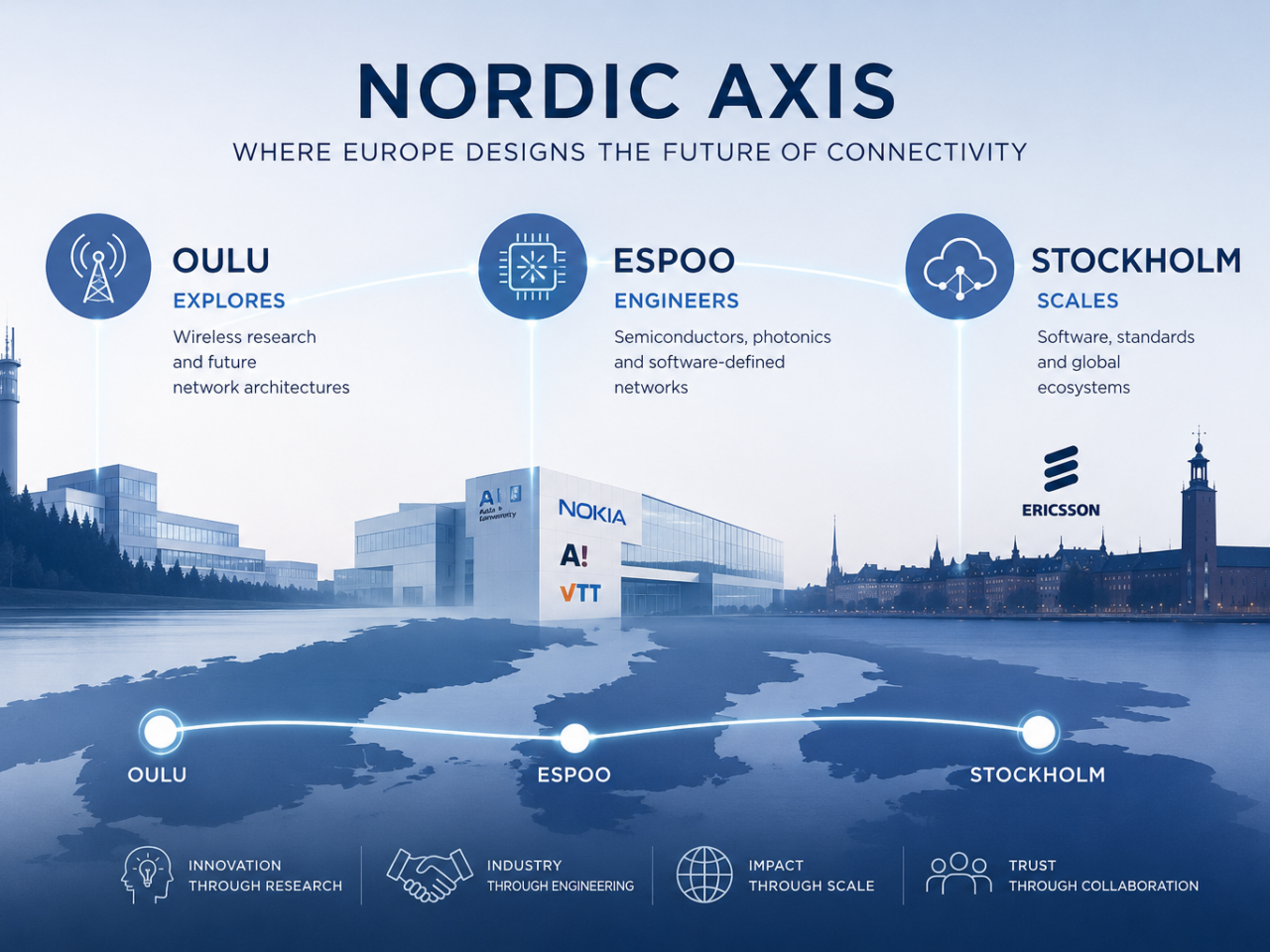
Why Europe’s telecommunications leadership is built across borders
For decades, Europe has remained one of the few regions capable of developing its own telecommunications infrastructure. Much of that capability has been associated with two globally recognised companies: Nokia and Ericsson.
Yet behind these familiar names lies a far broader innovation ecosystem stretching from northern Finland to Sweden—one that has quietly shaped successive generations of mobile communications and is now helping define the future of 6G.
Unlike many of the world’s leading technology regions, the Nordic telecommunications ecosystem does not revolve around a single city. Instead, it operates as an interconnected network of universities, research institutes, technology companies and public institutions whose combined capabilities extend far beyond national borders.
The Nordic Axis is not a single technology cluster. It is a distributed innovation system.
The Nordic Axis is not a single technology cluster. It is a distributed innovation system where scientific discovery, industrial engineering and global deployment reinforce one another. As telecommunications evolve from physical infrastructure into intelligent, software-defined systems, this collaborative model may represent one of Europe’s greatest strategic advantages.
Read More