Euronext — Can Europe’s Stock Exchange Enter the 21st Century?

Connecting markets is no longer enough. Europe increasingly needs its exchanges to help finance its future
Euronext has grown from connecting several European exchanges into a group spanning markets from Amsterdam and Paris to Milan and Oslo. But while Euronext has expanded, the task facing Europe’s exchanges has changed too: they must increasingly help finance an economy built around technology, energy, defence and industrial scale.
That is why Euronext deserves a closer look. The question is no longer whether it can operate efficient markets, but whether it can help connect European companies with the much larger pools of capital they will need to compete in the 21st century.
Read MorePayments Are More Than Financial Services
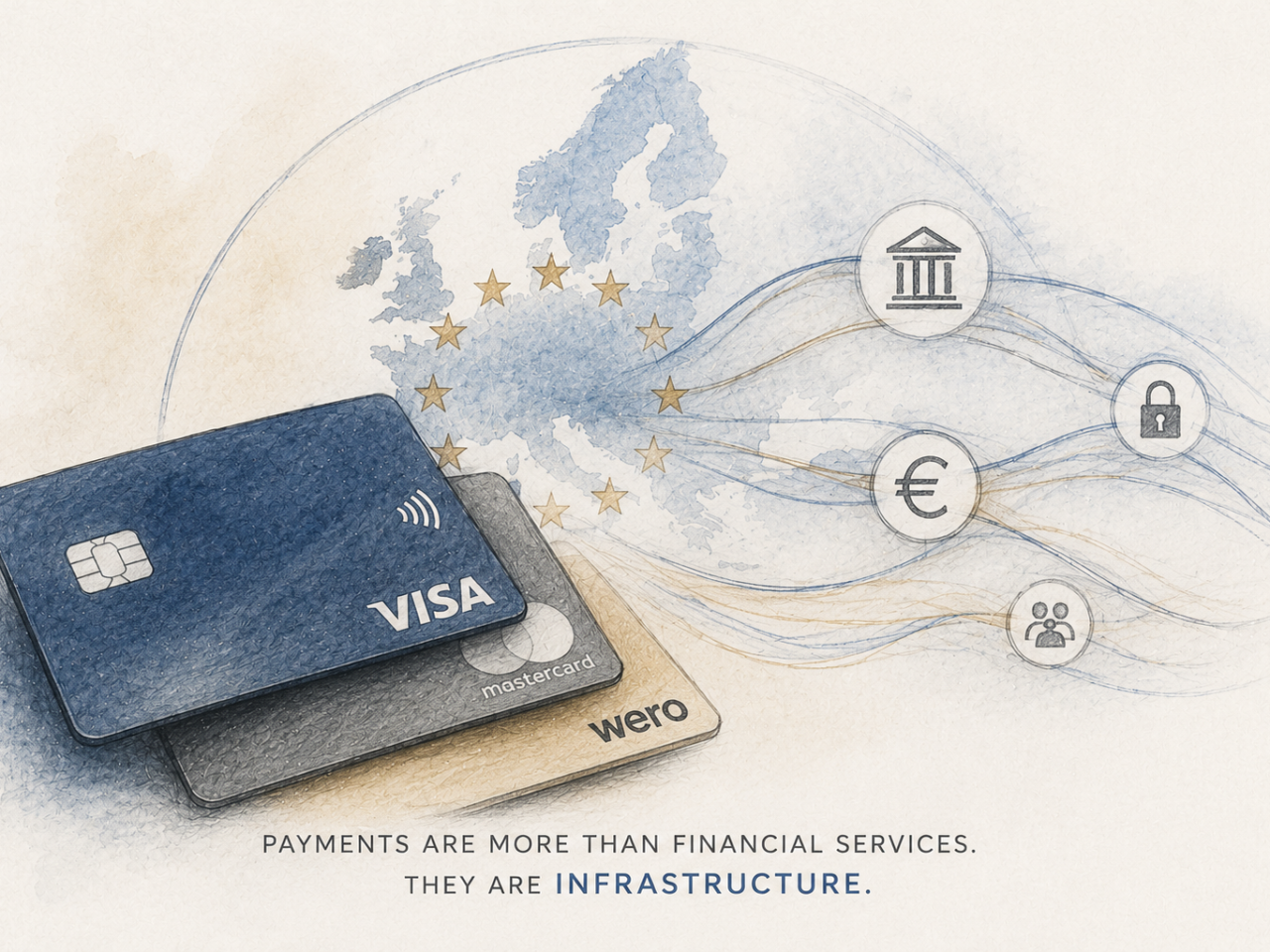
Why Europe’s Digital Economy Depends on Invisible Infrastructure
Paying for a cup of coffee has become one of the simplest actions in modern life. A card is tapped, a phone is held against a terminal and within seconds the transaction is complete. Yet behind that everyday moment lies a sophisticated financial infrastructure connecting banks, payment networks, clearing systems and central banks. As Europe becomes increasingly digital, understanding who operates that invisible architecture is becoming a strategic question in its own right.
For most people, a payment begins and ends with a familiar gesture. Whether using a debit card, a smartphone or a digital wallet, the experience feels almost effortless. The technology has become so intuitive that few consumers pause to consider what actually happens after pressing “Pay.”
In reality, a digital payment is the result of several independent systems working together. The payment application initiates the transaction, banks verify the accounts involved, payment networks route the request, clearing and settlement systems complete the transfer, and central bank infrastructure provides the monetary foundation that ultimately makes the entire process possible.
Every payment may feel instantaneous. The infrastructure behind it has taken decades to build.
Like electricity or telecommunications, this architecture has been designed to remain invisible. Its success is measured precisely by the fact that people rarely notice it.
Read MoreEurope Needs to See the Bigger Picture

Why governing the details is no substitute for building a vision
Europe rarely lacks policy. When a problem emerges, institutions investigate it, scientists measure it, governments develop frameworks and regulators establish standards. Environmental damage becomes a question of emissions. Artificial intelligence becomes a question of risk. Digital markets become a question of competition.
There are good reasons for this. Complex societies need rules, measurements and institutions capable of protecting public interests. But something can disappear when every challenge becomes a separate policy domain.
The larger picture.
Europe has become remarkably sophisticated at governing individual parts of society while sometimes struggling to articulate what those parts should ultimately create together.
When the Indicator Becomes the Debate
Consider nitrogen. Across Europe, environmental pressures increasingly translate into measurable targets, thresholds and regulatory obligations. Nitrogen has become one of the clearest examples of this tendency, particularly in densely populated and intensively used countries such as the Netherlands.
The science matters. Biodiversity matters. Environmental limits matter. Yet the debate quickly moves towards thresholds, permits, calculation models and reduction targets. These are necessary questions. But they are not necessarily the largest questions.
Read More