Oracle Cloud — The Database Empire Reimagined
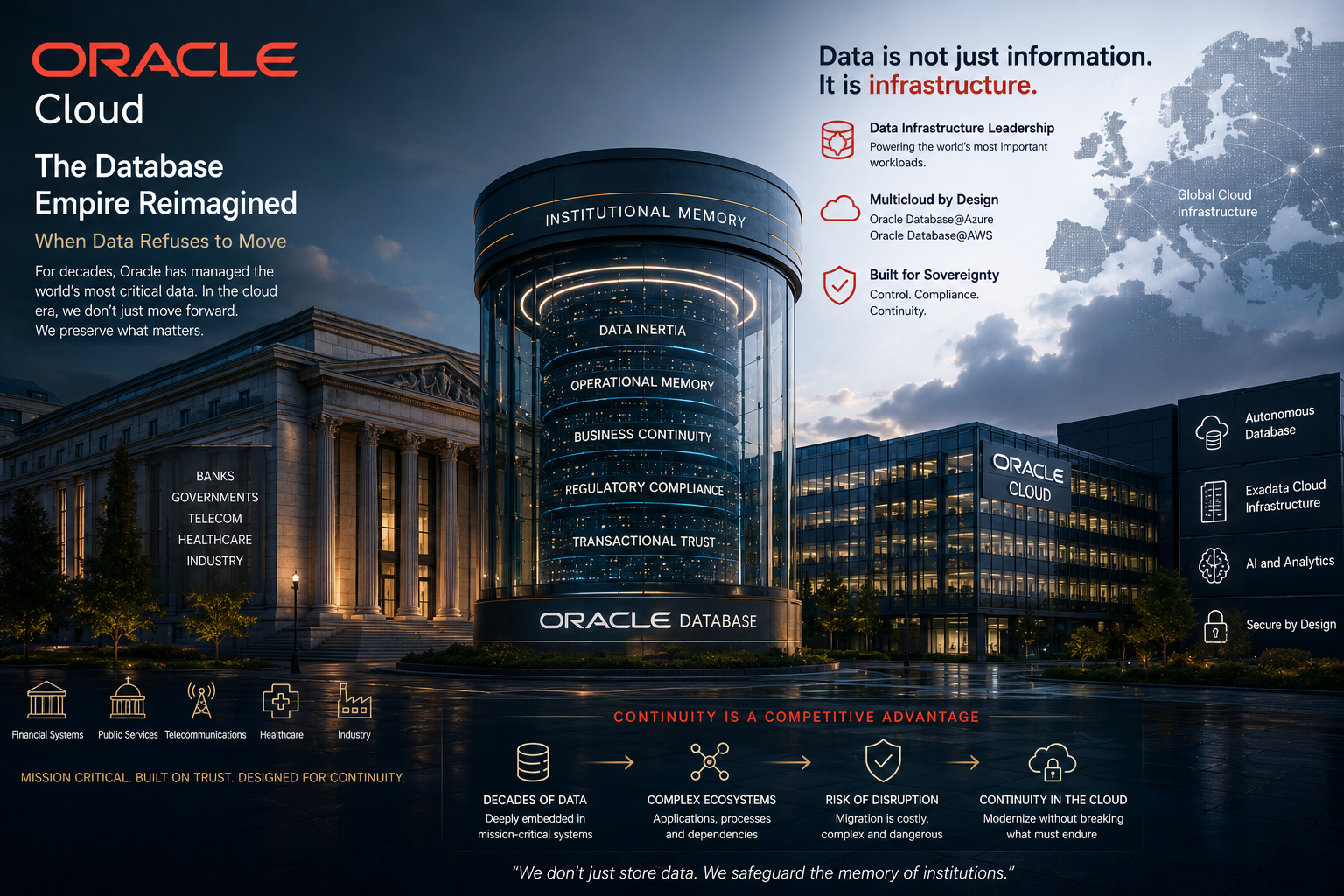
When Data Refuses to Move
Strategic Briefing
Cloud computing is often associated with scale, artificial intelligence and developer ecosystems. Oracle tells a different story. Its influence rarely emerges through consumer platforms, developer communities or hyperscale narratives. It resides elsewhere. Inside databases.
For decades, Oracle embedded itself within some of the world’s most critical institutions. Banks. Governments. Telecommunications providers. Healthcare systems. Industrial corporations. Much of the contemporary economy continues to operate on databases Oracle helped create.
The question is no longer whether Oracle is a database company. It may be whether Oracle has transformed data itself into infrastructure.
The Installed Base
Unlike AWS, Oracle did not create a new market. Unlike Microsoft, it did not extend an existing productivity ecosystem. Oracle entered the cloud era carrying decades of institutional dependence. Thousands of organisations already relied upon Oracle technologies for mission-critical workloads. The challenge therefore was never adoption. It was continuity.
Cloud became an exercise in preserving operational stability while enabling transformation. How do institutions modernise without disrupting systems that have accumulated decades of organisational memory? Oracle increasingly positions itself as the answer.
Data Inertia
If AWS built compute infrastructure and Google built intelligence infrastructure, Oracle increasingly represents data infrastructure.
Financial systems. Supply chains. Tax administrations. Customer databases. Public records. Healthcare information systems. Much of the operational memory of organisations remains stored within databases.
For many institutions, moving data is considerably more difficult than moving applications. Data possesses inertia. Data accumulates history. Data creates dependencies. Infrastructure therefore emerges not merely through innovation. But through persistence.
The Multicloud Paradox
Oracle illustrates an emerging paradox within cloud computing. Rather than forcing customers to migrate entirely toward Oracle Cloud, the company increasingly brings Oracle infrastructure into competing environments.
Initiatives such as Oracle Database@Azure and Oracle Database@AWS suggest that cloud competition may increasingly revolve around coexistence rather than replacement.
Oracle does not necessarily need to win the cloud market. It may simply need to remain indispensable. This reveals an uncomfortable reality. Data may ultimately prove more difficult to replace than compute itself.
Institutional Memory
Artificial intelligence is creating unexpected opportunities for Oracle. Models require compute. Organisations require data. Oracle already sits close to some of the largest repositories of enterprise information in the world.
Its strategy increasingly seeks to connect databases, analytics and artificial intelligence into a unified environment. The objective is not necessarily market dominance. It is continuity. Because continuity itself has become a form of infrastructure power.
The Database Empire
Oracle may never achieve the market scale of AWS. Nor the organisational integration of Microsoft. Nor the research prestige of Google. Yet it occupies a strategic position few others possess. It manages data. And increasingly, data is becoming one of the defining resources of the AI era.
Oracle therefore represents something distinct. Not merely a cloud provider. But an infrastructure built upon institutional memory.
Sovereignty Assessment
Global Scale Competitiveness ★★★★☆
Enterprise Integration ★★★★☆
AI Capability ★★★★☆
Data Infrastructure Leadership ★★★★★
European Datacentre Footprint ★★★★☆
European Jurisdiction ★★☆☆☆
Strategic Autonomy Alignment ★★☆☆☆
Series Note
Building Europe’s Cloud Architecture explores the infrastructures, organisations and governance models shaping Europe’s computing future.
Phase II — The Hyperscalers examines the global platforms that established the cloud paradigm itself: AWS, Microsoft Azure, Google Cloud and Oracle Cloud, and considers how Europe positions itself within an increasingly strategic computing landscape.
Credit
Artwork: Altair Media / AI-generated visualisation inspired by Oracle Cloud’s role in data infrastructure, institutional memory and continuity within the cloud era.
Caption
A contemporary interpretation of Oracle Cloud as an infrastructure of continuity, where databases, institutional memory, regulatory systems and enterprise workloads converge into a strategic layer of modern economies.
