Jean-Christophe Laloux — Europe Must Turn Risk into Momentum
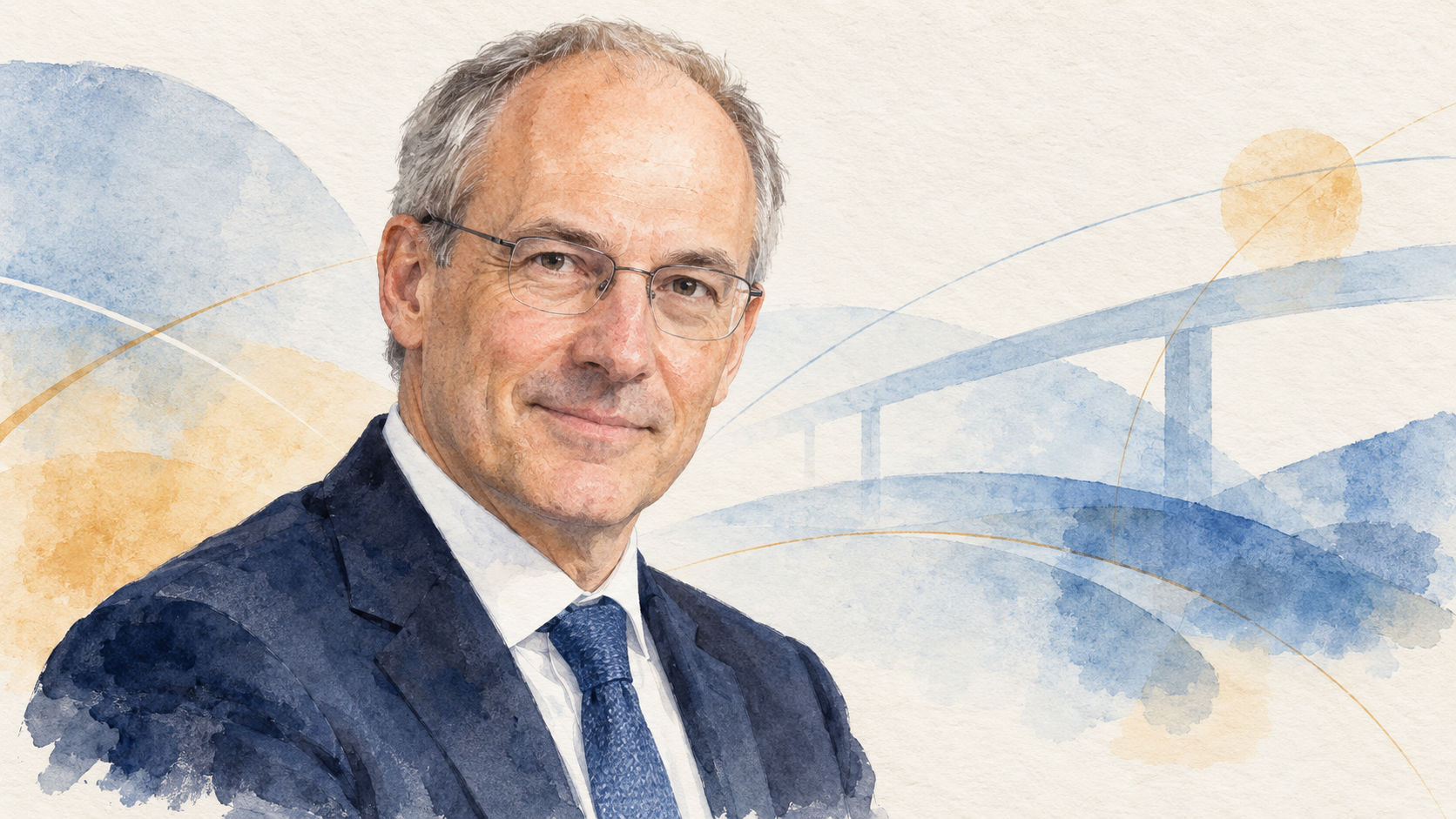
As he prepares to lead the European Investment Fund, Laloux’s task is not to finance Europe’s transition alone, but to create the instruments through which public support, private capital and industrial investment begin to reinforce one another.
THE PEOPLE SHAPING EUROPE | Jean-Christophe Laloux has spent more than a decade transforming the European Investment Bank’s financing operations. As the incoming Chief Executive of the European Investment Fund, he will move from financing individual projects and companies to shaping the markets through which European capital reaches them.
Europe does not lack investment ambitions. It wants to modernise its electricity grids, expand renewable generation, build artificial intelligence and quantum capacity, strengthen defence production and retain more of its emerging technology companies.
Nor does Europe lack capital. Its households, banks, insurers, pension funds and institutional investors collectively control vast financial resources. What it lacks is a sufficiently effective system for moving that capital towards projects that are strategically important but still too early, uncertain or complex for conventional investors.
Jean-Christophe Laloux has spent much of his career working inside that gap. As Director General responsible for lending and advisory operations within the European Union at the European Investment Bank, he has overseen the development of financial instruments intended to make difficult investments possible. When he becomes Chief Executive of the European Investment Fund on 1 January 2027, he will inherit a different position within the same institutional family—and a larger systemic question.
Can public finance create enough confidence, capacity and momentum for private capital to begin moving by itself?
“The EIF serves at the crossroads of European economic priorities.”
Jean-Christophe Laloux, incoming Chief Executive, European Investment Fund
From transactions to systems
Laloux is not moving into the EIF as an outsider. He joined the EIB in 1999 and previously worked as a senior venture capital officer at the EIF. He subsequently held positions across lending, private equity, human resources and operational management before taking charge of the EIB’s European lending and advisory activities.
During his decade at the head of the EIB’s operational frontline, his teams delivered more than half a trillion euros in new lending. But volume alone does not explain his importance.
Under his leadership, the EIB developed venture debt for high-growth technology companies, risk-sharing arrangements with commercial banks, new approaches to construction and technology risk, anchor investments in green bonds and counter-guarantees for industrial supply chains. Around €6 billion in venture debt has been invested in approximately 300 companies, while €5 billion in counter-guarantees has been deployed for the European wind industry.
These instruments share a common principle. Public capital does not necessarily have to finance an entire company, factory or infrastructure project. It can intervene at the point where uncertainty prevents others from participating.
A guarantee can release bank lending. An anchor investment can help a fund reach sufficient scale. Venture debt can extend the runway of a technology company. Patient equity can carry an infrastructure project through its riskiest development phase.
Laloux’s stated credo inside the EIB has been the pursuit of more meaningful risk-taking. At the EIF, that philosophy will acquire a broader institutional setting. At the EIB, he helped execute transactions. At the EIF, he will increasingly shape the intermediaries and incentives through which thousands of transactions become possible.
The multiplier beneath Europe’s ambitions
The European Investment Fund is sometimes mistaken for a smaller version of the EIB. Its actual function is different.
The EIB uses its balance sheet primarily to provide loans, guarantees and direct financing for companies and large projects. The EIF generally works through financial intermediaries. It invests in venture capital, private equity and infrastructure funds, supports securitisation and provides guarantees to banks and other lenders. Its power therefore lies less in the amount it invests than in what its participation enables.
When the EIF enters a fund as an anchor investor, other investors may acquire the confidence to follow. When it guarantees part of a bank portfolio, the bank may become willing to lend to smaller or less established companies. When it supports an emerging fund manager or unfamiliar technology class, it can help create an investment market that did not previously exist. The institution is designed to operate as a multiplier.
Public capital becomes strategic when it teaches private capital how to move.
This position is becoming more important as Europe attempts to construct a financial flywheel. Public institutions absorb part of the initial uncertainty. Private funds and banks bring additional capital. Companies acquire the means to grow. Successful investments produce expertise, returns and larger funds capable of financing the next generation.
No European public institution has a balance sheet large enough to fund every transition now being demanded of it. Europe’s energy system alone will require more than €10 trillion of investment by 2040. Artificial intelligence, semiconductor production, defence, housing and industrial decarbonisation add further claims on limited public resources.
The objective cannot be to create a public fund equal to the entire investment requirement. It must be to build a system capable of processing capital repeatedly. Laloux’s challenge is to help make that repetition possible.
Energy as the test of the machinery
Europe’s energy transition demonstrates both the potential and the limitations of this model. Large transmission lines, offshore connections and regulated electricity networks can be financed directly by the EIB, commercial banks and institutional infrastructure investors. These assets are expensive, but they often possess identifiable revenues, established operators and long operating lives. The less visible layers are more difficult.
Europe also needs developers capable of preparing renewable projects, manufacturers producing cables and transformers, companies deploying battery storage, software businesses managing flexible electricity demand and specialised funds willing to finance assets before they become operational.
Many of these investments are too small for direct EIB financing but too specialised or uncertain for mainstream institutional investors. They occupy the territory in which the EIF can be most influential.
The EIF’s infrastructure activities include €6.5 billion in commitments across 67 fund investments, reaching more than 3,300 companies and projects. Its climate and infrastructure instruments support funds investing in renewable generation, transmission and distribution, storage, sustainable transport, digital connectivity and industrial decarbonisation.
The strategic value lies in supporting projects during their formative stages. Once assets are operating and revenues have become predictable, pension funds, insurers and established infrastructure investors are more likely to acquire them. Capital invested in development can then be recycled into new projects.
The EIF is therefore not the centre of Europe’s energy system. It is part of the financial machinery that helps new assets enter it.
Laloux cannot solve inadequate electricity regulation, slow permitting, congested connection queues or disagreement between national governments. Financial engineering cannot compensate indefinitely for political and administrative failure.
But where credible projects are being prevented by unfamiliar risks, insufficient fund capacity or a lack of early-stage capital, the EIF can help remove the financial obstruction.
From innovation to investability
Laloux’s position connects the institutions already examined in this series.
Christine Lagarde can explain why monetary stability cannot compensate for fragmented capital markets. Michiel Scheffer and the European Innovation Council can identify technologies with transformative potential. Maria Luís Albuquerque is responsible for developing the Savings and Investments Union through which European capital should circulate. Nadia Calviño is turning the EIB Group into a more strategic European balance sheet.
Laloux will operate at the point where these ambitions must become investable structures.
Scheffer can support a breakthrough technology. But the company behind it will eventually need larger venture funds, venture debt, manufacturing capital and commercially credible customers.
Albuquerque can work to create deeper European capital markets. But savings will not automatically find their way into unfamiliar technologies or first-of-a-kind infrastructure.
Calviño can give the EIB Group permission to assume a more strategic role. But strategic direction must still be translated into instruments that banks, fund managers and private investors can use.
Strategy identifies the destination. Financial architecture determines whether capital can reach it.
The immediate pressure will be greatest in technology finance. Under Marjut Falkstedt, the EIF launched the European Tech Champions Initiative and prepared its successor. The first initiative helped create 15 European mega-funds and supported 45 companies, including 12 unicorns. Its expanded form brings together EU governments, the EIB Group and institutional investors in an alliance intended to mobilise as much as €80 billion.
Laloux has said that helping future European champions obtain the means to grow within the European Union will be central to his agenda. He also intends to pursue closer cooperation with the EIB and European Commission and develop new forms of partnership with private investors, according to the announcement of his appointment.
But creating larger European funds is only the first step. Pension funds and insurers control enormous pools of long-term capital, yet many remain reluctant to make meaningful allocations to European venture and growth funds. Some are more comfortable using large, established international managers than helping build comparable capacity within Europe.
The EIF can anchor European funds. A genuine flywheel requires private limited partners to remain after public support recedes.
Security and defence create an additional boundary. The EIF can support specialised and dual-use technology funds, but institutional investors differ sharply in what their mandates permit. Laloux must expand Europe’s defence-financing ecosystem without creating vehicles that private investors are unwilling or unable to enter.
His objective should not be financial enclosure. Outside capital can strengthen European companies. The deeper problem arises when those companies have no credible European financing alternative. A functioning capital market offers choice.
When mobilisation becomes illusion
The language surrounding public finance is filled with large multipliers.
A public commitment is expected to mobilise several times its own value. Guarantees unlock lending. Fund investments attract co-investors. Each euro of institutional support is presented as generating multiple euros of total investment. The logic is valid, but the numbers require discipline.
Capital can be counted as mobilised even when some of it might have participated without public support. Private investors may enter publicly backed funds because risk has been reduced while they retain most of the financial upside. Established managers can become skilled at navigating European mandates without becoming more willing to finance genuinely difficult projects.
The result may be activity without additionality: more transactions carrying a European institutional label, but too little investment that would otherwise have been impossible.
Mobilising capital is not the same as creating a market.
This is the central tension in Laloux’s mission.
If the EIF assumes too little risk, it supports projects already acceptable to the market. If it absorbs too much, it may protect private returns while transferring disproportionate losses to the public sector. If it withdraws too early, emerging markets may collapse. If it remains indefinitely, investors may become dependent on public participation.
There is also a geographical tension. Venture capital and specialised fund management remain concentrated in a relatively small number of European cities. Supporting proven managers can generate strong returns, but repeatedly directing public capital towards established hubs risks reproducing the fragmentation the EIF is supposed to overcome.
The institution says that 57 per cent of its infrastructure fund investments involve emerging or first-time teams. Its programmes also seek to strengthen investment in countries classified as moderate or emerging innovators.
Yet cohesion cannot mean distributing capital evenly regardless of quality. Nor can excellence become an automatic justification for concentrating successive rounds of public support in the same financial centres.
Meaningful risk-taking requires identifying where temporary public intervention can permanently change private investment behaviour. Success occurs when stronger markets and investors remain after the EIF steps back.
Turning risk into momentum
Laloux will take over an EIF that has already expanded substantially.
Falkstedt leaves behind larger equity operations, a growing infrastructure portfolio, new security and defence instruments and green finance representing more than a third of annual activity. The EIF is no longer concerned only with providing credit guarantees to small businesses. It is becoming an increasingly strategic investor in technology, industrial capacity, infrastructure and European security.
Laloux therefore inherits momentum rather than institutional stillness. His experience makes him a logical successor. He understands the EIB’s balance sheet, the European Commission’s mandates, commercial banks, project finance and the venture capital ecosystem. He has spent years developing instruments that lie between conventional lending and direct public subsidy.
But closer coordination between the EIB, EIF and Commission also increases their collective influence over European capital allocation. That can create strategic coherence. It also raises questions about who selects the markets to be created, which risks become public and which investors are invited to participate.
Europe’s investment challenge will not be solved by one institution, one fund or one balance sheet. It requires capital to move repeatedly: from public guarantees to private funds, from funds to companies and projects, from completed projects to institutional investors, and from successful investments into the next generation.
Laloux will not control that system. Nor can the EIF compensate for weak demand, slow permitting, fragmented regulation or the absence of political choices. Its influence lies in creating the conditions under which other capital begins to move.
Europe has identified much of what it wants to build. His task is to make the capital move—and eventually, to make it move without him.
This article is part of The People Shaping Europe, a series examining the ideas, ambitions and contradictions behind Europe’s institutional leadership.
Image credit
Watercolour illustration: Altair Media, created with OpenAI.
Caption
Jean-Christophe Laloux, currently responsible for EU lending and advisory operations at the European Investment Bank, will become Chief Executive of the European Investment Fund on 1 January 2027. His challenge is to turn public risk-sharing into self-sustaining investment momentum.
