Hungary and Europe’s Strategic Crossroads
Can a country prosper by positioning itself between competing economic worlds?
Few countries in Central Europe generate as much political debate as Hungary. For years, discussions about the country often focused on governance, European institutions and the relationship between Budapest and Brussels. Yet beneath the political headlines, a different story has been unfolding.
Hungary has quietly become one of the most strategically positioned economies in Europe’s industrial transformation. Located at the intersection of European manufacturing, Chinese investment and the continent’s accelerating energy transition, Hungary occupies a unique position within the emerging geography of European industry.
The country is no longer simply part of Europe’s manufacturing network. It increasingly sits at the crossroads of competing economic systems. The question is whether that position represents a long-term advantage or a growing vulnerability.
From Manufacturing Platform to Strategic Hub
Like many Central European economies, Hungary benefited enormously from European integration. Foreign investment transformed industrial regions, multinational manufacturers established production facilities and exports became a central driver of economic growth.
Automotive manufacturing emerged as one of the pillars of the Hungarian economy. German companies invested heavily in production facilities, creating extensive supplier networks and integrating Hungary into one of Europe’s most important industrial corridors.
Over time, however, Hungary began pursuing a slightly different path from many of its regional neighbours. Rather than relying exclusively on European capital, Budapest increasingly sought investment from multiple directions. The result was a more diversified, but also more geopolitically complex, economic strategy.
“Hungary’s strategic significance no longer derives solely from where it is located, but from the industrial relationships it enables.”
The country’s growing importance stems not only from geography, but from its ability to connect investment, manufacturing and technology across multiple economic spheres.
The Battery State
Few developments illustrate Hungary’s transformation more clearly than the rapid expansion of battery manufacturing.
As Europe accelerates its transition toward electric mobility, battery production has become one of the continent’s most strategically important industries. Governments are competing for investment. Manufacturers are seeking secure supply chains. Industrial policy increasingly revolves around control of critical technologies.
Hungary has emerged as one of the principal beneficiaries of this shift. Major investments from companies such as CATL, BYD and Samsung SDI have helped position the country as a key production centre within Europe’s emerging battery ecosystem.
This has brought jobs, infrastructure investment and industrial growth. It has also increased Hungary’s strategic importance within the European economy.
The batteries being produced today are not merely industrial products. They are increasingly becoming part of the infrastructure underpinning Europe’s electric future.
“Hungary is no longer simply producing vehicles. It is helping build the industrial foundation of Europe’s energy transition.”
Much of this investment did not emerge in isolation. German automotive manufacturers increasingly require access to battery production close to their European assembly facilities. As companies accelerate their transition toward electric mobility, Hungary has positioned itself as a location where European manufacturing demand and Asian battery expertise can converge.
In many ways, the country has become a physical meeting point between Germany’s industrial transformation and China’s growing influence within global battery supply chains.
Between Brussels and Beijing
The battery economy also reveals the complexity of Hungary’s position. While much of Europe has spent recent years debating strategic autonomy and reducing external dependencies, Hungary often pursued a more pragmatic approach toward foreign investment.
Chinese capital was viewed not only as a geopolitical issue, but also as an economic opportunity. As a result, Hungary became one of the most significant destinations for Chinese industrial investment within the European Union. This created both advantages and tensions.
Supporters argue that investment strengthens competitiveness, creates employment and accelerates industrial modernization. Critics question whether growing dependence on external capital may create new strategic vulnerabilities. Both perspectives contain elements of truth.
What makes Hungary particularly interesting is that it demonstrates how difficult it has become to separate economics from geopolitics.
“Few countries illustrate the complexity of modern economic interdependence more clearly than Hungary.”
Hungary increasingly reflects a broader European reality in which supply chains, industrial policy and geopolitical relationships are becoming deeply intertwined.
Growth, Wages and Economic Pressure
Hungary has experienced substantial economic growth over the past two decades. Industrial expansion, foreign investment and export-oriented manufacturing have helped raise living standards and improve infrastructure. Major cities such as Budapest have become increasingly integrated into European economic networks. Yet challenges remain.
Inflationary pressures, housing affordability concerns and regional inequalities continue shaping economic debates. Labour shortages affect several industries, while demographic decline presents long-term questions about workforce sustainability.
Like many countries across Central Europe, Hungary faces a familiar dilemma: How can economic growth be maintained as populations age and labour markets tighten?
Beyond Assembly
The next stage of Hungary’s development may depend less on attracting factories and more on strengthening innovation. Manufacturing remains essential.
Yet as value increasingly shifts toward software, battery technologies, automation and research, countries that participate only in production risk capturing a smaller share of future economic value. This challenge is particularly relevant for Hungary.
Foreign investment has brought industrial capacity. The question now is whether that capacity can gradually evolve into stronger domestic innovation ecosystems, research capabilities and technological expertise. Battery factories create employment, exports and industrial capacity.
Yet the technologies, patents and software systems that generate the highest long-term value often remain concentrated elsewhere. The challenge for Hungary is therefore not simply attracting investment, but increasing its participation in the knowledge layers that increasingly determine industrial competitiveness.
“The long-term value of industrialization is not measured by the number of factories a country attracts, but by how much knowledge remains when the factories arrive.”
Hungary and the Future of Europe
Hungary reveals something important about the changing nature of the European economy. The old divisions between East and West, Europe and Asia, manufacturing and technology are becoming increasingly blurred.
Industrial ecosystems now operate through complex networks of investment, supply chains, intellectual property and geopolitical relationships. Hungary sits directly at the intersection of those forces.
Its economic future will therefore depend not only on domestic policy, but also on how Europe itself navigates questions of technological sovereignty, industrial competitiveness and global interdependence.
“Industrial power increasingly emerges where supply chains, capital flows and technological capabilities intersect.”
Looking Ahead
Hungary occupies one of the most strategically complex positions within Central Europe. The country is simultaneously integrated into European manufacturing networks, deeply connected to German industry and increasingly linked to Asian investment flows.
This combination creates opportunities. It also creates difficult choices. As Europe attempts to balance competitiveness, resilience and strategic autonomy, Hungary may offer an early glimpse into the challenges many other countries will eventually face.
“The future of Europe may not be determined by choosing between competing economic blocs, but by understanding how deeply interconnected those blocs have already become.”
Because if Germany represents the industrial heart of Central Europe, Poland its rising frontier, Czechia the power of specialization, Slovakia the risks of concentration and Austria the coordination layer, then Hungary represents something different: the geopolitical frontier where industrial strategy, technological competition and economic pragmatism increasingly converge.
Series — Economic Europe: Central Europe
This article is part of Economic Europe, a United Europe series exploring the economic foundations beneath European cohesion. The Central Europe chapter examines Germany, Poland, Czechia, Slovakia, Austria, Hungary, Switzerland and Liechtenstein — a region that forms the industrial and manufacturing core of the European economy.
Credit
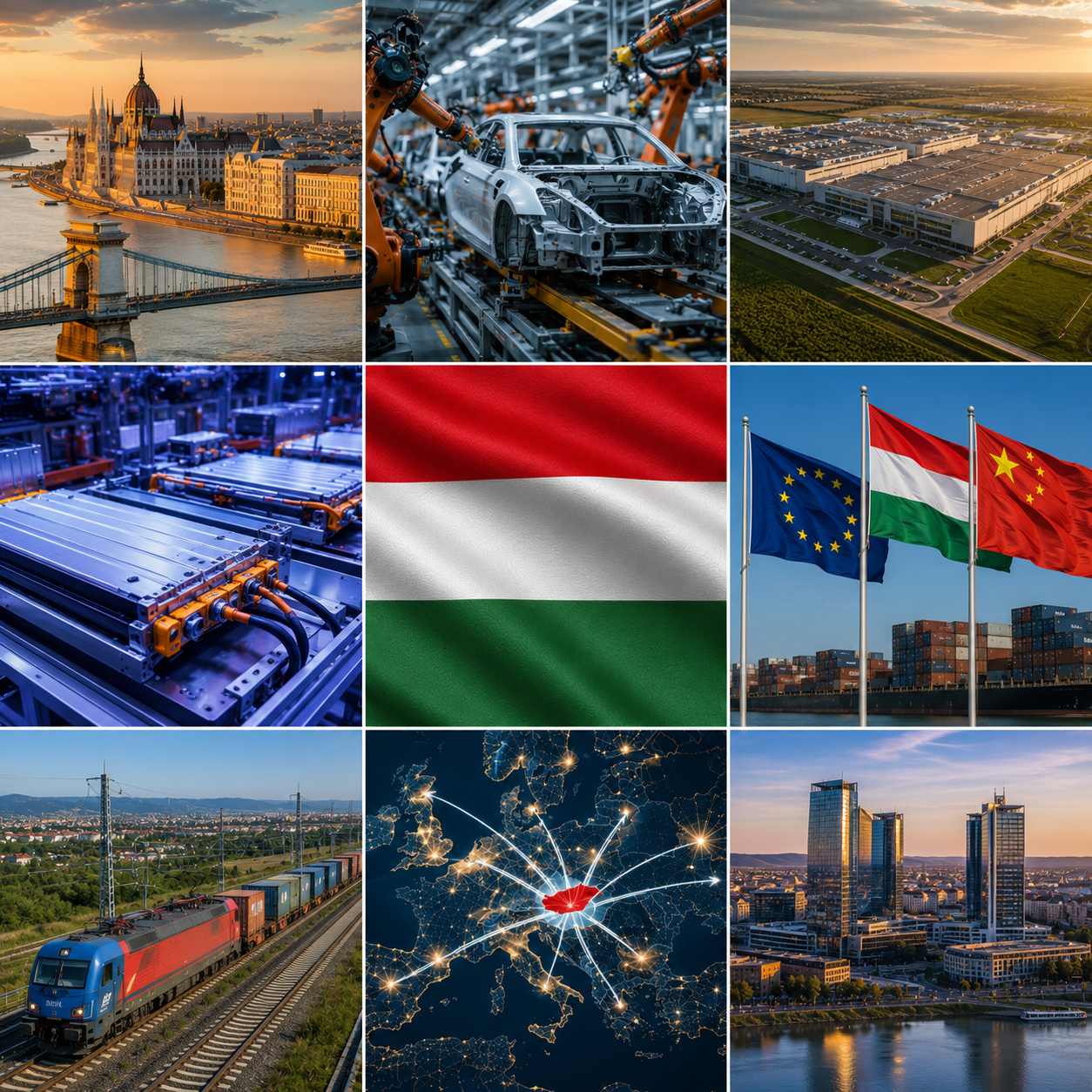
Illustration generated by OpenAI’s DALL·E for Altair Media Europe
Caption
Hungary sits at the crossroads of industry, geopolitics and technological transformation. As battery production, electric mobility and global supply chains reshape Europe’s economy, the country increasingly functions as a meeting point between German manufacturing, Asian investment and European strategic ambitions.
