Europe’s Strategic Seven
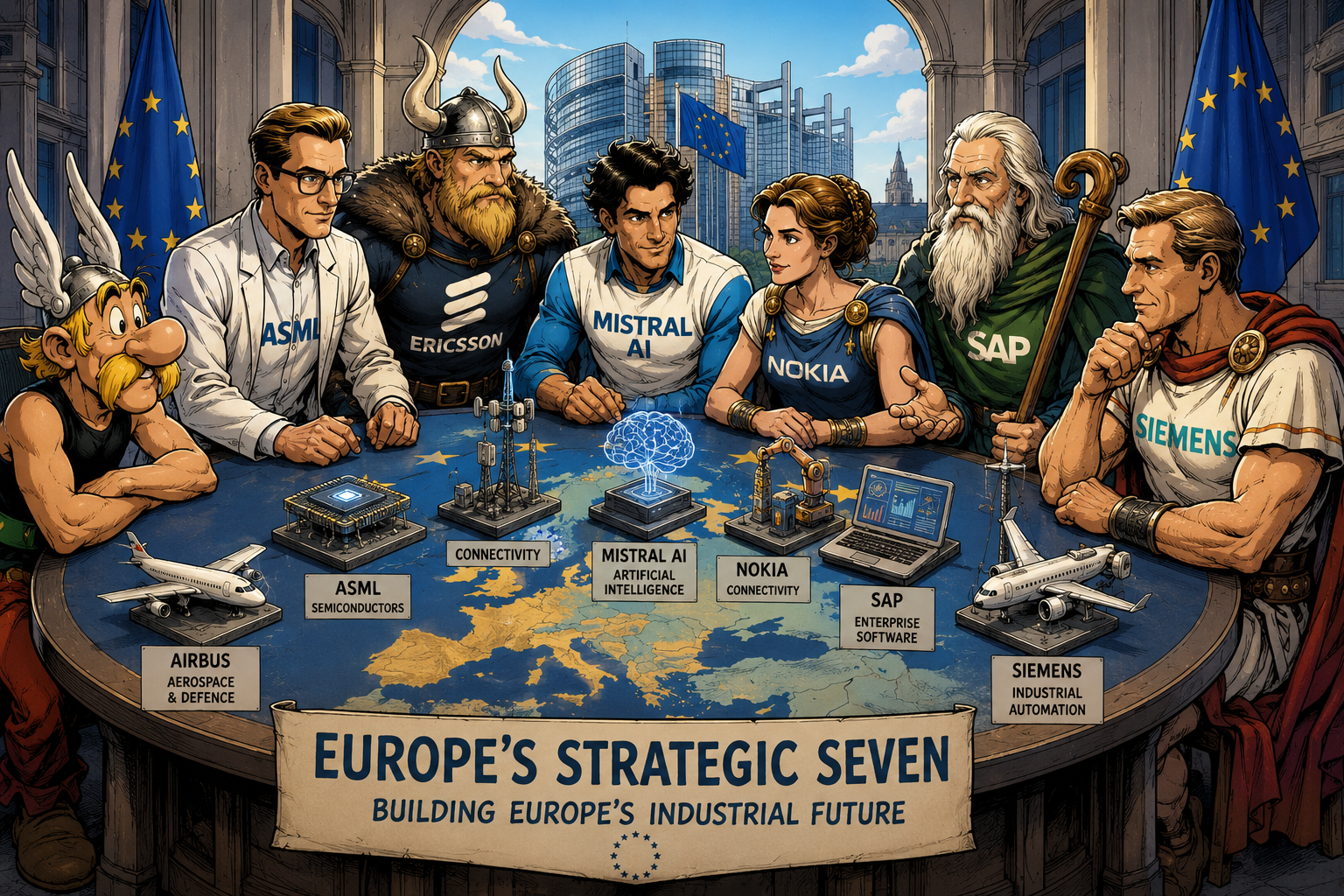
The emerging architecture of Europe’s industrial future
Europe’s approach to industrial policy appears to be changing. Rather than viewing leading technology companies simply as market participants, the European Commission is increasingly engaging a small group of firms whose technologies underpin Europe’s long-term competitiveness.
Airbus, ASML, Ericsson, Mistral AI, Nokia, SAP and Siemens represent very different industries. Yet together they cover many of the technologies Europe considers strategically essential: semiconductors, artificial intelligence, telecommunications, aerospace, industrial software and advanced manufacturing.
Recent discussions with European Commission President Ursula von der Leyen suggest that this is about more than individual policy consultations. They may signal the emergence of a new model of industrial cooperation—one in which Europe’s most strategically important technology companies help shape the continent’s future competitiveness.
🟦 Why these seven companies?
They are not Europe’s largest companies by market value, nor the only innovators on the continent. What connects them is their strategic position within critical industrial systems. Together they represent technologies that Europe increasingly considers essential for economic resilience, digital sovereignty and industrial leadership.
More importantly, they do not operate in isolation. Advanced manufacturing increasingly depends on industrial software, telecommunications infrastructure, artificial intelligence and semiconductor technologies. Aerospace relies on advanced manufacturing. AI relies on computing infrastructure. Connectivity underpins them all. Rather than forming a collection of successful companies, they increasingly represent an interconnected industrial ecosystem.
Seen together, the seven companies span much of Europe’s strategic technology stack—from semiconductor production and artificial intelligence to connectivity, industrial software, advanced manufacturing and aerospace. They represent less a list of companies than an emerging industrial architecture.
🟦 Is Europe creating its own “Magnificent Seven”?
Not in the American sense.
The U.S. Magnificent Seven became symbols of financial markets, consumer platforms and digital scale. Europe’s emerging group represents something fundamentally different. Their strategic importance lies not in platform dominance or market capitalisation, but in enabling the technologies upon which entire industries depend.
Europe’s strength has traditionally been industrial capability rather than consumer platforms. If the American Magnificent Seven define the digital economy, Europe’s Strategic Seven increasingly represent the foundations of the industrial economy.
🟦 What are they asking from Brussels?
Their joint message has been remarkably consistent.
The companies argue for faster implementation of Europe’s technology agenda through a stronger Digital Single Market, reduced regulatory fragmentation, a more competitive approach to AI regulation and merger rules that better support globally competitive European champions.
Their argument is straightforward: Europe already possesses world-class technologies. The challenge is deploying them with greater speed, scale and coordination before global competitors move faster.
🟦 Why does this matter beyond business?
Industrial competitiveness has become a geopolitical issue.
Semiconductors, artificial intelligence, telecommunications, industrial software and advanced manufacturing increasingly determine economic resilience, national security and strategic autonomy. Decisions about these technologies therefore extend well beyond commercial policy.
Europe’s industrial strategy is becoming inseparable from its geopolitical strategy.
🟦 Does this strengthen Europe—or raise new questions?
Both.
Few would dispute that policymakers need access to technical expertise when designing industrial strategy. The technologies shaping Europe’s future are often developed inside companies rather than government institutions.
At the same time, closer cooperation between governments and strategically important industries inevitably raises questions about transparency, accountability and democratic legitimacy. As industrial policy becomes more coordinated, maintaining public trust may prove just as important as accelerating innovation.
🟦 What could this mean for Europe’s future?
If this cooperation continues, Europe may be moving towards a more coordinated industrial model.
Rather than relying solely on market forces, the European Union appears increasingly willing to identify strategic technologies, engage directly with key industrial actors and coordinate long-term competitiveness at continental scale.
Whether this evolves into a lasting institutional framework or remains an informal coalition may shape Europe’s technological position for decades to come.
Signify
Europe’s Strategic Seven may ultimately be remembered less as a group of influential companies than as an early signal of a broader transformation.
For decades, European industrial policy focused primarily on creating markets and regulating competition. Today, a different approach appears to be emerging—one that places greater emphasis on coordination, strategic technologies and long-term industrial capability.
Whether this model succeeds will depend not only on technological excellence, but also on Europe’s ability to combine industrial ambition with democratic legitimacy. If that balance can be achieved, Europe will not simply compete through markets alone, but through the deliberate architecture of strategic capabilities.
Image Credit
Illustration: Altair Media (AI-generated)
Caption
Europe’s Strategic Seven brings together seven companies whose technologies span semiconductors, artificial intelligence, telecommunications, industrial software, advanced manufacturing and aerospace. Together, they illustrate the emerging architecture of Europe’s industrial future.
