Europe’s Strategic Seven Have Sounded the Alarm. Where Is Their Plan?
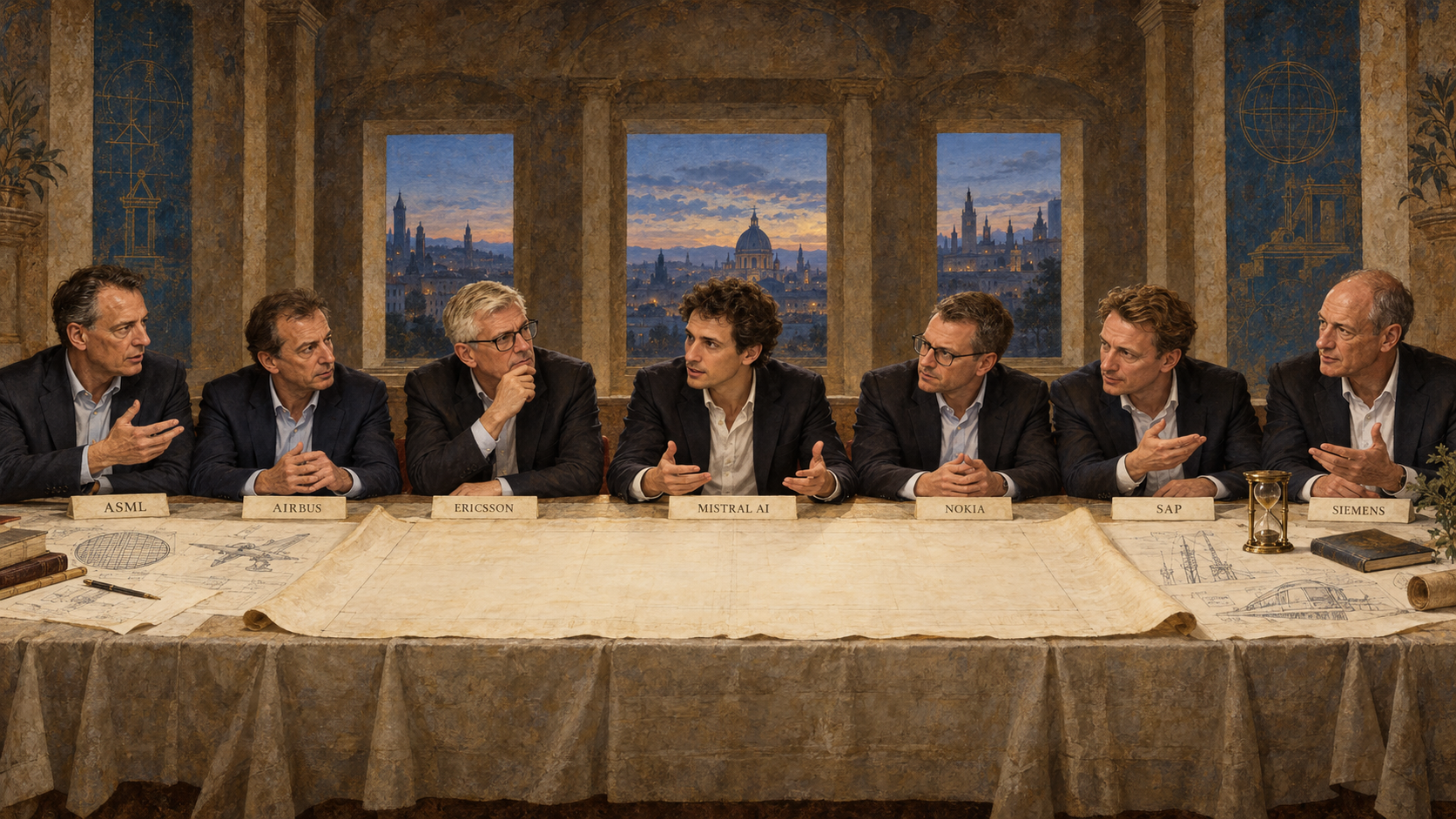
ASML, Airbus, Ericsson, Mistral AI, Nokia, SAP and Siemens want Europe to scale. What are they prepared to finance, purchase and build together?
In May, seven of Europe’s leading technology companies urged policymakers to confront fragmentation, accelerate innovation and restore industrial competitiveness. Five months later, their warning deserves a different response: what will they commit themselves? Individual investments and partnerships demonstrate ambition. A visible collective programme, backed by capital, customers and shared responsibility, remains harder to identify.
🟦 What comes after the warning?
The joint appeal from Europe’s technology leaders identified real constraints: fragmented markets, regulatory complexity and difficulty translating technological strength into commercial scale. Governments have responsibilities here. Energy infrastructure, procurement rules and cross-border market access cannot be repaired through corporate initiative alone.
But the seven also presented themselves as central to Europe’s technological future. That creates an expectation beyond advocacy. If their capabilities are complementary, what are they prepared to organise together?
As of mid-October, the public announcements reviewed for this Signal do not establish a joint programme across all seven with committed funding, named initial customers, delivery milestones and shared accountability. That does not prove that nothing is being prepared. It does mean that the collective warning is easier to inspect than the collective response.
Five months is a short period for building industrial infrastructure. It is a reasonable period in which to ask for a roadmap.
🟦 Why is Nvidia helping organise the market Europe wants to own?
Nvidia’s European expansion illustrates how a technology supplier can also help develop its market. Its partnerships connect computing infrastructure, software, model developers, industrial applications and customer access. Its announced $1 billion investment in Nokia tied capital to collaboration around AI networking and Nvidia’s architecture.
The commercial logic is powerful: help partners expand, make applications easier to deploy and strengthen demand for the platform supporting them. European partners and outside investors finance substantial parts of this expansion; announced infrastructure spending should not all be attributed to Nvidia.
This approach creates opportunities for Europe. It can also deepen reliance on a supplier whose technology becomes embedded across successive investment decisions.
Europe’s companies have different products, balance sheets and incentives. They cannot simply reproduce Nvidia’s model. Yet the strategic question remains uncomfortable: how much of Europe’s technological integration will be organised around someone else’s platform?
🟦 Where is the industrial strategy beyond the bilateral deals?
There is substantial activity to acknowledge. ASML invested €1.3 billion in Mistral AI alongside a long-term technology partnership. SAP and Mistral announced joint development of industry applications and cooperation on sales. Siemens expanded its partnership with Nvidia to develop industrial AI across engineering, manufacturing and operations.
Airbus also signed a partnership with Mistral in May, including licences for its AI product suite and work on aerospace applications. Its cooperation with Ericsson on private 5G in production facilities provides another concrete link between European industrial demand and technology supply.
These are meaningful commercial commitments. They also follow different strategic directions. Some strengthen European connections; others deepen integration with global platforms. Both can produce valuable outcomes.
The unresolved issue is whether these relationships accumulate into a shared European capability with identifiable objectives. A collection of successful partnerships can still leave important gaps between chip design, production, computing infrastructure, applications and distribution.
The seven do not cover that entire chain. Any credible programme would need additional manufacturers, designers, infrastructure operators and financial partners. Their potential contribution is to help connect those actors around viable business, using their own operations and customer relationships as a starting point.
🟦 Why should ASML build a European market when it can prosper globally?
ASML exposes the difference between corporate success and European industrial strength. It supplies chipmakers with manufacturing technology. European demand for AI can reach ASML indirectly through a foreign computing platform and semiconductor production outside Europe. Its business can benefit without Europe gaining control over the wider system.
That position helps explain why the incentive to organise European demand is less direct for ASML than for Nvidia. It also complicates the expectation that ASML should lead such an effort alone.
ASML already contributes to Europe’s technological foundations through research partnerships, including its cooperation with imec. But expanding research capability and securing commercial demand are distinct tasks.
The case for deeper involvement rests on long-term resilience: a stronger home ecosystem could broaden industrial relationships, sustain expertise and create future options. Those benefits must compete with immediate commercial priorities. That tension makes collective commitment necessary—and difficult.
🟦 Where are the customers willing to sign?
Europe’s industrial base offers substantial potential demand for advanced technology. Potential demand, however, does not finance a supplier’s expansion. A factory interested in AI becomes a dependable customer when it allocates a budget, validates a use and commits to purchasing it.
A serious initiative could start with a limited number of industrial applications and customers prepared to support deployment over several years. Supplier development would then follow identifiable operational needs. Financing could support the difficult transition between a successful demonstration and repeatable commercial delivery.
Airbus could help anchor such a programme through its own engineering and production needs. Ericsson and Nokia could contribute industrial connectivity, with Siemens, SAP and Mistral supplying complementary capabilities. The test would be whether these connections produce repeatable deployments and demand beyond the founding companies.
The trade-off is real. Early customers may pay more, accept integration costs or support a supplier before its offering matches established alternatives. Investors will want evidence that this support can lead to a competitive business.
Blanket commitments to buy European would conceal those questions. Carefully specified contracts could make the costs, performance requirements and strategic benefits visible.
🟦 Who will own the delivery—and carry the risk?
A credible plan needs someone authorised to make decisions when the participants’ interests diverge. Which applications receive funding? Who chooses suppliers? What happens when a project misses its targets, or a global alternative offers better performance?
Shared governance must allow decisions without turning every investment into a negotiation among seven headquarters. Competition and open access also matter: a programme intended to strengthen Europe should give smaller firms a route into the market.
Joint purchasing and supplier coordination would require clear competition safeguards, particularly where participants are rivals: limits on sensitive information exchange, protection against exclusion and a defined scope for cooperation. EU rules already provide frameworks for assessing such arrangements; invoking European sovereignty does not remove those obligations.
Its public commitments could be straightforward: an initial capital allocation, participating customers, selected deployment areas, a timetable and regular reporting against commercial milestones. Governments could then judge where infrastructure, procurement or risk-sharing would add value.
The question put to the seven is therefore concrete: you are asking Europe to create the conditions for scale. Which investments, purchases and risks will you commit to jointly?
Their answer would show whether the coalition can move from a shared diagnosis to shared execution.
Signal
Europe’s technology leaders made their warning public in May. Their collective response now needs the same visibility. The measure is capital committed, customers contracted, deployments delivered and responsibility accepted. Until those commitments become inspectable, the Strategic Seven remain more convincing as a statement of Europe’s potential than as a programme for realising it.
Sources
- The seven companies’ joint appeal, published in May 2026. (investor.asml.com)
- Nvidia’s European infrastructure partnerships and announced investment in Nokia. (nvidianews.nvidia.com)
- ASML–Mistral, SAP–Mistral and Siemens–Nvidia partnerships. (www.asml.com)
- Airbus–Mistral cooperation and Airbus–Ericsson private 5G deployments. (Airbus)
- ASML–imec research cooperation. (investor.asml.com)
- European Commission guidelines on horizontal cooperation, joint purchasing and information exchange. (competition-policy.ec.europa.eu)
Credit
AI-generated illustration for Altair Media, inspired by Leonardo da Vinci’s The Last Supper.
Caption
An imagined gathering of Europe’s Strategic Seven around an unfinished blueprint. The capabilities are assembled; the shared plan remains to be drawn.
