Europe’s Next Generation Is Rethinking Security. But What Kind of Europe Will It Inherit?
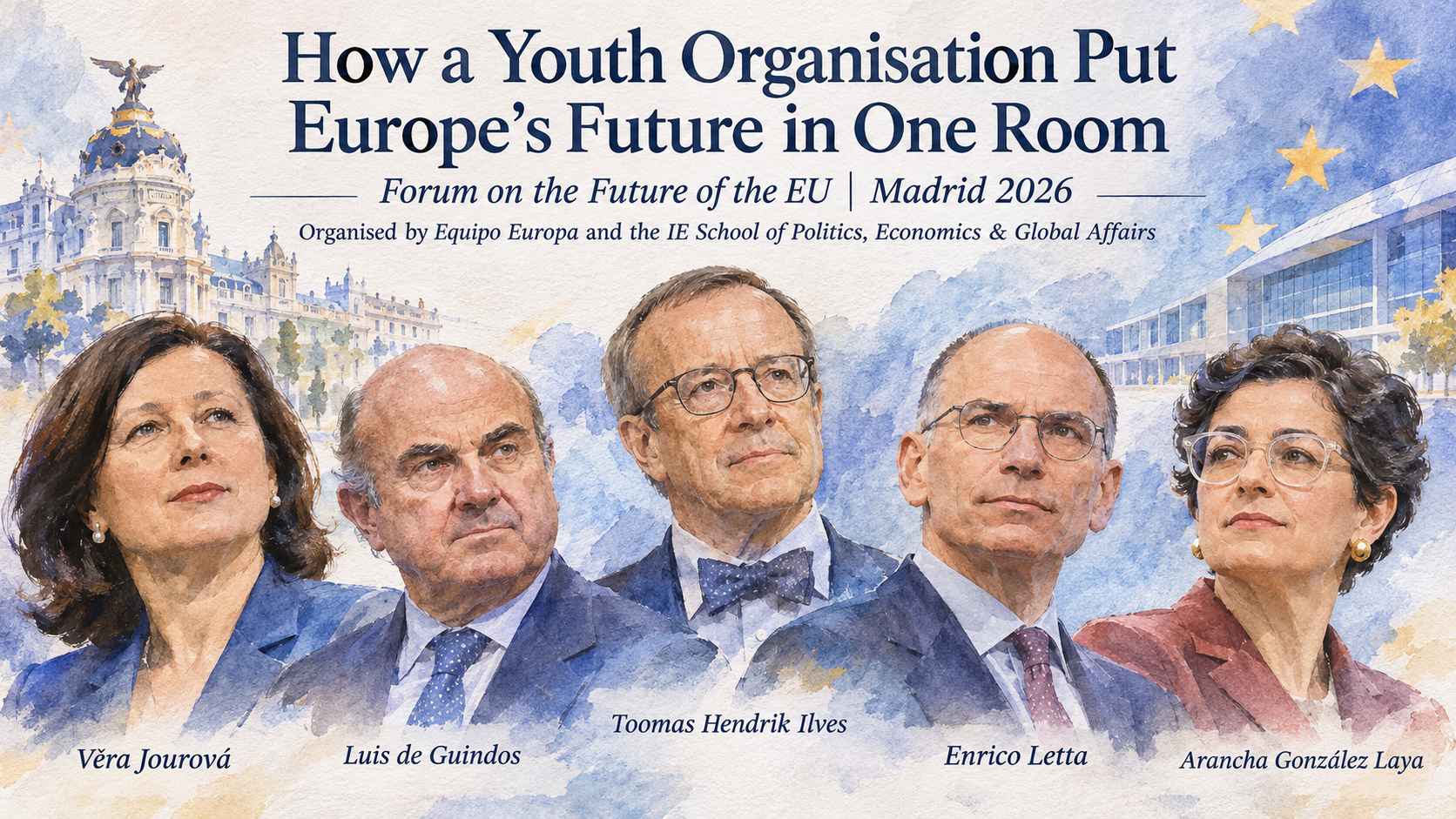
From democratic resilience and capital markets to technological sovereignty, a youth-led forum in Madrid reveals the increasingly interconnected architecture of Europe’s future.
Around 800 young people gathered in Madrid from 20 to 22 November for the fifth Forum on the Future of the European Union. With 85 announced speakers and a programme spanning defence, democracy, finance and technology, the youth-led initiative raises a broader question: who will shape Europe’s strategic transformation?
Organised by Equipo Europa and the IE School of Politics, Economics & Global Affairs, the forum addressed European Security in a Changing World. The programme featured prominent figures including former Estonian President Toomas Hendrik Ilves, former European Commission Vice-President Věra Jourová and former European Central Bank Vice-President Luis de Guindos.
Yet the most revealing aspect of the programme may be the convergence of policy areas traditionally treated as separate European challenges. Security is increasingly becoming a question of how Europe organises its economy, technology, institutions and society.
Five questions emerge.
🟦 When Did European Security Become More Than Defence?
Europe’s security debate is expanding beyond military capabilities and territorial protection. The Madrid programme connected defence with economic prosperity, energy, technological capabilities and democratic resilience, exposing a structural challenge.
Military preparedness requires industrial capacity. Industrial capacity requires energy, infrastructure, technology and access to capital. Europe can increase defence expenditure while remaining dependent on external suppliers of critical technologies, or strengthen its military capabilities without necessarily improving its economic resilience.
Meanwhile, responsibility for these interconnected challenges remains distributed across national governments, European institutions, financial markets and private companies.
Increasing expenditure in one policy domain does not automatically resolve vulnerabilities in another.
The tension: Europe’s security challenges are becoming systemic, while its institutional responsibilities remain fragmented.
🟦 Can Europe Protect Its Democracy Without Protecting Its Information Space?
Information integrity and democratic resilience featured explicitly in the Madrid programme. Generative artificial intelligence, synthetic content and algorithmic distribution are changing the conditions under which citizens encounter information, evaluate institutions and form opinions.
The European response increasingly involves regulation, platform accountability and measures against disinformation. But regulation addresses only part of the challenge. Citizens must also be capable of recognising uncertainty, evaluating competing claims and distinguishing evidence from interpretation.
Independent journalism, education and media literacy consequently become relevant to European security — not as instruments for directing public opinion, but as mechanisms supporting informed democratic participation.
There is, however, an institutional dilemma. Measures intended to protect the information environment must themselves remain subject to democratic scrutiny. Disagreement, criticism and uncertainty cannot automatically be treated as threats to information integrity.
The tension: Europe must protect its democratic information space without undermining the intellectual independence and freedom of expression on which democracy depends.
🟦 Can Europe Finance Its Own Strategic Future?
The financing of European security was another central element of the Madrid programme. It connects directly with the debate advanced by former Italian Prime Minister Enrico Letta, Dean of the IE School of Politics, Economics & Global Affairs.
In his April 2024 report, Much More Than a Market, Letta identified fragmentation within the European Single Market as a constraint on Europe’s strategic capacity. Altair Media previously examined aspects of this challenge in The Checklist No One Wants to Tick.
The issue is becoming increasingly relevant as Europe seeks to finance defence, artificial intelligence, energy infrastructure and industrial transformation simultaneously.
Europe possesses substantial private savings, established financial institutions and internationally competitive companies. Yet public budgets face competing demands, private investors require credible returns, and pension funds must protect the long-term interests of their beneficiaries.
Strategic necessity does not automatically translate into an investable proposition.
Nor does the availability of capital guarantee that investment will reach the companies, technologies or regions where it could generate the greatest additional value.
The tension: Europe’s strategic ambitions are increasingly collective, while the capital required to realise them remains governed by different commercial, institutional and national priorities.
🟦 Who Will Own the Technologies Europe Depends On?
Artificial intelligence, quantum computing, digital connectivity and critical infrastructure featured prominently in Madrid. Europe’s technological ambitions are frequently expressed through research capacity, innovation programmes and industrial investment.
But technological development and technological sovereignty are not necessarily the same thing.
A European AI company may rely on American computing infrastructure. A European research institution may generate intellectual property whose commercial value is ultimately captured outside Europe. A European public authority may retain legal responsibility for essential services while depending on privately controlled technological systems.
These dependencies are not inherently undesirable. International cooperation remains essential to technological progress. The question is whether Europe retains sufficient alternatives, bargaining power and institutional control when those relationships become strategically significant.
For younger Europeans, this is also a question of ownership.
Who controls the infrastructure through which they will work, communicate, learn and participate in democratic society?
The tension: Europe may become increasingly capable of developing advanced technologies without necessarily controlling the infrastructure, capital or ownership structures through which their strategic value is realised.
🟦 Is Europe Giving Its Next Generation a Voice — or Influence?
The institutional identity of the Madrid forum deserves particular attention. Equipo Europa is a youth association, rather than an established governmental or financial institution. Its Forum on the Future of the EU was Spain’s national winner of the European Charlemagne Youth Prize in 2024.
The Madrid initiative therefore represents more than an opportunity for young Europeans to listen to established policymakers. Its programme included policy laboratories, simulations and opportunities to develop recommendations, culminating in the scheduled adoption of the forum’s conclusions on Sunday, 22 November.
But democratic participation must be distinguished from institutional influence.
The number of participants, speakers and recommendations provides a measure of engagement. It does not establish whether that engagement will affect subsequent policy decisions.
The next institutional test is whether the forum’s recommendations reach relevant decision-makers, receive substantive consideration and generate visible follow-up.
There is also a question of representation. The experiences of internationally engaged young Europeans attending policy conferences may differ substantially from those of young people primarily concerned with housing, employment, education or financial insecurity.
Connecting these experiences remains an essential democratic challenge.
The tension: Europe is creating opportunities for its next generation to participate in strategic discussions, but participation does not automatically translate into influence over strategic decisions.
The Signal
The Madrid forum illustrates how European security, capital, technology and democracy are becoming interconnected. Yet the institutions governing these domains remain fragmented, and opportunities for youth participation do not necessarily confer influence over their decisions.
Europe’s next generation will inherit these systems.
Whether it will also help govern them remains unresolved.
Sources & Further Reading
- Forum on the Future of the EU 2026 — Official website
- Forum on the Future of the EU — Programme and Speakers
- Equipo Europa — Official website
- El Diario de Madrid — 800 jóvenes debaten en Madrid sobre el futuro de Europa, 22 November 2026
- European Parliament — Spanish national winner of the European Charlemagne Youth Prize 2024
- Enrico Letta — Much More Than a Market, April 2024
- Altair Media — The Checklist No One Wants to Tick
Image credit
Illustration: Altair Media | AI-generated editorial watercolour, November 2026.
Image caption
How a youth organisation put Europe’s future in one room. The Madrid Forum on the Future of the EU 2026, organised by Equipo Europa and the IE School of Politics, Economics & Global Affairs, provides a platform for intergenerational dialogue on European security, democracy and strategic autonomy.
