Europe’s AI Gigafactory Race: Who Will Control the Continent’s Computing Future?
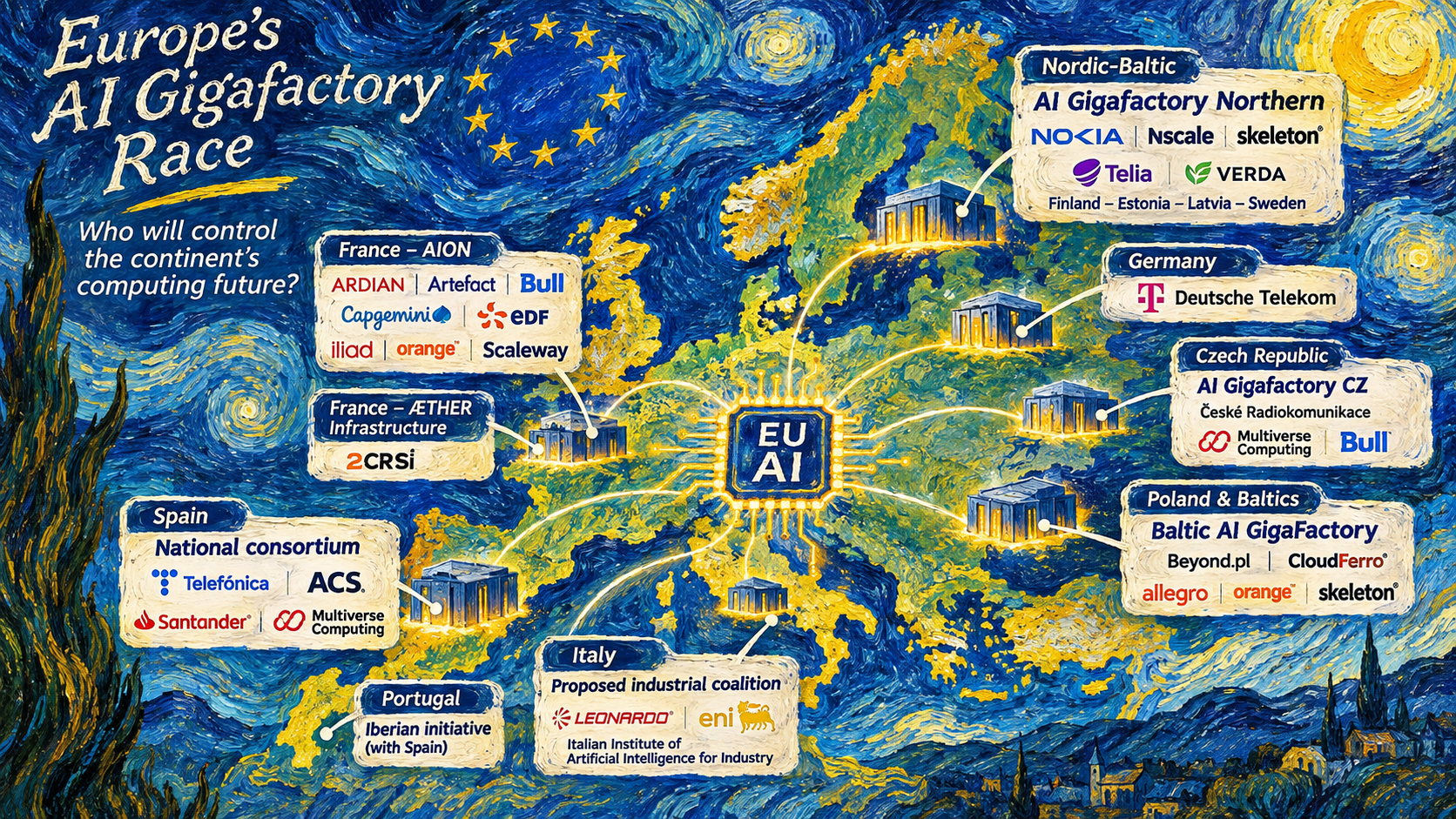
Europe’s industrial coalitions compete for AI infrastructure, technological sovereignty and economic control
As Nokia joins the race for Europe’s AI gigafactories, competing coalitions across the continent are bringing together technology, energy, telecommunications and capital. But building European computing capacity raises a deeper question: who will control the infrastructure, the technology and the economic value it creates?
On 16 November, Nokia and four partners unveiled plans to connect AI computing facilities across Finland, Estonia, Latvia and Sweden. Their consortium enters a European competition expected to mobilise more than €30 billion for up to seven AI gigafactories. The announcement reveals a broader shift: Europe’s AI ambitions are becoming a contest between industrial coalitions.
The question is no longer simply whether Europe can build these facilities. It is increasingly about which partnerships can bring together the technology, infrastructure, financing and customers needed to operate them.
🟦 Why is Nokia entering Europe’s AI gigafactory race?
Nokia has joined Nscale, Skeleton Technologies, Telia and Verda to establish AI Gigafactory Northern (AIGF Northern), a consortium preparing to compete in the European High-Performance Computing Joint Undertaking’s gigafactory procurement.
Announced on 16 November, the initiative proposes something different from the conventional image of an enormous data centre concentrated in one location.
Instead, the partners want to connect computing facilities in Oulu, Finland; Iru, Estonia; Valmiera, Latvia; and a location yet to be identified in Sweden.
The distributed structure reflects the capabilities of its founders. Nokia brings high-performance networking expertise, while Telia contributes telecommunications infrastructure and systems integration. Nscale and Verda provide AI computing and cloud expertise, and Skeleton specialises in high-power energy systems.
Together, they aim to create an interconnected European computing infrastructure that combines cloud services, AI processing and access to low-carbon electricity.
Northern Europe offers several advantages. Its relatively cool climate can reduce cooling requirements, while established digital networks and access to low-carbon power provide favourable conditions for energy-intensive computing.
Yet the geographic model also raises an important technical question.
Large AI training workloads require extremely fast connections between processors. Distributing facilities across national borders may improve resilience and expand access to computing resources, but it does not automatically create the performance of a tightly integrated computing cluster.
How workloads are divided between sites will therefore be as important as the connectivity linking them.
The consortium has not announced a definitive investment commitment or construction timetable. Nor has it received a European funding award.
The tension: Distributing computing infrastructure across borders could strengthen Europe’s resilience, but delivering a technically coherent and commercially competitive system will require more than connecting data centres.
🟦 Who else wants to build Europe’s AI gigafactories?
The Nordic-Baltic initiative is entering a rapidly developing European field.
France, Spain, Germany, Italy and several Central European countries are assembling their own combinations of industrial companies, cloud providers, energy suppliers and investors.
The European Commission previously received 77 expressions of interest covering 60 locations in 16 member states. That demonstrated substantial enthusiasm, although the earlier proposals should not be confused with formal submissions under the procurement launched in July 2026.
Several publicly identified initiatives illustrate how different national and industrial approaches are emerging.
Europe’s emerging AI gigafactory candidates
Publicly announced consortia and initiatives, as of 18 November 2026. Their status does not imply formal selection or an awarded contract.
Nordic-Baltic region — AI Gigafactory Northern
Status: Consortium announced. Nokia, Nscale, Skeleton Technologies, Telia and Verda intend to develop a distributed gigafactory spanning Finland, Estonia, Latvia and Sweden. Their proposal combines large-scale computing with cross-border connectivity and energy infrastructure.
France — AION
Status: Consortium formed. Ardian, Artefact, Bull, Capgemini, EDF, iliad, Orange and Scaleway announced their alliance in May 2026. The consortium combines investment, energy, computing hardware, telecommunications and cloud expertise in a French bid for European support.
France — ÆTHER Infrastructure
Status: Industrial project under development. Led on the technical side by 2CRSi, this initiative is developing a high-density computing and industrial infrastructure concept around Strasbourg, with potential expansion to additional European locations. Its approach also seeks to create opportunities for European technology suppliers.
Spain — National public-private consortium
Status: Consortium formally structured. The Spanish government, through SETT, is working with Telefónica, ACS, Banco Santander and Multiverse Computing, alongside the Catalan government. The project envisages locations near Tarragona and Madrid and aims to mobilise investments of up to €5 billion.
Germany — Deutsche Telekom
Status: Application in preparation. Deutsche Telekom has publicly confirmed that it is working on an application for European gigafactory support and could consider a billion-euro investment under suitable conditions. Its existing Industrial AI Cloud operations provide an operational foundation for potential expansion.
Czech Republic — AI Gigafactory CZ
Status: Project supported by industrial agreements. České Radiokomunikace is developing a Czech gigafactory initiative for Central and Eastern Europe. Partnerships with Multiverse Computing and, more recently, Bull are intended to strengthen its computing and AI software capabilities.
Poland and the Baltic region — Baltic AI GigaFactory
Status: Earlier expression of interest submitted. A Polish-led regional initiative brought together companies including Beyond.pl, CloudFerro, Allegro, Orange Polska and Skeleton Technologies. Its earlier proposal involved Poland, Estonia, Latvia and Lithuania. The final consortium composition for the current procurement has not been publicly confirmed.
Italy — Proposed Italian industrial coalition
Status: National candidacy under development. Italian authorities have discussed a prospective initiative involving Leonardo, Eni, the Italian Institute of Artificial Intelligence for Industry and other industrial partners. The definitive governance, financing and consortium structure remain unclear.
Portugal is also exploring an Iberian approach. Its government has committed to pursuing participation in a joint initiative with Spain, although the final relationship between Portuguese plans and Spain’s existing consortium has not been established publicly.
These initiatives are not directly comparable. Some have named shareholders and formal agreements. Others remain industrial proposals or earlier expressions of interest. None of these announcements alone establishes that a consortium has secured a place in the European programme.
A second competition is emerging beneath the surface
Perhaps the most revealing development is that several technology companies are appearing across different national initiatives.
Skeleton Technologies participated in the earlier Baltic AI GigaFactory coalition and has now joined Nokia’s Nordic-Baltic consortium. Multiverse Computing is part of Spain’s public-private project while also collaborating on the Czech initiative. Bull is a member of France’s AION consortium and has signed an industrial agreement with České Radiokomunikace.
These connections reveal something important about the emerging European market.
Although governments and consortia may compete to attract gigafactories, many depend on overlapping groups of technology suppliers, engineering specialists and infrastructure providers.
The contest is therefore not simply between countries. It is also about which companies will become indispensable to the construction and operation of Europe’s next generation of computing infrastructure.
The tension: National consortia may compete for European support, while the same specialist suppliers could capture value across several projects, regardless of which proposals are selected.
🟦 Is Brussels financing construction or creating a market for European computing?
The financing model behind the European initiative deserves particular attention.
The European Commission expects up to €10 billion in European and national public support to help mobilise at least €20 billion in private investment.
However, this is not simply a conventional programme of construction grants.
Under the EuroHPC procurement model, European institutions and participating member states will purchase access to computing capacity from selected operators.
That arrangement gives public authorities an additional role: they become customers.
For private investors, this matters enormously. Building a large AI computing facility requires substantial capital before the operator has generated significant revenue. Processors, cooling systems, power connections and networking equipment must be secured long before the commercial future of the facility becomes clear.
A guaranteed public customer can make those investments easier to finance. It provides an initial source of demand and reduces part of the uncertainty facing the consortium.
But it does not remove the underlying commercial risks.
Advanced AI processors are expensive and can lose their technological competitiveness relatively quickly. Energy prices can fluctuate, while competition from established international cloud providers may put pressure on the prices European operators can charge.
Ultimately, a gigafactory needs customers beyond its initial public commitments.
Industrial companies must be willing to use European computing services for automation, simulation and AI deployment. Research institutions need access to advanced processing capacity, while AI developers must find a commercially attractive alternative to the platforms they already use.
The real challenge is therefore to transform public investment into a sustainable European market.
The tension: Public procurement can help finance new computing infrastructure, but long-term commercial demand will determine whether it becomes a self-sustaining European industry.
🟦 Can Europe achieve AI sovereignty while depending on foreign technology?
The emerging consortia all operate within a political environment in which technological sovereignty has become an important strategic objective. But sovereignty is not a single technical achievement.
A European company can own a data centre, operate its networks and offer cloud services under European law. This can provide meaningful control over data management, infrastructure access, security and operational decisions.
That does not necessarily mean it controls the technologies on which the facility depends.
Many advanced AI computing systems rely on processors developed by NVIDIA and AMD. In NVIDIA-based environments, the dependency also extends into software ecosystems such as CUDA and into specialised high-performance networking and interconnect technologies.
These relationships matter because computing infrastructure is more than a collection of chips.
Applications must be developed, optimised and maintained within software environments. AI systems also require networking architectures capable of moving enormous quantities of information between processors without creating performance bottlenecks.
Replacing an established computing platform therefore involves far more than selecting a different processor supplier.
European companies such as Nokia, Bull, SiPearl and others are developing capabilities across networking, advanced computing, processor design and related infrastructure. Their involvement can deepen Europe’s technological capabilities, even where foreign hardware remains essential.
Yet it would be premature to assume that European ownership of gigafactories will automatically produce independence from international technology suppliers.
There is also a question of where the economic value will accumulate.
If European investors finance the buildings, electricity connections and operating infrastructure, while substantial portions of technology spending flow to suppliers outside Europe, the continent may still depend on external companies for some of the most valuable components of the AI economy.
That does not make the investments meaningless. Control over data, computing access and infrastructure operations can itself be strategically valuable.
But it establishes a distinction between controlling the location of AI infrastructure and controlling the technologies that make AI possible.
The tension: Europe can strengthen its control over AI computing without achieving full technological independence. The strategic challenge is to determine which dependencies it can reduce and which it must continue to manage.
🟦 What will ultimately determine which gigafactories succeed?
As the competition develops, the decisive differences between projects may prove less visible than the names of their industrial partners.
Electricity availability will be fundamental. A location offering attractive land prices and political support has limited value if its power grid cannot deliver sufficient capacity on a commercially realistic timetable.
The same applies to cooling, network connectivity, engineering expertise and construction readiness.
Equally important will be the ability to attract customers willing to pay for computing services over the long term.
Different national approaches already reveal contrasting strategies.
France is assembling broad industrial coalitions that combine existing national capabilities. Spain has established a relatively concrete public-private investment structure, while the Nordic-Baltic consortium is proposing a distributed model that takes advantage of regional energy and connectivity resources.
Germany’s Deutsche Telekom is examining how an existing commercial computing business might support a larger European investment.
The Netherlands provides an interesting contrast.
Dutch companies VOLT and Eneco have expressed ambitions to develop large-scale AI infrastructure. VOLT is also pursuing its Rotterdam AI data centre project, for which Nebius signed a letter of intent covering computing capacity in October 2026.
But the Dutch government decided in March not to undertake the financial commitments required for participation in the joint EuroHPC gigafactory procurement.
Instead, it is concentrating public investment on the smaller AI factory in Groningen while supporting the development of privately financed infrastructure.
This creates two different routes towards expanded European computing capacity.
One depends on public procurement to establish an initial customer base. The other relies more directly on private demand, commercial contracts and the willingness of investors to finance new facilities.
Neither route automatically resolves the problems of electricity supply, technological dependence or long-term profitability.
For projects pursuing the European procurement route, however, the timetable is becoming increasingly pressing.
The deadline for large-scale gigafactory proposals remains 3 December 2026, while the deadline for medium-scale projects has been extended to 4 February 2027.
EuroHPC announced the extension in November to give participating member states additional time to complete national budget procedures and financial commitments.
That decision illustrates how difficult the coordination challenge has already become. Before any facility can be built, governments, investors and industrial partners must agree on how future computing capacity will be financed and purchased.
The coming months should therefore provide a clearer picture of which announced ambitions can be translated into credible investment and operating plans.
The tension: Political support can bring consortia together, but the ability to secure financing, electricity, technology and paying customers will determine which projects become viable infrastructure.
The Signal
Nokia’s entry into the European AI gigafactory race is significant because it illustrates a broader transformation already taking place across the continent.
Telecommunications companies are moving closer to computing infrastructure. Energy suppliers are becoming strategic partners in digital technology. Cloud providers, semiconductor specialists and investment institutions are increasingly dependent on one another.
The emerging consortia show that Europe’s AI ambitions are no longer confined to research programmes or political declarations. They are beginning to take the form of industrial partnerships with concrete infrastructure objectives.
Yet the central challenge remains unresolved.
Europe could build several large AI gigafactories without developing a sufficiently strong commercial market for their services. It could increase its computing independence while retaining substantial dependence on foreign processors and software platforms. And it could attract billions in investment without capturing an equivalent share of the economic value generated by AI.
The outcome will depend on how successfully Europe connects computing capacity with industrial demand, technological development and sustainable investment.
The real measure of Europe’s AI gigafactory strategy will not be how many facilities it builds, but how much technological capability, economic value and strategic control remains in Europe once they begin operating.
About this series
Europe’s AI Gigafactories is an Altair Media Featured Stories series examining the industrial, technological and institutional foundations of Europe’s AI ambitions.
Previous articles explored the infrastructure behind AI, the coordination required to build it, the importance of location and the practical constraints facing Europe’s plans.
This fifth Signal examines the emerging competition between European industrial consortia and the question of who will ultimately control the continent’s computing future.
Explore the earlier articles:
- Europe’s AI Gigafactories
- Who Will Build Europe’s AI Gigafactories?
- Where Should Europe Build AI Gigafactories?
- Can Europe Build Seven AI Gigafactories?
Sources: Nokia, European Commission, EuroHPC procurement, Spanish government, Ardian, Dutch government.
Image credit
Image: Altair Media / AI-generated illustration, inspired by the painting style of Vincent van Gogh.
Image caption
Europe’s emerging AI gigafactory landscape brings together telecommunications companies, cloud providers, energy suppliers and investors in a continent-wide competition for computing capacity and technological sovereignty. Illustration: Altair Media.
