Who Will Build Europe’s AI Gigafactories?
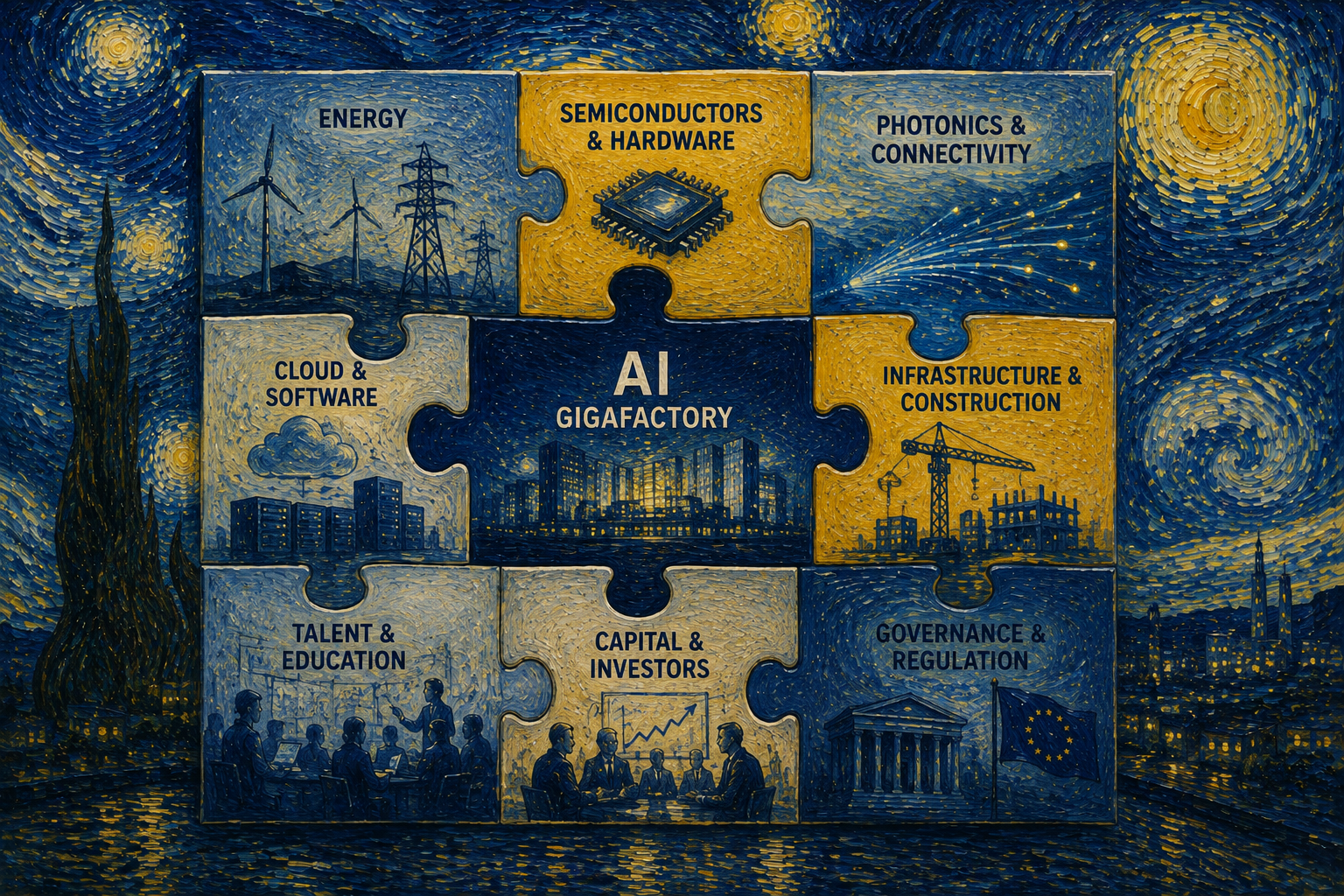
The industrial challenge behind Europe’s AI ambitions
The European Commission can announce an AI Gigafactory. It can launch a tender and mobilise public funding. But none of these actions actually builds a Gigafactory. They merely create the conditions for others to begin.
Europe’s ambition to build up to seven AI Gigafactories raises a simple question.
Who actually builds an AI Gigafactory?
Governments can define strategy and provide funding. They cannot build power grids, manufacture semiconductors, install fibre networks or educate the engineers needed to operate them.
An AI Gigafactory is not built by one organisation. It is built by an industrial ecosystem. The real challenge begins when thousands of companies, researchers, investors and public institutions must coordinate their efforts to create one functioning infrastructure.
🟦 Why can’t Europe simply decide to build an AI Gigafactory?
Political announcements often create the impression that infrastructure appears once funding has been approved. Reality is far more complex.
A €10 billion programme can accelerate investment, but it cannot create electricity, manufacture transformers or expand fibre networks overnight. Nor can it instantly produce engineers, construction capacity or advanced cooling systems.
Public funding creates momentum. Industrial capacity creates infrastructure. The announcement is therefore not the beginning of construction. It is the beginning of coordination.
🟦 If governments don’t build Gigafactories, who does?
No single organisation can build an AI Gigafactory. Every participant contributes a different capability.
Energy companies secure reliable electricity.
Construction firms create highly specialised facilities.
Semiconductor manufacturers provide the computing hardware.
Photonics companies move information at the speed of light.
Telecommunications operators connect Gigafactories to Europe and beyond.
Cloud providers orchestrate computing resources.
Universities educate the engineers and researchers who design, operate and improve the entire ecosystem.
Each organisation solves a different part of the challenge. Together, they build Europe’s AI infrastructure.
🟦 Why is coordination becoming Europe’s greatest challenge?
An AI Gigafactory is only as strong as its weakest dependency. Without electricity, processors remain idle. Without semiconductors, there is nothing to compute. Without photonics, data cannot move efficiently between thousands of AI chips.
Without cooling, performance becomes unsustainable. Without connectivity, computing power remains isolated. Without engineers, none of these systems can be designed, operated or maintained.
Every dependency becomes someone else’s responsibility. Every responsibility becomes another coordination challenge. The challenge is no longer technological. It is systemic.
🟦 Could coordination become Europe’s competitive advantage?
Europe already possesses many of the capabilities required to build AI infrastructure. It leads in semiconductor equipment. It has world-class photonics research. Its universities educate globally recognised engineers. Its energy and telecommunications networks rank among the most advanced in the world.
The question is no longer whether Europe has the necessary building blocks. The question is whether Europe can connect them.
The countries that lead the AI era may not be those with the largest subsidies or the fastest processors. They may simply be those that learn to coordinate complexity better than anyone else.
Final Reflection
The debate about AI Gigafactories often begins with artificial intelligence. Perhaps it should begin with industrial ecosystems.
History shows that transformative infrastructure is never created by a single technology or a single institution. It emerges when governments, industry, investors, researchers and engineers succeed in aligning thousands of independent decisions around one shared objective.
Europe’s AI ambitions will ultimately be measured not only by the intelligence of its algorithms, but by its ability to build the ecosystem that allows those algorithms to exist.
Signal
Artificial intelligence may be written in software. Europe’s AI future will be built through industrial coordination.
Credit
Illustration: AI-generated artwork by OpenAI for Altair Media.
Caption
Europe’s AI future will not be built by one technology or one institution. It will emerge when the essential pieces of the industrial puzzle finally fit together.
