Central Europe — Europe’s Production Belt
Manufacturing at Continental Scale
Europe’s automotive future is often discussed through its most visible brands and boardrooms. Germany brings engineering, France coordination, Italy identity and Sweden systems thinking. Yet much of Europe’s automotive reality is built elsewhere: across assembly lines, supplier regions, logistics corridors and specialised industrial clusters that turn strategy into physical output.
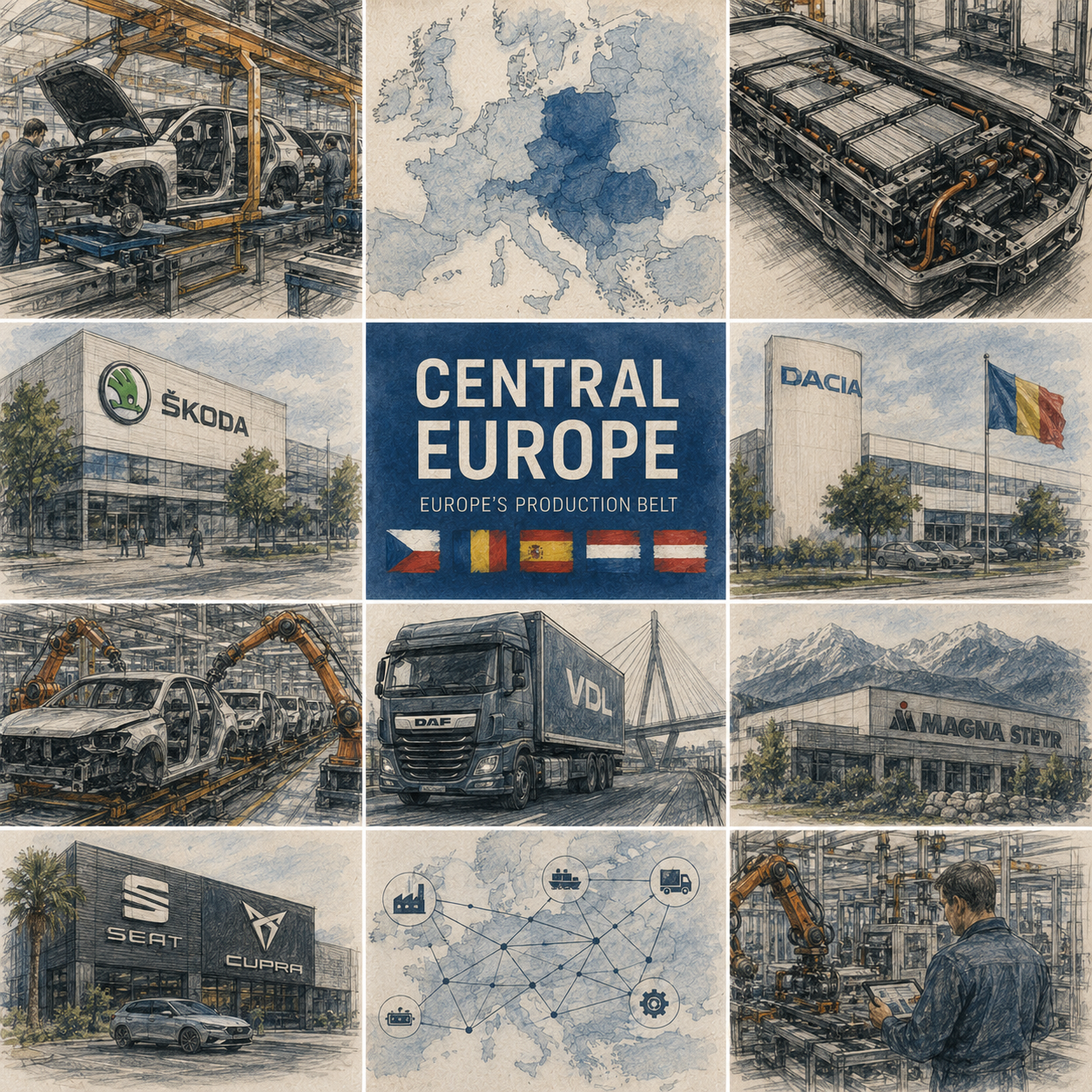
Škoda in Czechia, Dacia in Romania, SEAT and CUPRA in Spain, DAF and VDL in the Netherlands, and Magna Steyr in Austria reveal the manufacturing layer beneath Europe’s mobility ambitions.
This is where automotive becomes real.
🟦 Who Actually Builds Europe’s Mobility?
European automotive power does not live only in design studios, policy documents or corporate headquarters. It depends upon factories, suppliers, skilled labour, transport infrastructure and regional ecosystems that produce vehicles and components at continental scale.
These regions are often treated as the operational layer of European automotive. They assemble, adapt, optimise and deliver. But in a period of industrial transition, that operational layer becomes strategic. Electric vehicles require new supply chains. Battery systems require new industrial capabilities. Automation changes the labour model. Energy access becomes a production factor.
Can Europe rethink automotive without first understanding where automotive is actually made?
🟦 From Cost Efficiency To Strategic Capability
For decades, parts of Central, Southern and Western Europe served as efficient production platforms for larger automotive groups. Skilled workers, lower relative costs, proximity to markets and EU integration made these regions attractive manufacturing bases. But the old logic of assembly is changing.
The factory floor is no longer only about labour cost. It is about flexibility, robotics, logistics, energy resilience, battery integration and the ability to absorb new product generations quickly. Production itself is becoming a strategic capability.
Can Europe’s production belt move from cost efficiency to industrial power? Or will it remain dependent on investment decisions, platform choices and technology strategies made elsewhere?
🟦 The Sovereignty Paradox
The production belt exposes one of the central tensions in Europe’s automotive transition. Factories may be European. Workers may be European. Infrastructure may be European. Public support may be European. But strategic control is often less local.
Brands, platforms, software architectures, battery strategies and capital allocation may sit with multinational groups, distant headquarters or global supply chains. That creates a difficult question for Europe.
Does manufacturing capacity create sovereignty? Or does it merely reveal the gap between physical production and strategic ownership?
If the future value of mobility sits increasingly in batteries, software, semiconductors and platform control, then assembly alone will not be enough.
🟦 The Industrial Stress Test
Europe’s production belt will absorb the consequences of the automotive transition before many boardrooms do. If electrification scales, these regions must build it. If supply chains fracture, they will feel the disruption. If automation accelerates, their labour markets will adjust. If energy costs remain high, factories will carry the burden.
They are not the supporting cast of Europe’s automotive future. They are the execution layer.
Germany may engineer. France may coordinate. Italy may design. Sweden may optimise. But Europe’s industrial strategy only becomes real when it can be manufactured, assembled, transported and scaled. Someone still has to build.
Signifier
Europe’s automotive transition will not be decided by brands alone. It will be decided by whether the continent can turn its production belt into a strategic industrial capability rather than a dependent manufacturing layer within global value chains.
Brands
Škoda • Dacia • SEAT • CUPRA • DAF • VDL • Magna Steyr
Keywords
Manufacturing • Production • Supply Chains • Industrial Capacity • Dependency
This article is part of Rethinking Europe’s Automotive Future, a Signal series exploring how electrification, artificial intelligence, industrial policy and geopolitical competition are reshaping Europe’s mobility ecosystem.
Credit
Illustration by Altair Media Europe
Caption
Europe’s production belt stretches from Czechia and Romania to Spain, the Netherlands and Austria. As electrification accelerates, these manufacturing ecosystems may determine whether Europe’s automotive
