Building Europe’s Electro-Powered Continent
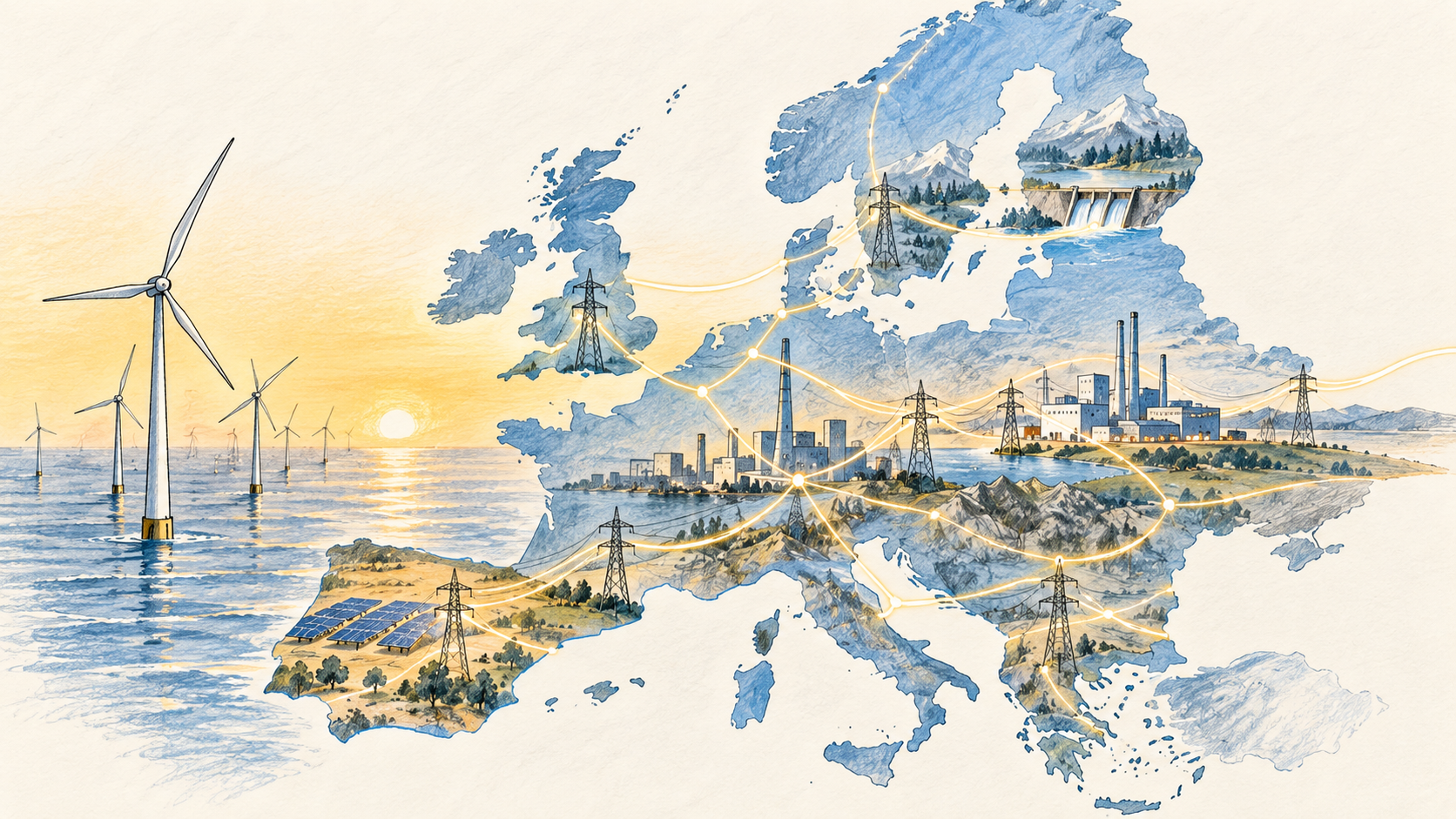
Europe has the resources, companies and infrastructure. The next challenge is making them work as one system.
Perspective | Europe’s energy debate is often framed around what the continent lacks. Too little investment. Too little grid capacity. Too much dependence. Too many national differences. Yet the three Strategic Briefings in this series reveal another side of the European energy story.
Europe already possesses many of the foundations of an electro-powered economy. It has an extraordinarily diverse energy landscape. It has some of the world’s largest utilities and energy companies. And it has an electricity network that already connects countries and markets on a continental scale.
Europe’s diversity does not have to disappear. It has to become connected.
The challenge is not starting from zero. The challenge is making these strengths work together.
A Continent of Different Strengths
There is no single European energy model.France built its electricity system around nuclear power. Norway developed enormous hydropower resources. Germany became one of Europe’s largest markets for wind energy. Spain is rapidly expanding solar generation, while the Netherlands combines offshore wind with ports, industrial clusters and an increasingly important position in North Sea energy infrastructure. For decades, these differences were primarily understood as national characteristics.
Electrification changes that perspective. As electricity increasingly moves across borders, national energy systems become complementary parts of a larger European architecture. Hydropower can provide flexibility when wind and solar production fluctuate. Nuclear power can provide continuous generation. Offshore wind can supply industrial regions across several countries.
Europe’s diversity does not have to disappear. It has to become connected. That may ultimately prove to be one of Europe’s greatest advantages. The continent does not depend upon a single technology, geography or energy source. It possesses multiple capabilities that can reinforce one another — provided the infrastructure exists to connect them.
The Companies That Build
Infrastructure, however, does not build itself. Behind Europe’s transition stands a relatively small group of companies capable of investing billions of euros over periods measured in decades.
EDF, Iberdrola, Enel, RWE, E.ON, Engie, Statkraft and Ørsted emerged in the second briefing not simply as electricity producers, but increasingly as builders of an electrified economy. Their roles differ.
Europe’s energy companies increasingly help determine where its future economy can grow
Some invest heavily in renewable generation. Others operate electricity networks, develop offshore infrastructure or provide the flexibility and digital services required to balance increasingly complex energy systems. But collectively, their role is becoming more strategic.
Where utilities were once primarily expected to produce and distribute electricity, they are increasingly required to anticipate an economy in which electricity becomes central to transport, heating, industrial production and digital infrastructure.
Their investment decisions therefore reach far beyond the energy sector. They increasingly help determine where Europe’s future economy can grow. That brings Europe to perhaps the most difficult part of the transition. Electricity must move.
The Infrastructure That Connects
A wind farm in the North Sea has limited value if its electricity cannot reach industrial consumers. Solar generation in southern Europe becomes more valuable when it can serve wider markets. New factories, charging infrastructure and data centres can only be built where sufficient grid capacity exists.
The grid is no longer merely supporting the economy. It is beginning to shape it.
The electricity network is therefore becoming the backbone of Europe’s electro-powered economy. Yet this is also where the European paradox becomes most visible.
Electricity increasingly moves across borders, while much of the planning, permitting, regulation and investment remains organised nationally.
Europe has created an interconnected electricity system without yet creating an equally interconnected system for building it. That mismatch matters.
As electrification accelerates, grid congestion and connection delays can increasingly influence where investment takes place. Infrastructure that was once largely invisible in economic debates is becoming a strategic factor in industrial competitiveness.
The grid is no longer merely supporting the economy. It is beginning to shape it.
From Electrification to Architecture
Taken together, the three briefings point towards a broader conclusion. Europe’s energy transition is not fundamentally a story about individual technologies. It is a story about systems.
Generation must connect to grids. Grids must connect countries. Energy companies must coordinate investment across decades. Markets must balance increasingly variable supply and demand. Governments must create the conditions in which infrastructure can actually be built.
Europe has created an interconnected electricity system without yet creating an equally interconnected system for building it.
Each component depends upon the others. That is why Europe’s ambition to build an electro-powered continent cannot be measured simply by the number of wind turbines, solar panels or electric vehicles it deploys.
The real measure will be whether Europe can turn its existing strengths into a functioning continental architecture. And Europe does possess considerable strengths. It has the geography. It has the energy resources. It has the companies capable of investing at scale. It has sophisticated electricity markets. And it already has one of the world’s most interconnected electricity systems.
What remains is perhaps the most characteristically European challenge of all. Coordination.
Europe does not need every country to follow the same energy strategy. Nor does it need every company to build the same infrastructure. It needs those different choices to reinforce one another.
Because the decisive question is no longer whether Europe can generate enough electricity.
It is whether Europe can build the architecture that allows an electro-powered continent to function.
Credit
Altair Media / OpenAI Image Generation
Caption
Europe’s electro-powered future will not be built around a single technology or national energy model. Its strength lies in connecting diverse resources, leading energy companies and cross-border electricity infrastructure into one functioning continental system.
