Airbus Commercial Aircraft and the Economics of Scale
How Europe built a global competitor in commercial aviation
Commercial aviation is often presented as a story of aircraft, airlines and passengers. Yet behind every aircraft lies a more fundamental economic reality. Modern aviation is an industry defined by scale.
The question facing Europe during the second half of the twentieth century was therefore not simply how to build aircraft. It was whether any individual European nation possessed the scale required to compete at all. Airbus emerged as Europe’s answer.
For much of the post-war era, commercial aviation was dominated by American manufacturers. Companies such as Boeing benefited from a vast domestic market, deep pools of capital and industrial ecosystems capable of supporting large-scale aircraft development.
European countries possessed many of the same technological capabilities. They produced world-class engineers, advanced manufacturing systems and highly skilled workforces. What they lacked was scale. Competing individually risked permanent fragmentation. The alternative was cooperation.
The Scale Axiom: Airbus was created because aviation had become too expensive, too complex and too global for European nations to compete alone.
🟦 The Scale Question: The A320 and the Power of Standardisation
How can Europe compete in industries that have become too large for individual nations to sustain alone?
Commercial aviation rewards scale in almost every dimension. Larger manufacturers can spread development costs across thousands of aircraft, support broader supplier networks and continuously improve production efficiency through experience and repetition.
Scale generates efficiency. Efficiency generates competitiveness. Competitiveness generates additional scale. Breaking into this cycle is extraordinarily difficult.
Airbus succeeded because Europe effectively pooled multiple national markets, industrial capabilities and engineering traditions into a single platform. The company did not simply build aircraft. It engineered scale.
No programme illustrates this achievement more clearly than the A320 family. The aircraft became one of the most successful commercial programmes in aviation history not merely because of its engineering excellence, but because of its economics. A common platform allowed airlines to train pilots more efficiently, simplify maintenance procedures and reduce operating costs across entire fleets.
The lesson extends beyond aviation. Standardisation, when applied at continental scale, ceases to be a technical decision. It becomes a strategic capability. The A320 therefore represents more than a successful aircraft. It demonstrates how Europe transformed fragmentation into scale.
🟦 The Dependency Question: The Friction of Interdependence
Does continental scale create strength or does it create new vulnerabilities?
The Airbus model depends upon one of the most sophisticated industrial ecosystems in the world. Aircraft components are manufactured across multiple countries before being integrated into final assembly lines. Wings, fuselage sections, avionics, engines and specialised materials move continuously through a network of suppliers spread across Europe and beyond.
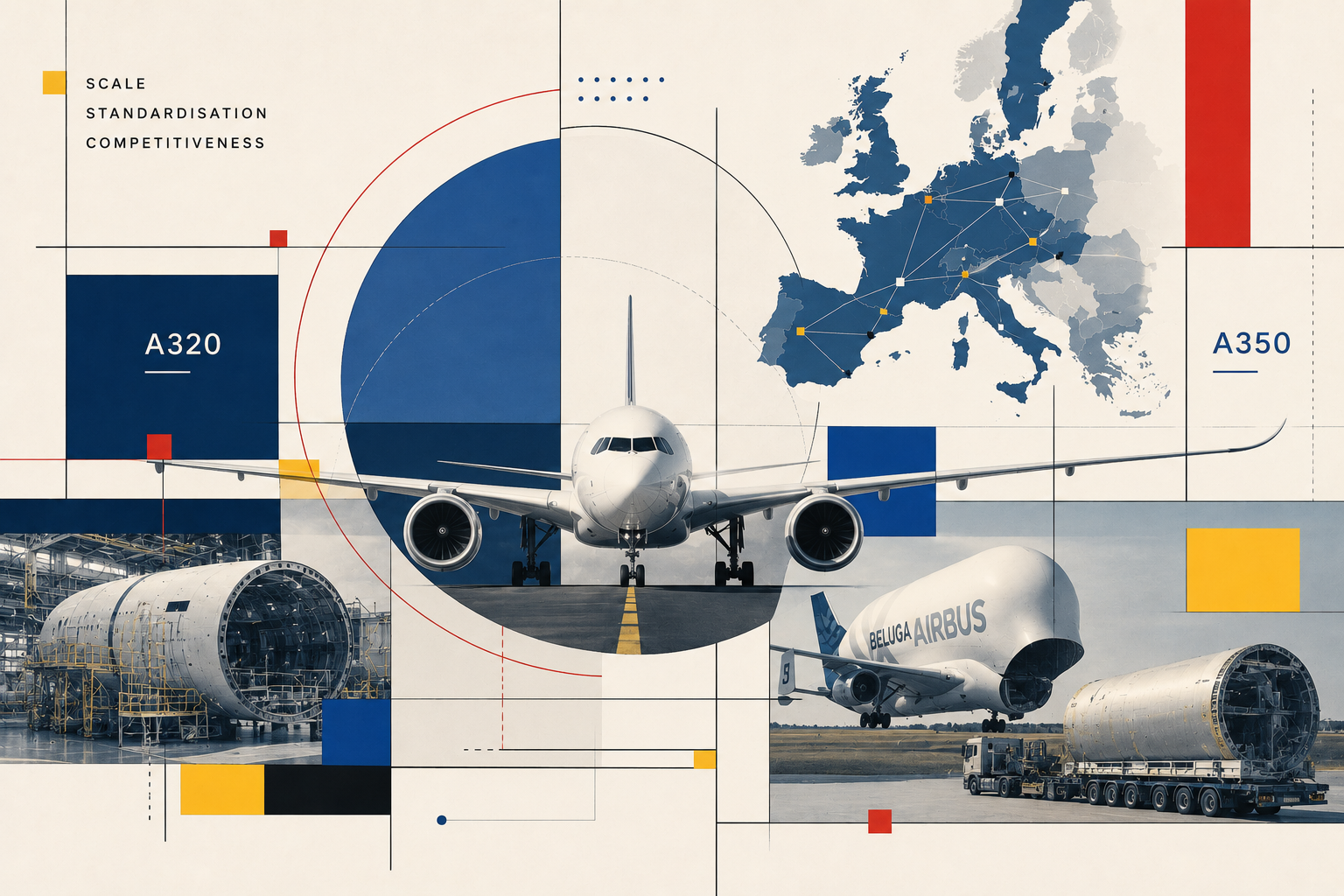
The physical reality of Airbus remains striking. Oversized aircraft sections travel between production sites using specially designed Beluga transport aircraft. Other components move by ship, rail and road through highly coordinated logistical networks.
Airbus is not simply an aircraft manufacturer. It is a logistical architecture.
The Interdependence Trap: The same interconnected system that creates capability can also become a source of vulnerability.
A disruption at a highly specialised supplier can ripple through the entire production network. Delays in one region can affect assembly lines hundreds or even thousands of kilometres away.
The same tension now appears across semiconductors, energy infrastructure and artificial intelligence. Scale solves some problems. It creates others.
🟦 The Technological Frontier: The A350 and the Limits of Capability
How do industrial ecosystems remain competitive once they reach the technological frontier?
If the A320 demonstrated Europe’s ability to compete at scale, the A350 demonstrated its ability to compete at the highest levels of technological complexity.
Developed to challenge Boeing in the long-haul market, the A350 incorporated advanced carbon-composite materials, highly sophisticated manufacturing processes and significant improvements in fuel efficiency.
The programme represented far more than a new aircraft. It represented Europe’s capacity to sustain technological leadership within one of the world’s most demanding industries.
Capabilities of this kind cannot be created through capital alone. They depend upon decades of accumulated knowledge, specialised suppliers, research institutions and engineering cultures built over generations.
The A350 illustrates an often-overlooked reality. Industrial leadership is not purchased. It is cultivated.
🟦 The Export Question: Geopolitics by Material Means
Can Europe remain globally influential without maintaining globally competitive industries?
Commercial aircraft remain one of Europe’s most important export products. Every aircraft delivered to an airline in Asia, North America, the Middle East or Latin America carries more than economic value. It represents technological influence, industrial employment and long-term strategic relevance.
Industrial capability increasingly shapes geopolitical influence. Countries that design, manufacture and export complex technological systems occupy a different position within the global economy than countries that merely consume them.
Airbus therefore contributes more than growth and employment. It helps sustain Europe’s position within the international industrial system.
The Altair Perspective
The success of Airbus Commercial Aircraft is often described as a victory for European aviation. It may be more accurate to describe it as a victory for European scale.
The company’s greatest achievement was not building aircraft capable of competing with Boeing. Its achievement was creating an institutional architecture capable of sustaining industrial capability across multiple nations, political cycles and economic shocks.
Yet Airbus also reveals a deeper paradox. Europe needs scale to remain competitive in strategic industries. At the same time, scale inevitably creates concentration, interdependence and vulnerability. This tension now extends far beyond aviation.
As Europe debates artificial intelligence, advanced semiconductors, quantum technologies and strategic infrastructure, the same fundamental question continues to emerge. How do societies build capabilities that exceed the scale of any individual nation?
Airbus solved one version of that problem in the twentieth century.
Whether Europe can apply similar lessons to artificial intelligence, semiconductors and strategic infrastructure may become one of the defining economic questions of the twenty-first century.
This article forms part of the series Airbus and the Architecture of European Capability, examining how Europe creates and sustains capabilities that exceed the scale of any individual nation.
Credit
Illustration by Altair Media (AI-assisted visualisation inspired by European modernist design, industrial logistics and aerospace engineering)
Caption
The Airbus A320 and A350 represent more than successful aircraft programmes. Together they illustrate how Europe transformed industrial fragmentation into continental scale, creating one of the world’s most sophisticated aerospace ecosystems. The inclusion of the Beluga transport aircraft highlights a less visible reality: Airbus is not only an aviation company, but also a complex logistical architecture connecting suppliers, factories and capabilities across Europe.
