Leiden University – Tradition and Knowledge Production
Why Universities Still Shape the Future of Knowledge
Modern societies increasingly depend upon knowledge. Scientific discovery drives healthcare, technological innovation strengthens economies and evidence informs public policy. Yet while knowledge has become one of the world’s most valuable resources, surprisingly little attention is paid to where new knowledge actually originates.
Artificial intelligence can retrieve information within seconds, while digital platforms distribute knowledge almost instantly. Neither, however, creates the scientific foundations upon which future discoveries depend. That remains the work of research universities.
Reliable knowledge is rarely created at speed. It is built through curiosity, criticism and scientific rigour.
Few institutions illustrate this role more clearly than Leiden University. For nearly five centuries it has contributed not only to education, but also to the continuous production of knowledge that shapes science, society and public life.
Beyond Education
Universities are often associated with teaching. Students attend lectures, complete assignments and earn degrees. Yet education represents only part of a research university’s purpose. Its deeper mission is to create environments where new knowledge can emerge through curiosity, critical inquiry and scientific investigation.
Knowledge is not simply transferred from one generation to the next. It is questioned. Tested. Refined. Sometimes completely reimagined. That continuous process of renewal remains one of civilisation’s most important investments.
Knowledge Is Produced
Knowledge is often treated as something that already exists, waiting to be discovered. Reality is far more demanding.
Scientific understanding develops slowly through observation, experimentation, criticism and verification. New ideas are challenged, replicated, refined and sometimes rejected altogether before they gradually become accepted knowledge. That process is neither efficient nor fast. It is deliberately rigorous.
In an age where information can be generated almost instantly, reliable knowledge increasingly derives its value from precisely this slower process of scientific validation.
Universities therefore produce something that cannot simply be downloaded or replicated overnight. They produce the capacity to create trustworthy new knowledge. That capacity may prove one of Europe’s most valuable strategic resources.
Why Tradition Matters
Leiden University is frequently described through its history. Founded in 1575, it is the oldest university in the Netherlands. Its greatest strength, however, lies not in its age. It lies in institutional continuity.
Tradition therefore does not constrain innovation. It provides the intellectual continuity upon which innovation depends.
Tradition does not constrain innovation. It provides the intellectual continuity upon which innovation depends.
Scientific methods, academic standards and institutional memory allow each generation to begin where previous generations ended rather than starting again from the beginning.
Innovation is rarely created in isolation. It grows through continuity.
Knowledge In The Age Of Artificial Intelligence
Artificial intelligence has transformed access to information. Students, researchers and professionals can now retrieve explanations, summaries and analyses within seconds. This fundamentally changes how knowledge is accessed. It does not fundamentally change how knowledge is created.
Artificial intelligence can identify patterns across enormous bodies of existing knowledge. What it cannot independently establish is whether an entirely new scientific insight accurately describes reality. That still requires observation, experimentation, peer review and institutional accountability.
Artificial intelligence reorganises existing knowledge. Universities create the discoveries that expand it.
Artificial intelligence reorganises existing knowledge. Universities continue to generate the discoveries upon which future artificial intelligence will depend. The relationship is therefore complementary rather than competitive.
Science As Public Infrastructure
Scientific research rarely produces immediate results. Fundamental discoveries often require years or even decades before their broader significance becomes visible.
History nevertheless demonstrates that long-term scientific investment eventually transforms medicine, engineering, economics, law and public policy.
Research universities therefore function as public infrastructure. Not because they deliver instant solutions. But because they continuously expand humanity’s understanding of the world.
Knowledge is often described as a resource. Perhaps it should increasingly be understood as infrastructure. Unlike physical infrastructure, knowledge expands every time it is questioned, shared and refined. Universities make that continuous renewal possible.
Beyond Leiden
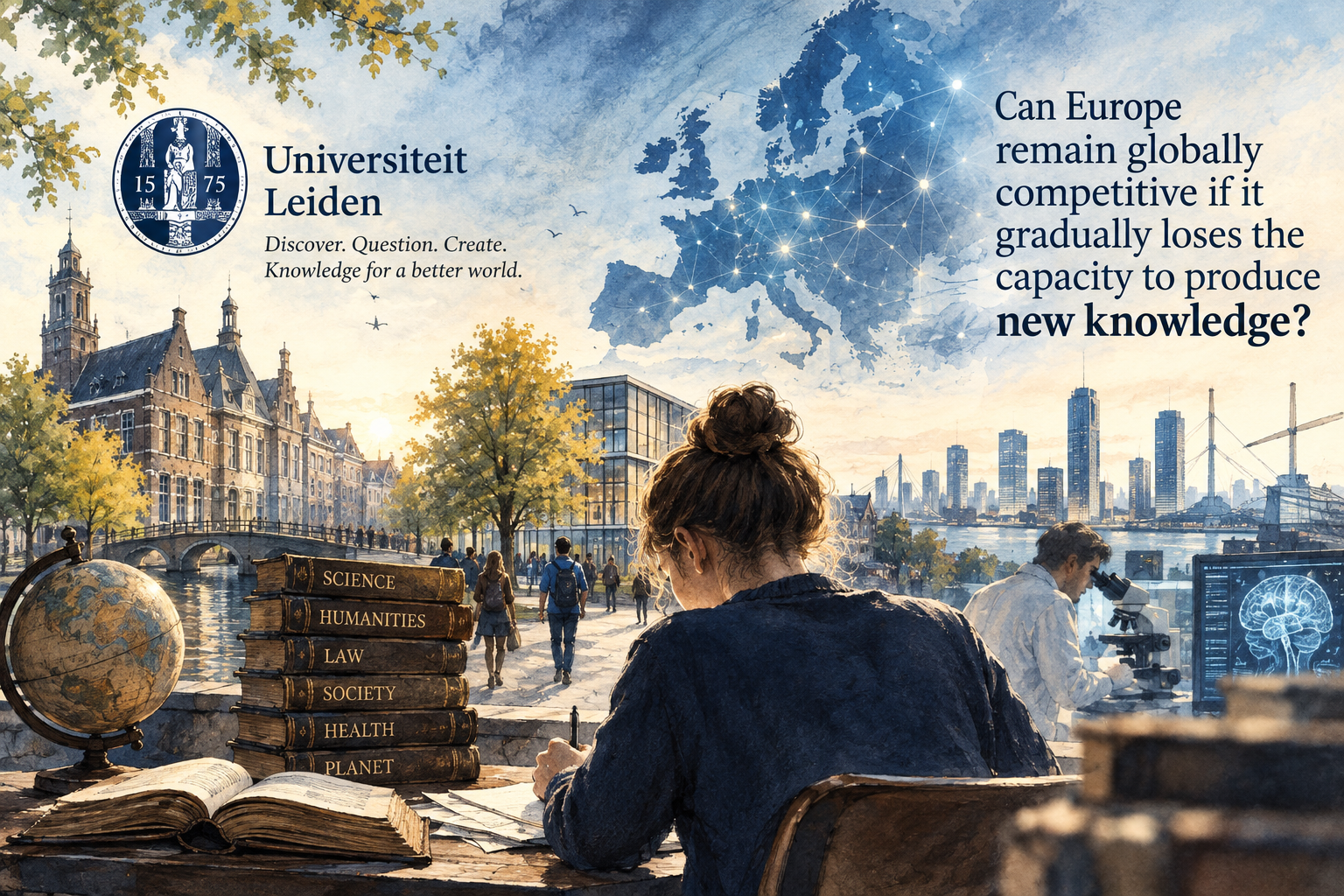
Ultimately, this article is not only about one university. It asks a broader European question. Can Europe remain globally competitive if it gradually loses the capacity to produce new knowledge?
Technological leadership begins long before products reach the market. It begins inside laboratories where fundamental research expands the boundaries of scientific understanding.
If that capacity weakens, Europe risks becoming an increasingly successful adopter of technologies developed elsewhere while gradually losing its position as a creator of knowledge.
Societies that continue to produce new knowledge will ultimately shape the future of those that merely consume it.
Innovation depends upon research. Research depends upon institutions. Institutions depend upon long-term commitment. Perhaps Europe’s greatest strategic asset has never been knowledge itself. It has always been the ability to continue creating it.
Final Reflection
Artificial intelligence is transforming how societies access information. Research universities determine whether genuinely new knowledge continues to emerge.
Leiden University illustrates that distinction with remarkable clarity. Its enduring contribution lies not simply in educating students, but in sustaining one of civilisation’s most important capabilities: the continuous production of reliable knowledge.
Because societies that create knowledge ultimately shape the future more profoundly than societies that merely consume it.
This article is part of The Dutch Education System, a Perspective series exploring education, talent and the future capacity of society.
Credit
Altair Media / AI-generated visualisation inspired by Leiden University and Europe’s tradition of scientific knowledge production.
Caption
Artificial intelligence can organise existing knowledge, but research universities create the discoveries that expand it. Leiden University represents one of Europe’s enduring centres of knowledge production, where scientific tradition and curiosity continue to shape the ideas that define tomorrow’s society.
