Psychology Nation
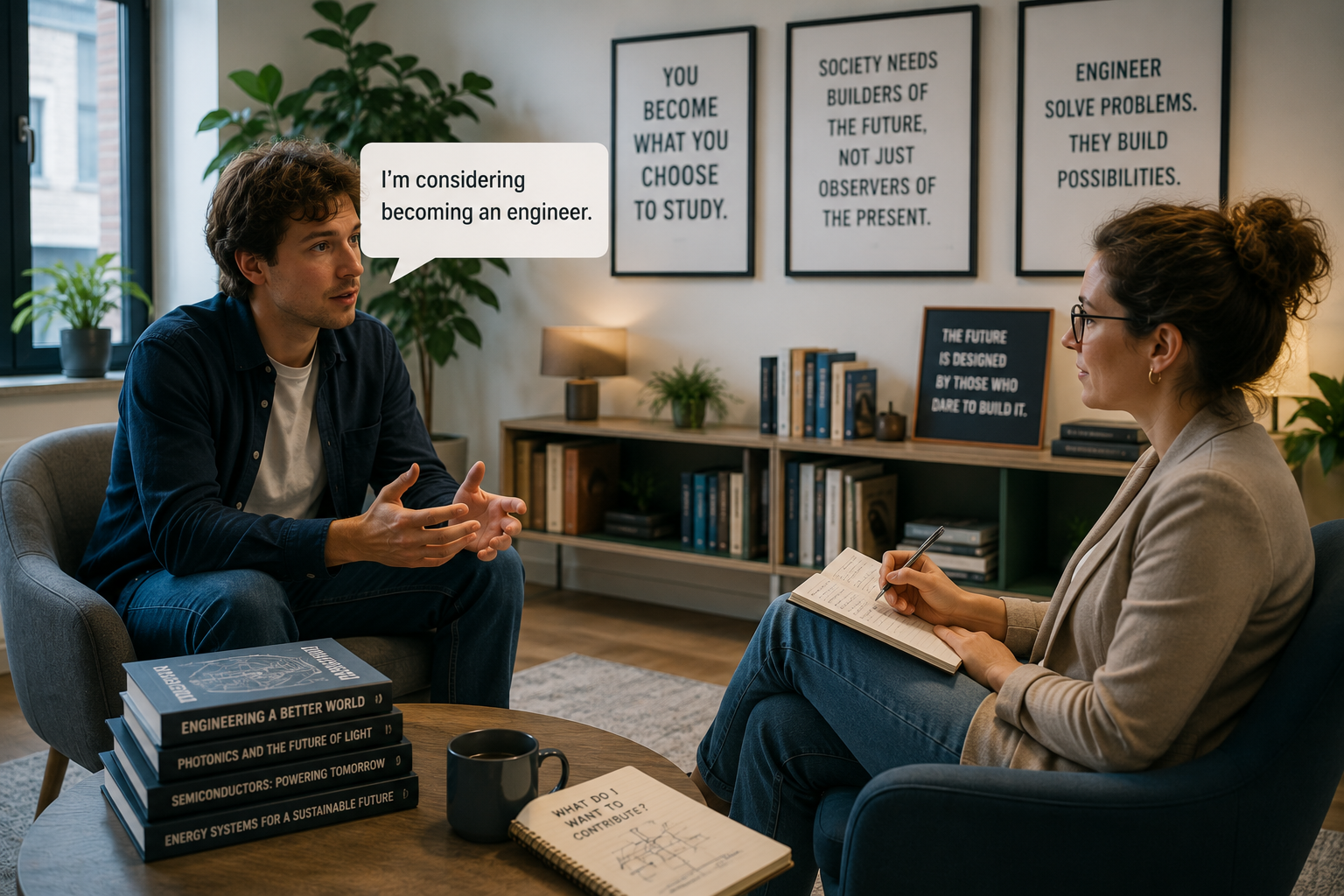
Why Dutch Students Choose Psychology Over Engineering
Every year, thousands of Dutch students decide what they will study. Some choose engineering, others medicine, law, business or teaching. Increasingly, however, psychology remains one of the country’s most popular university programmes.
At first glance, this appears to be a simple matter of personal preference. Yet when viewed collectively, these individual decisions reveal something much larger. They show how a society imagines success, values different professions and ultimately allocates its future talent.
The question, therefore, is not simply why so many students choose psychology. It is why one of Europe’s most technologically ambitious economies continues to produce relatively few engineers while some of its most popular degrees lead elsewhere.
Education Is Also Identity
Students rarely choose a degree solely because of employment statistics or salary forecasts. They choose an identity. They ask themselves what kind of person they want to become, what type of work feels meaningful and where they believe they can make a difference.
Students rarely choose only a degree. They choose a story about who they hope to become
Psychology offers answers that are immediately recognisable. It promises insight into people, behaviour, relationships and mental wellbeing. These themes connect directly with everyday life and personal experience.
Engineering offers something different. It promises the opportunity to design systems, solve complex technical problems and build the physical foundations upon which modern societies depend.
Both choices create value. But they appeal to different imaginations of what a meaningful life looks like.
The Invisible Economy
One reason for this difference lies in visibility. Young people regularly encounter teachers, psychologists, doctors, lawyers and entrepreneurs. These professions are visible in schools, families, television programmes and social media. They are easy to imagine because they are part of everyday life. The engineers shaping the country’s future are far less visible.
Few teenagers ever meet a photonics engineer, a semiconductor architect or a specialist designing electricity grids. Yet these professionals increasingly determine whether the Netherlands can achieve its ambitions in artificial intelligence, energy, defence and advanced manufacturing.
Societies cannot expect young people to aspire to careers they rarely see
Societies cannot expect young people to aspire to careers they rarely see. Educational choices are therefore shaped not only by interest, but also by exposure.
Beyond Status
Engineering has never lacked societal importance. What it has often lacked is cultural visibility.
For many years, prestige became associated with finance, consulting, law and management. More recently, psychology has gained prominence as societies pay increasing attention to mental health, personal development and wellbeing.
At the same time, engineers have quietly become some of the most strategically important professionals in the economy. They design semiconductor production facilities. They strengthen electricity networks. They develop photonic technologies. They build resilient communication systems.
The paradox is striking. As technical professions become more important for society, they do not necessarily become more visible within society’s cultural imagination.
The Rational Individual and the Collective Outcome
Every individual student makes a rational choice. Collectively, however, thousands of rational choices can produce an outcome that no longer aligns with national ambitions.
This is not a criticism of students. Nor is it an argument against psychology. It is an observation about how educational preferences, labour markets and cultural expectations interact.
The Netherlands wants technological leadership. Students choose careers that feel meaningful, visible and attainable. Both are entirely understandable. The challenge emerges only when the two begin to drift apart.
Looking Beyond Psychology
Ultimately, this article is not about psychology at all. Psychology simply illustrates a broader societal mechanism. Educational choices emerge where identity, aspiration, opportunity and culture intersect.
Individual educational choices become collective economic outcomes
Changing the technical talent gap is therefore unlikely to begin by persuading more students to choose engineering. It begins much earlier. By changing how technical professions are introduced in schools. How they are represented in society. How they are valued. And perhaps most importantly… How they are imagined by the next generation.
Conclusion
The Netherlands does not face a generation unwilling to contribute to society. It faces a society whose cultural narratives, educational incentives and economic ambitions do not always point in the same direction.
The future of technical talent will therefore depend not only on universities or employers, but also on the stories societies tell about the people who build their future.
Series Reference
Part of The Dutch Education System, a series exploring education, talent and the future capacity of society.
Credit
Altair Media / AI-generated visualisation
Caption:
The question is not simply which degree students choose. It is which future they can imagine for themselves. Individual educational choices ultimately shape the collective capacity of society.
