The Physics of Compute
Why Cloud Has Become Industrial Infrastructure
Strategic Briefing
For more than two decades, one of the technology industry’s most successful ideas has also been one of its most misleading. The cloud suggested something almost immaterial. Data appeared to move effortlessly through invisible networks, software seemed detached from geography and computing was increasingly presented as a service that simply existed somewhere beyond the physical world. The metaphor proved remarkably powerful. It also obscured a fundamental reality.
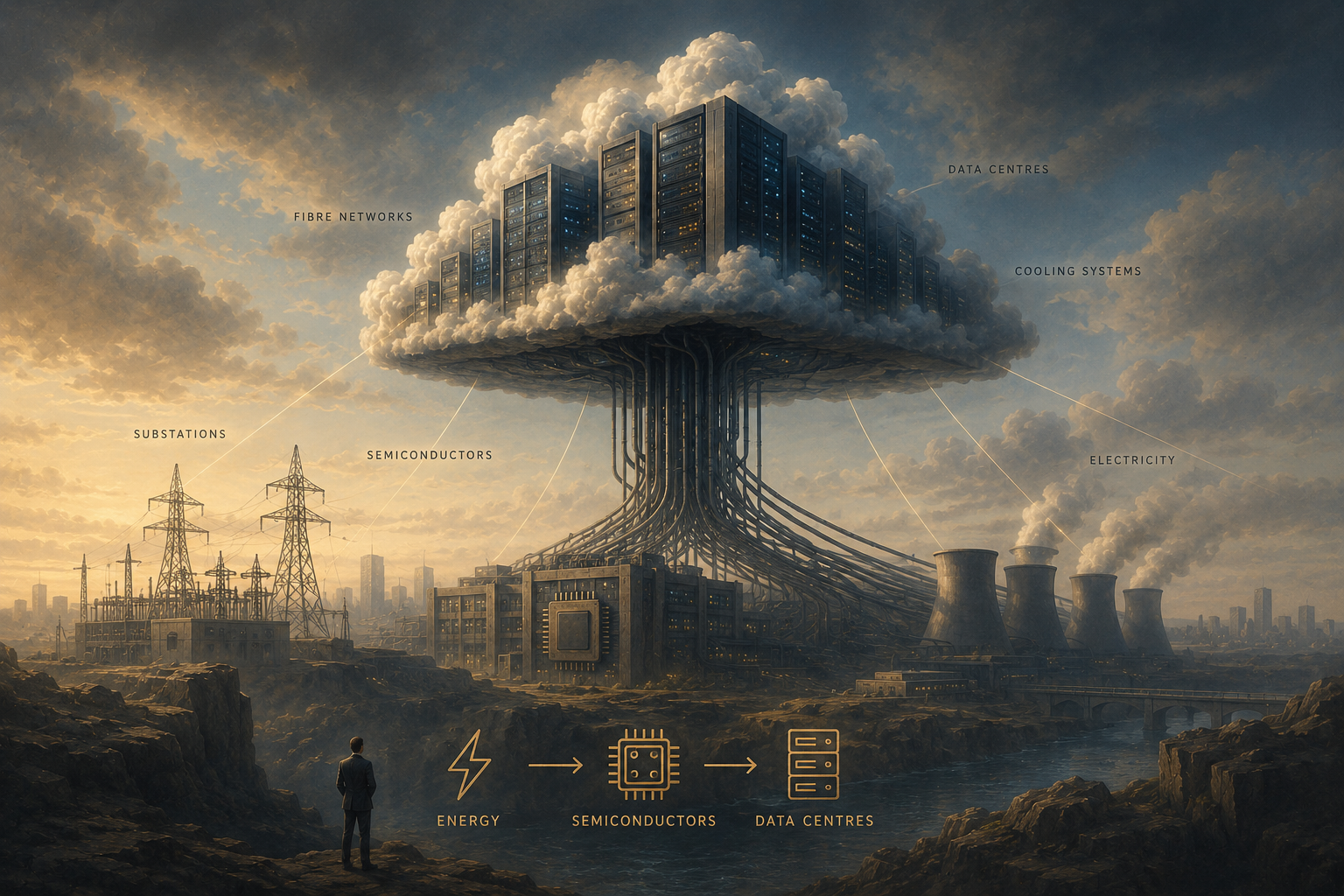
The cloud was never a cloud. It has always depended upon buildings, fibre-optic networks, substations, cooling systems, semiconductors and vast quantities of electricity. Artificial intelligence has not fundamentally changed that reality. It has simply made it impossible to ignore.
Beyond Software
For many years, cloud computing was discussed primarily through the language of software. Conversations focused on platforms, applications, subscriptions and digital transformation. Infrastructure remained largely hidden beneath the surface.
The cloud was never immaterial. Artificial intelligence has simply made its physical foundations impossible to ignore.
That perspective is becoming increasingly inadequate. As artificial intelligence expands and organisations rely on ever greater volumes of compute, the physical foundations of the digital economy are reappearing in plain sight. Every model trained, every dataset analysed and every service delivered ultimately depends upon tangible assets that must be designed, constructed and maintained.
Cloud computing has therefore entered a new phase. It is no longer simply a software industry. It is increasingly an industrial system whose performance depends as much upon engineering and energy as upon code.
Compute Has Weight
The phrase the cloud remains one of technology’s most enduring metaphors because it implies weightlessness. Yet modern computing is becoming progressively heavier. Large-scale AI systems require thousands of advanced processors operating continuously, generating enormous amounts of heat that must be removed through increasingly sophisticated cooling technologies. As processing densities continue to rise, engineers encounter limits that software alone cannot overcome.
These constraints are now driving innovation at the most fundamental level of computing. Liquid cooling is replacing traditional air-cooled systems in many advanced facilities. Silicon photonics is emerging as a promising way to move data using light rather than electricity, reducing latency and overcoming the physical limitations of conventional electrical interconnects. Even advances in artificial intelligence increasingly depend upon breakthroughs in materials science, semiconductor engineering and applied physics.
The future of artificial intelligence may depend as much upon physics as upon algorithms.
The future of compute is therefore being shaped not only by algorithms, but by the laws of thermodynamics.
Territory Matters Again
As cloud infrastructure becomes more physical, geography once again becomes strategically significant. Datacentres cannot simply be built wherever demand exists. They require abundant electricity, reliable fibre connectivity, suitable land, access to water, skilled engineers and stable regulatory environments. In other words, they depend upon the same kinds of long-term planning traditionally associated with ports, railways or power stations.
This represents a remarkable shift in how digital infrastructure is understood. For much of the internet era, location appeared increasingly irrelevant. Today, the opposite is becoming true. Regions capable of providing energy, connectivity and industrial capacity are becoming increasingly attractive locations for AI investment, while those constrained by limited grid capacity or inadequate infrastructure may struggle to participate fully in the next phase of the digital economy.
Cloud, in other words, has returned to geography.
The New Industrial Triangle
This transformation can perhaps best be understood through three interconnected infrastructures.
Energy provides the electricity required to power increasingly compute-intensive workloads. Semiconductors provide the processors that make artificial intelligence possible. Datacentres provide the physical environments where those processors can operate safely and efficiently.
None of these pillars can function independently. Electricity without processors produces no intelligence. Processors without datacentres cannot be deployed at scale. Datacentres without reliable energy remain empty buildings.
Energy, semiconductors and datacentres have become the industrial foundations of artificial intelligence.
The future of artificial intelligence may therefore depend less upon software alone than upon Europe’s ability to coordinate energy policy, semiconductor capability and industrial infrastructure. Compute has become an ecosystem rather than a product.
From Digital Economy to Heavy Industry
Perhaps the most profound change is conceptual. For decades, economists described the internet as part of a weightless economy in which information displaced physical assets. Artificial intelligence suggests almost the opposite. As computing capacity scales, cloud infrastructure increasingly resembles heavy industry, requiring billions in capital investment, years of planning, dedicated energy infrastructure and complex supply chains.
Hyperscale datacentres now influence regional electricity demand, accelerate investment in transmission networks and reshape industrial development strategies. Decisions about cloud infrastructure are therefore no longer confined to technology companies. They increasingly involve energy providers, transmission operators, construction firms, semiconductor manufacturers and public authorities responsible for spatial planning.
Cloud has become part of national infrastructure.
Beyond the Hyperscalers
Much of the public discussion surrounding cloud computing focuses on companies such as AWS, Microsoft Azure and Google Cloud. Yet these platforms represent only the visible layer of a much larger industrial ecosystem. Beneath every cloud service lies a network of electricity producers, fibre operators, cooling specialists, equipment manufacturers, chip designers and engineering firms whose combined capabilities determine how much compute can actually be delivered.
This broader perspective also changes how digital sovereignty is understood. Ownership remains important, but ownership alone cannot create computing capacity. A sovereign cloud ultimately depends upon access to electricity, advanced semiconductors, resilient supply chains and the industrial expertise required to build and operate infrastructure at scale.
Strategic Significance
Europe increasingly speaks about digital sovereignty, AI leadership and technological competitiveness. Yet these ambitions cannot be realised through software policy alone. They require physical capability. The ability to generate electricity, manufacture advanced technologies, construct datacentres and expand critical infrastructure may ultimately prove as important as developing new algorithms.
Perhaps the central question has therefore changed.
It is no longer simply:
Who owns the cloud?
It is increasingly:
Who can build, power and sustain intelligence?
Strategic Outlook
Perhaps the defining misconception of the digital age has been the belief that computing escaped the physical world. Artificial intelligence demonstrates precisely the opposite. Every model requires electricity. Every processor generates heat. Every datacentre occupies land. Every cloud depends upon infrastructure.
The question is no longer who owns the cloud. It is who can build, power and sustain intelligence.
The cloud has never been detached from the physical economy. It has simply become large enough for everyone to see.
Europe’s digital future may therefore depend less upon writing better software than upon building stronger infrastructure. In the age of artificial intelligence, compute is no longer merely digital.
It has become industrial.
Credit
Artwork: Altair Media / AI-generated visualisation
Caption
Cloud may appear weightless, but intelligence is built upon physical infrastructure. Electricity, semiconductors, fibre networks and datacentres increasingly form the industrial foundations of Europe’s digital future.
