Infineon’s €5 Billion Dresden Fab and the Demand for Power Chips
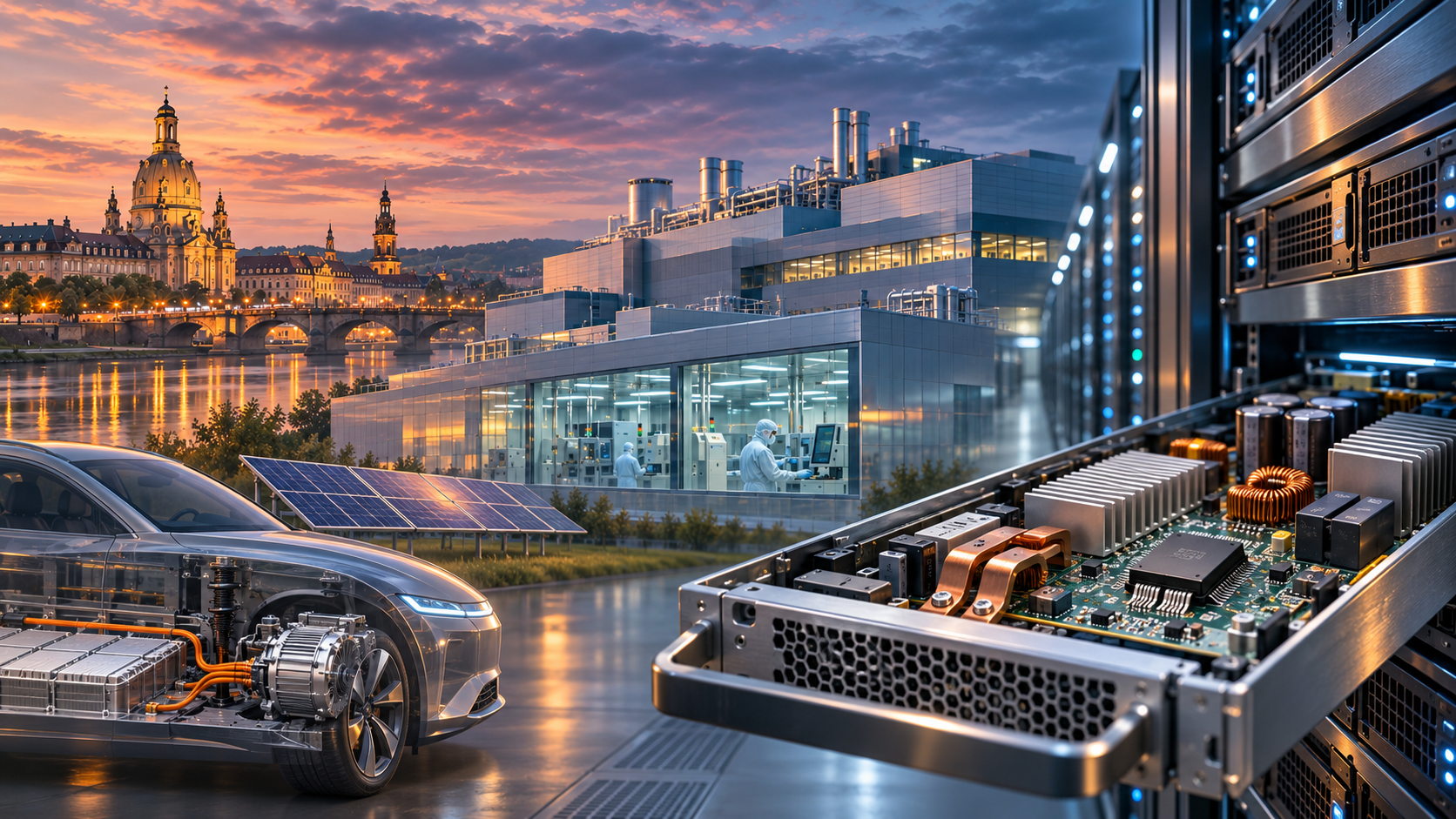
AI data centres, electric vehicles and energy systems all need chips that control electricity. Their demand will shape the pace of production in Silicon Saxony.
Infineon opened its €5 billion Smart Power Fab in Dresden on 2 July 2026. On 5 November, the company and South Korea’s SOLUM announced plans to deepen their cooperation on power supplies for AI data centres.
The journey from a chip factory to a server rack runs through a power supply that has to be designed, tested and sold. Electric vehicles and solar inverters pose the same commercial challenge. How quickly can customers put Dresden’s new capacity to work?
🟦 Can Dresden turn its head start into sales?
Infineon opened the factory several months ahead of schedule. The company says the facility doubles its manufacturing capacity in Dresden and is expected to create around 1,000 direct jobs. It expands production of power semiconductors and chips that measure and control electrical signals.
The head start gives Infineon more room to respond as orders grow. For a customer, the timetable starts when it chooses a chip for a new product. It then has to test the chip in its equipment and establish that the product can be made reliably at scale. The two timetables determine how quickly capacity becomes sales.
🟦 Can a power chip cut the cost of running AI?
Electricity is converted several times before it reaches an AI processor. Power chips help control those steps so the processor receives electricity at the voltage it needs. Each step loses some energy as heat. Reducing those losses can cut electricity use and ease the load on cooling equipment.
For an operator working within a fixed power limit, the benefit can be more room for computing. The result depends on how the whole power supply performs in use. An operator can use less electricity for the same amount of computing while still consuming more overall as it adds servers.
🟦 Can one factory keep up with three markets?
An electric vehicle uses power electronics to control energy flowing from its battery to the motor. A solar inverter uses them to turn electricity from panels into a form the grid can accept. In a data centre, they help deliver stable power to servers.
These applications give Infineon several sources of demand, each with its own product requirements and testing. A surge in orders from one market is useful only if the factory has the right equipment and approved processes to make the chips those customers need.
🟦 How much can Dresden and Villach achieve together?
Dresden’s new factory adds capacity for power and analogue chips on 300 mm wafers, the circular discs on which chips are made. On 27 October, Infineon announced a separate investment of around €1.1 billion at its Villach site in Austria through 2034. It plans to start making power chips there on 300 mm gallium nitride wafers by the end of 2027. Gallium nitride can help make power converters smaller and more efficient.
Infineon calls its linked production model One Virtual Fab. The company says the connection helps it approve processes and products faster. The value of that link will depend on how much the sites can share as they build up different production capabilities.
🟦 What should Europe get for around €1 billion in public funding?
Infineon puts total funding for the Dresden site at around €1 billion across the European Chips Act and a European programme for microelectronics and communications technologies. The employment target gives one measure of what the investment could bring to the region.
A second measure is whether European companies gain a source of chips they can qualify and keep using over the life of their products. For Silicon Saxony, the wider return also depends on local suppliers gaining work and experience they can use to win other customers.
🟦 What would turn the SOLUM agreement into repeat orders?
The memorandum of understanding covers work on power supplies, battery backup units and equipment that converts electricity within a data centre. SOLUM has to turn the components into equipment it can sell. The operator buying it has to see a benefit in running costs, computing capacity or reliability.
The announcement sets out the development work. The next evidence to watch is which designs customers adopt, where the chips are made and whether initial deployments generate repeat orders. Those steps would show how the cooperation translates into production and what share Dresden might supply.
Signal
Dresden’s next milestone is repeat business. That depends on customers turning better power conversion into equipment they can sell at scale and operators can run with less energy, heat or space.
Credit
AI-generated illustration for Altair Media Europe, created with OpenAI.
Caption
A conceptual view of Dresden links semiconductor manufacturing in Silicon Saxony to the equipment that relies on power chips, from AI server power supplies to electric vehicles and solar energy systems.
