The Factory Beyond the Chip
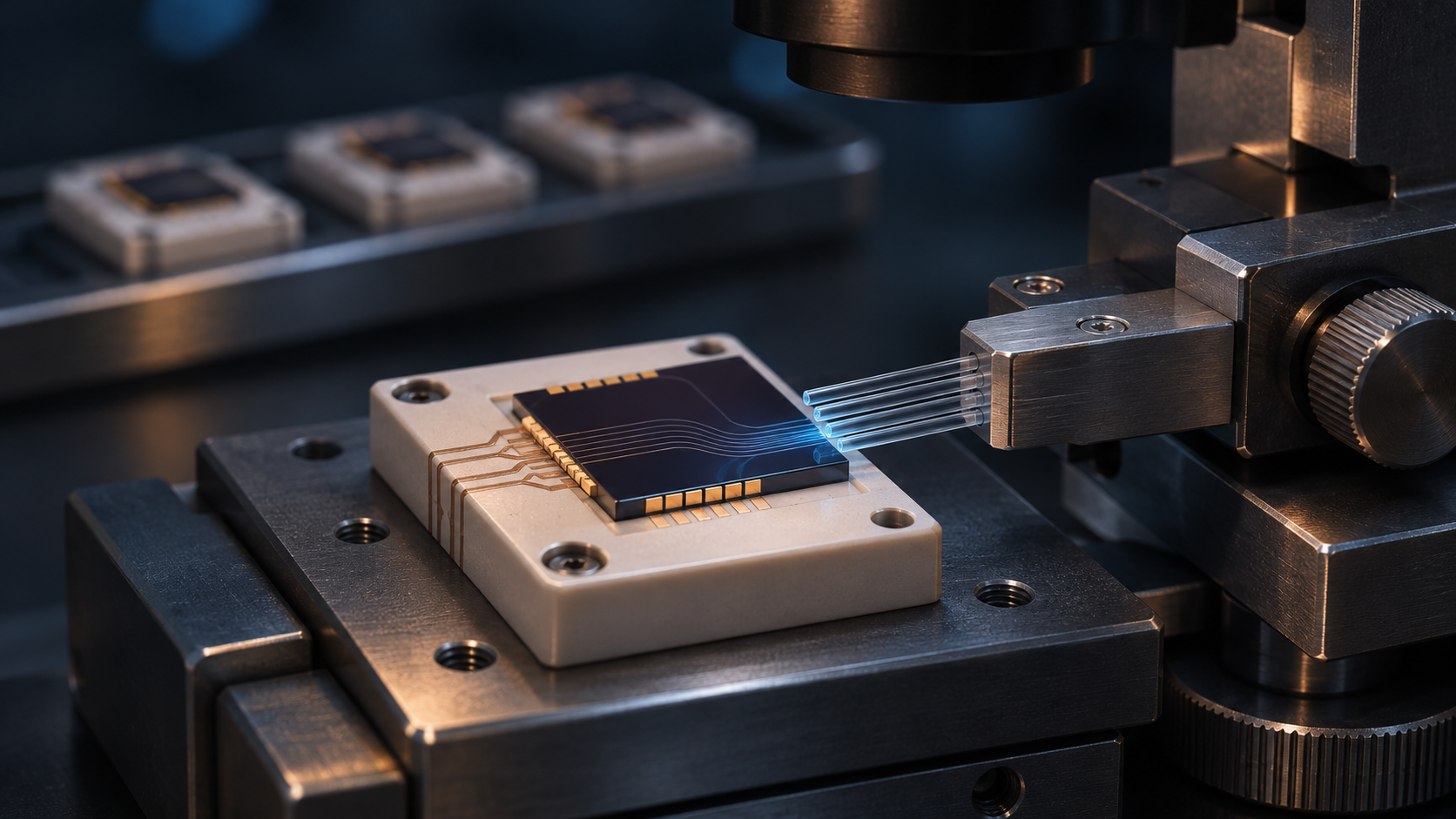
What turns a working photonic chip into a product customers can rely on?
A photonic chip can meet its specifications on the wafer and still fail once assembled into a module. Fibre alignment, electrical connections and heat management all affect what reaches the customer. At PIC Summit Europe in Eindhoven, that distinction framed a practical question: how much of Europe’s photonics capacity can deliver finished modules at a predictable rate?
A collaboration between Dutch packaging specialist PHIX and optical connectivity supplier SENKO brings that question down to a single component: the connection between a photonic module and the fibre that carries its signal.
🟦 What still has to happen after the chip leaves the fab?
The chip has to be mounted, connected to electronics and aligned with one or more optical fibres. The package also has to manage heat and protect the assembly. This is where design for packaging starts to matter: decisions about where to put optical ports and electrical contacts affect how easily equipment can reach, align and test them. A design that works on the bench can still require too much adjustment per unit to be economical in series production.
🟦 What does a detachable fibre connection have to prove?
In September, PHIX and SENKO announced a detachable interface designed to serve during assembly, module testing and final system integration. It also opens a path to replacing a fibre connection without replacing the module. The test is whether the connection keeps optical loss within specification after repeated reconnection and across the operating temperature range. The companies describe the architecture. Their announcement gives no production yield, distribution of optical loss across units or customer qualification results.
🟦 Where does good output get lost?
Yield compounds across production steps. Take 100 assemblies built with chips that have already passed an initial test. If 90% pass fibre attachment and 90% of those pass the final test on the first attempt, only 81 are ready to ship without rework. That is an illustration, not a reported factory result. The economic point is that a late failure puts the value of the chip, other components and assembly time at risk. An IEEE roadmap illustrates how large that exposure can be: in one indium phosphide device, packaging and testing accounted for more than 80% of product cost. The share varies by product.
🟦 When does a line become capacity a buyer can rely on?
A supplier can have alignment machines available while the buyer’s module is still in qualification. Qualification asks whether the module meets the requirements of its intended application, including reliability. Series production asks whether successive batches can meet those same requirements at the promised rate. Both matter when a buyer commits to a launch date. The production figures to ask for are finished modules passing final test per shift, the share that needs rework and how those numbers hold up as volume rises.
🟦 What does Montana tell us about where capacity grows?
PHIX opened a facility in Bozeman, Montana, in October to bring engineering and production closer to North American customers. That expansion points to a question for Europe: where will customers qualify their next products, resolve assembly problems with suppliers and place repeat orders? A region may have the tools and expertise to build a module. It still needs customers prepared to put that capacity to work.
The Signal
Count the modules that pass final test and reach customers on schedule. That is the capacity a buyer can build a product around.
This is the second Signal in Altair Media Europe’s series from PIC Summit Europe 2026 in Eindhoven, examining what it takes to turn Europe’s photonics expertise into industrial production.
Image credit
AI-generated editorial illustration for Altair Media Europe.
Caption
An optical fibre array is aligned with a photonic chip in an illustrative test setup. The challenge in series production is to make that connection consistently across thousands of modules.
